
Incredibly sensitive instruments used in landmark discoveries could help solve one of the biggest remaining mysteries in the Universe.
The technology behind one of the biggest scientific breakthroughs of the century – the detection of gravitational waves – is now being used in the search for elusive dark matter. In a study published recently in Nature, a team led by scientists from Cardiff University’s Gravity Exploration Institute used data from the German-UK GEO600 gravitational-wave detector near Hannover, Germany, to search for a new kind of dark matter for the very first time. Though no direct detection has been made, this unique search is the first step in establishing a novel search method. The non-detection allowed the researchers to rule out some theories about dark matter and helps to improve future searches for this invisible constituent of our Universe.
The Mystery of Dark Matter
Thought to make up roughly 85% of all matter in the Universe, dark matter has never been observed directly and remains one of the biggest unsolved mysteries in modern physics. Even though dark matter has never been directly detected, scientists suspect it exists due to its gravitational effect on objects across the Universe. For example, a large amount of unseen matter may explain why galaxies rotate as they do, and how they could have formed in the first place.
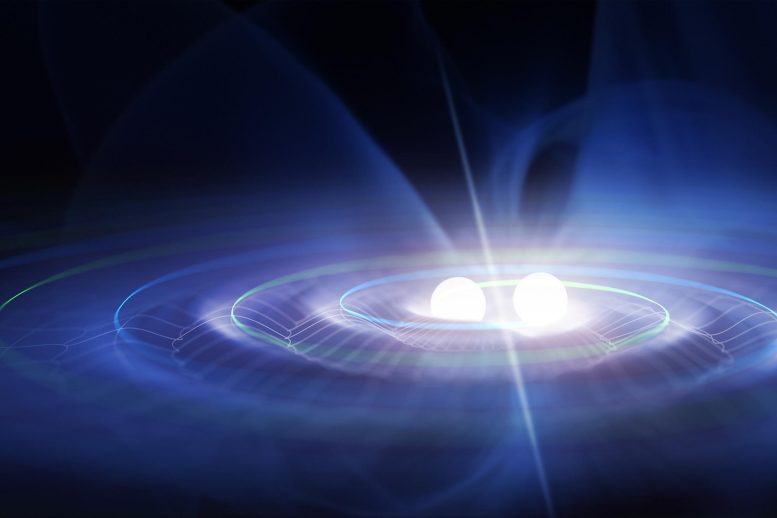
Until recently, it was widely believed that dark matter was composed of heavy elementary particles. These were not discovered despite a multitude of efforts, and scientists are now turning to alternative theories to explain dark matter. A recent theory says that dark matter is actually something called a scalar field, which would behave as invisible waves bouncing around galaxies, including our own Milky Way.
Gravitational Wave Technology: A New Hope
With extremely sensitive detectors now at their disposal, already proven through several outstanding discoveries, scientists believe that existing gravitational wave technology has the true potential to finally directly discover dark matter and even find out what it is made of.
“We realized our instruments could be used to hunt for this new kind of dark matter, although they were initially designed for detecting gravitational waves,” said Hartmut Grote, from Cardiff University’s Gravity Exploration Institute, who instigated the investigation and who was the GEO600 lead scientist from 2009 to 2017.
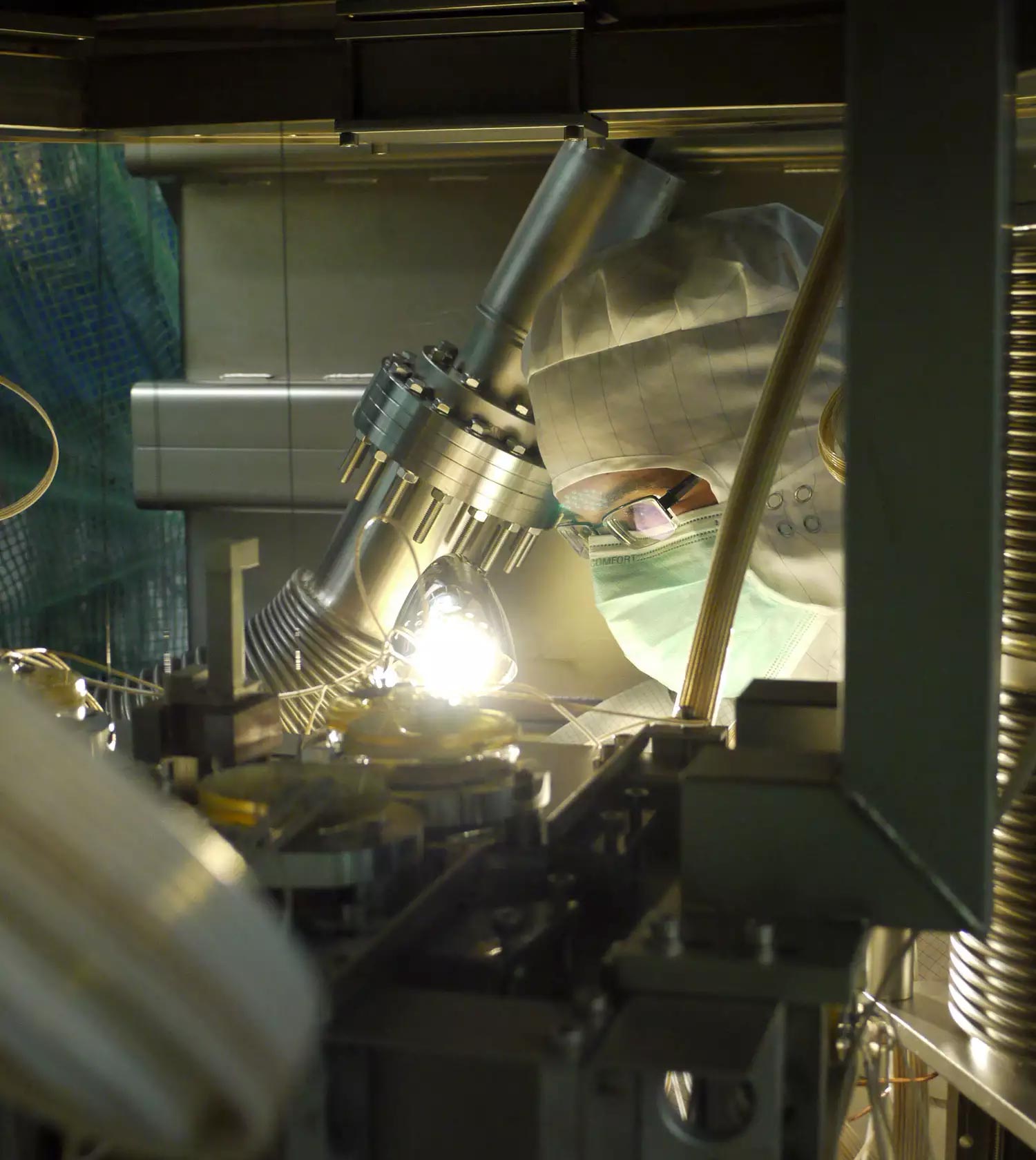
Within a laser interferometer such as GEO600, a laser is split into two beams of light that travel hundreds of meters through vacuum tubes, and are bounced between mirrors before meeting up on a detector. From this, scientists can gauge with great accuracy how out of sync the beams of light are with each other, which is itself proxy for any disturbance the beams encounter. In gravitational-wave detection, ripples in space-time from distant astronomical events compress and stretch the distance the laser light travels by a thousandth of a proton diameter.

© H. Lück/AEI
The GEO 600 detector in Germany is a highly sensitive interferometer and was used to develop much of the technology needed to detect gravitational waves by LIGO and Virgo. Although the other detectors are more sensitive to gravitational waves, GEO600 is the most sensitive to the effects of scalar field dark matter.
“Scalar field dark matter waves would pass right through the Earth and our instruments, but as they do so, would cause objects such as mirrors to vibrate ever so slightly,” said lead investigator Sander Vermeulen, also from Cardiff University. “Vibrations of mirrors would disturb the beams of light in instruments like GEO600 or the LIGO detectors in a particular way characteristic of dark matter, which is something we should be able to detect, depending on the exact properties of that dark matter.”
The Future of Dark Matter Research
Though the team were unsuccessful in making any sort of detection in this new study, they say they are making important first strides in terms of introducing this technology to dark matter searches and have already made progress in terms of narrowing down certain parameters for future studies.
“I was surprised by how sensitive an instrument can be for hunting dark matter when it was built for an entirely different purpose originally,” says Grote.
“We have definitively ruled out some theories that say dark matter has certain properties, so future searches now have a better idea of what to look for,” said Vermeulen. “We believe these new techniques have the true potential to discover dark matter at some point in the future.”
“It’s marvelous how GEO600 has once more proven to be a very useful and sensitive instrument for pioneering research,” said Karsten Danzmann, director at the Max Planck Institute for Gravitational Physics (Albert Einstein Institute) in Hannover and director of the Institute for Gravitational Physics at Leibniz University Hannover.
Reference: “Direct limits for scalar field dark matter from a gravitational-wave detector” by Sander M. Vermeulen, Philip Relton, Hartmut Grote, Vivien Raymond, Christoph Affeldt, Fabio Bergamin, Aparna Bisht, Marc Brinkmann, Karsten Danzmann, Suresh Doravari, Volker Kringel, James Lough, Harald Lück, Moritz Mehmet, Nikhil Mukund, Séverin Nadji, Emil Schreiber, Borja Sorazu, Kenneth A. Strain, Henning Vahlbruch, Michael Weinert, Benno Willke and Holger Wittel, 15 December 2021, Nature.
DOI: 10.1038/s41586-021-04031-y
GEO600
GEO600 is designed and operated by scientists from the Max Planck Institute for Gravitational Physics, along with partners in the United Kingdom and is funded by the Max Planck Society and the Science and Technology Facilities Council (STFC).
Never miss a breakthrough: Join the SciTechDaily newsletter.
Follow us on Google and Google News.
6 Comments
Dark matter is the new ether. How many remember that the ether was the consensus for 100 years until Einstein, who originally was working with ether theory, determined it did not exist. Articles need to be much more clear that dark matter theory is just a theory , and one that has gone through multiple revisions due to failure to find experimental evidence.
Rotation of any galaxy is cnnected to a law that measures the acceleration enhanced in velocity.The velocity is stated by the Hubble’s law.This is the Law of Rotation of a galaxy.Which is only related to gravity thus relates no direct existance of dark energy or matter although present precisely.Hence detection of dark matter or energy is not a prime goal to study the effects of rotation.
… dark this, dark that, probably new ether, just what is it scientist observe…
The Law of Rotation of galaxy states about the acceleration enhanced.While velocity is related by the Hubble’s Law.Hence as sole effect of the rotation is increase in gravity,so detection of dark energy or dark matter defined by rotation is not a prime goal for study though exist precisely.
The Law of Rotation of galaxy states about the acceleration enhanced.While velocity is related by the Hubble’s Law.Hence as sole effect of the rotation is increase in gravity,so detection of dark energy or dark matter defined by rotation is not a prime goal for study though exist precisely.
The aim of studies are to focus on the common visible matter.Dark matter and dark energy are to deal on one side.
Another possibility, from a view of String Theory, is that Dark Matter appears to us as an effect of string/anti-string annihilations. As you may know, quantum mechanics requires that strings must be formed as pairs in the quantum foam – a string and an anti-string – that immediately annihilate each other. Quantum mechanics also requires both the string and anti-string to be surrounded by “jitters” that reduce their monstrous vibrating energies. What if this jitter remains for a fraction of an instant after their string/anti-string annihilations? This temporary jitter would be seen by us as matter, via E=mc2, for that instant before it too returns to the foam. That’s why we never see it – the “mass” lasts only for that instant but is repeated over and over and over, all over. Specifics on this can be found in my YouTube, Dark Matter – A String Theory Way at https://www.youtube.com/watch?v=N84yISQvGCk