
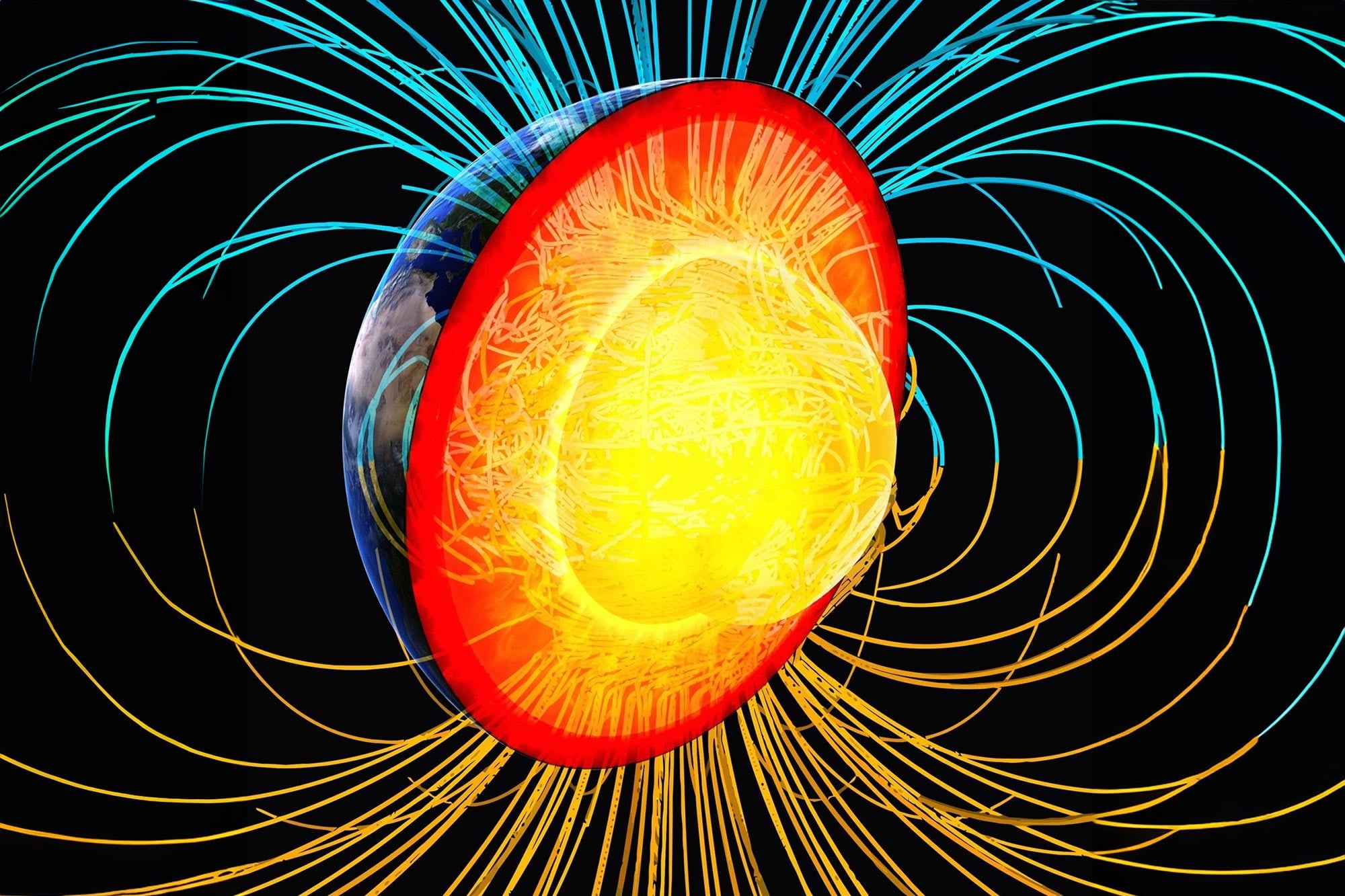
Hidden mega-structures deep inside Earth may have been quietly steering our planet’s magnetic field—and rewriting what we thought we knew about Earth’s past.
Peering into Earth’s interior is far more difficult than exploring space. Humans have traveled about 25 billion km beyond our planet, yet the deepest drill hole ever made reaches just over 12 km below the surface. As a result, scientists still know surprisingly little about what happens far beneath our feet.
This lack of access is especially significant at the boundary between the mantle and the core. This zone marks the most important internal interface within Earth and plays a crucial role in shaping the planet’s behavior. New research now suggests it is also a key player in controlling Earth’s magnetic field.
Giant Hot Structures at the Core Mantle Boundary
A study published today (February 3) in Nature Geoscience and led by the University of Liverpool has uncovered magnetic evidence that two enormous, extremely hot rock structures at the base of Earth’s mantle influence the liquid outer core below. These structures lie roughly 2,900 kilometres beneath Africa and the Pacific Ocean.
The research indicates that these massive bodies of solid, superheated rock, encircled by a pole to pole ring of cooler material, have been affecting Earth’s magnetic field for millions of years.
Reconstructing Earth’s Ancient Magnetic Field
Tracking ancient magnetic fields and recreating the processes that produce them is a major technical challenge. To tackle this problem, the research team combined palaeomagnetic data from ancient rocks with advanced computer simulations of the geodynamo. The geodynamo refers to the movement of liquid iron in Earth’s outer core that generates the magnetic field in much the same way a wind turbine produces electricity.
Using numerical models, the scientists were able to reproduce key features of Earth’s magnetic behavior going back 265 million years. Even with access to supercomputers, running these simulations over such long periods requires enormous computational power.
Uneven Heat and Long Lasting Magnetic Patterns
The results showed that the top of the outer core is not evenly heated. Instead, it contains sharp temperature differences, with especially hot regions located beneath the continent-sized mantle structures.
The findings also revealed that while some parts of Earth’s magnetic field have changed dramatically over time, other features have remained relatively stable for hundreds of millions of years.
Andy Biggin, Professor of Geomagnetism at the University of Liverpool, said: “These findings suggest that there are strong temperature contrasts in the rocky mantle just above the core and that, beneath the hotter regions, the liquid iron in the core may stagnate rather than participate in the vigorous flow seen beneath the cooler regions.
“Gaining such insights into the deep Earth on very long timescales strengthens the case for using records of the ancient magnetic field to understand both the dynamic evolution of the deep Earth and its more stable properties.
“These findings also have important implications for questions surrounding ancient continental configurations—such as the formation and breakup of Pangaea—and may help resolve long-standing uncertainties in ancient climate, palaeobiology, and the formation of natural resources. These areas have assumed that Earth’s magnetic field, when averaged over long periods, behaved as a perfect bar magnet aligned with the planet’s rotational axis. Our findings are that this may not quite be true.”
Reference: “Mantle heterogeneity influenced Earth’s ancient magnetic field” by A. J. Biggin, C. J. Davies, J. E. Mound, S. J. Lloyd, Y. E. Engbers, D. Thallner, A. T. Clarke and R. K. Bono, 3 February 2026, Nature Geoscience.
DOI: 10.1038/s41561-025-01910-1
The research was carried out by scientists from the DEEP (Determining Earth Evolution using Palaeomagnetism) group within the University of Liverpool’s School of Environmental Sciences, in collaboration with researchers from the University of Leeds.
Professor Biggin and his colleagues focus on studying magnetic signals preserved in rocks from around the world to piece together the history of Earth’s magnetic field and the planet’s internal processes.
DEEP was founded in 2017 with funding from the Leverhulme Trust and the Natural Environment Research Council (NERC).
Never miss a breakthrough: Join the SciTechDaily newsletter.
Follow us on Google and Google News.
1 Comment
Humans have not traveled “about 25 billion km from Earth.” The moon is less than 400,000 kilometers from Earth–when have humans traveled beyond the orbit of the Moon? The Earth-Sun distance, 1 AU, is less than 150 million miles.
Are you talking about Voyager, which is now at about 25 billion km (167 AU) from Earth? You might want to say “Human artifacts have traveled about 25 billion km from Earth.”