
Close Menu
    Facebook X (Twitter) Instagram
    SciTechDaily
    • Biology
    • Chemistry
    • Earth
    • Health
    • Physics
    • Science
    • Space
    • Technology
    Facebook X (Twitter) Pinterest YouTube RSS
    SciTechDaily
    Home»Earth»Scientists Uncover Unexpected Behavior Deep Inside Earth’s Mantle
    Earth

    Scientists Uncover Unexpected Behavior Deep Inside Earth’s Mantle

    By University of LiverpoolMarch 27, 2026No Comments4 Mins Read
    Facebook Twitter Pinterest Telegram LinkedIn WhatsApp Email Reddit
    Share
    Facebook Twitter LinkedIn Pinterest Telegram Email Reddit
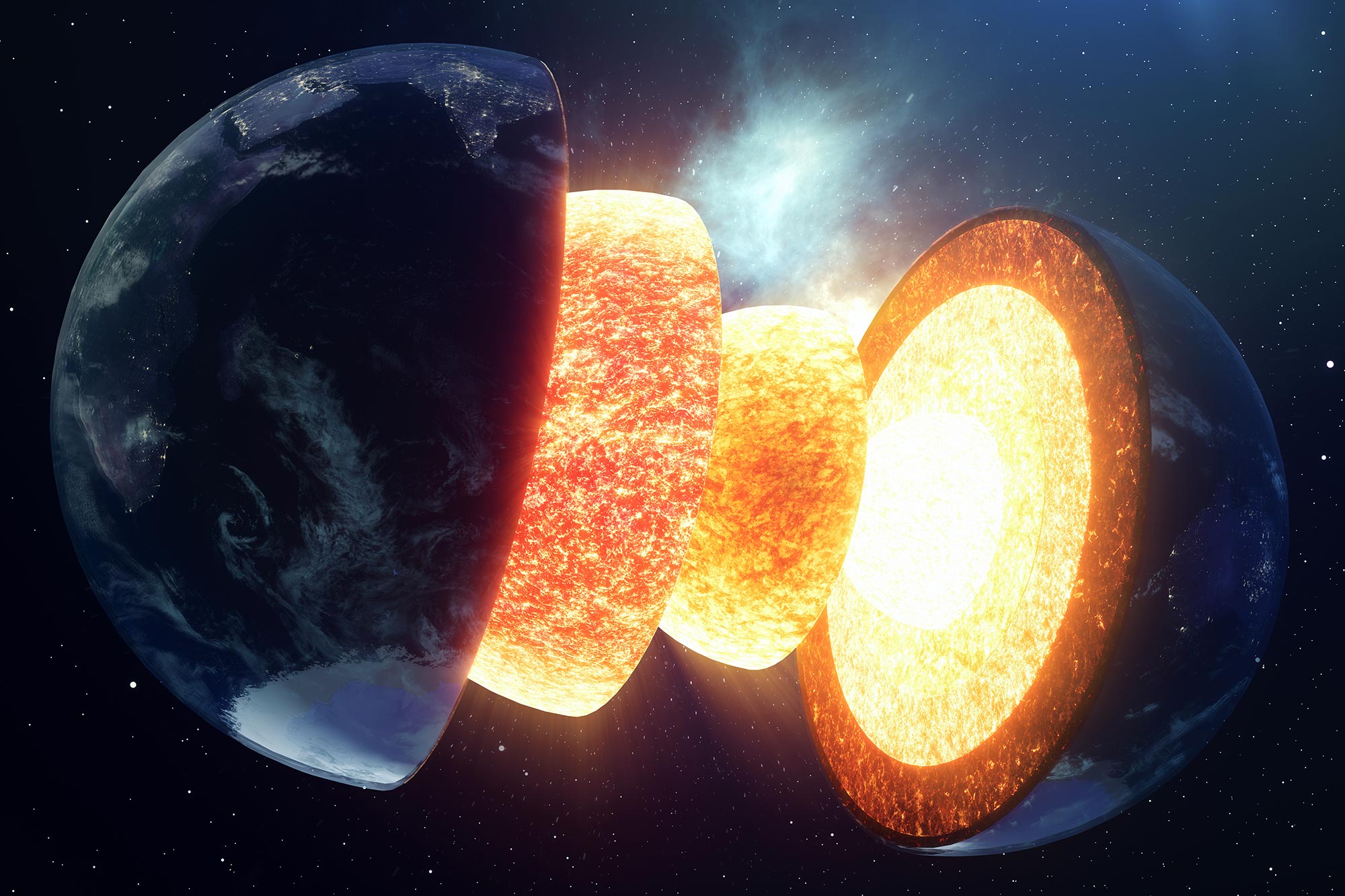
    Earth Core Interior Structure Layers Illustration
    The Earth’s mantle is a vast, mostly solid layer that extends from the base of the crust to the outer core, reaching depths of about 2,900 kilometers. Composed primarily of silicate minerals such as olivine and pyroxene, it behaves as a slow-flowing, ductile medium over geological timescales. Credit: Stock

    Tiny defects in common minerals may reveal unexpected patterns in how Earth’s interior moves.

    Minerals quietly shape the world around us, from the rocks beneath our feet to the deep interior of the planet. At their core are crystals, orderly arrangements of atoms that repeat in precise, three-dimensional patterns. While these structures may seem rigid, they are far more dynamic than they appear.

    Under intense pressure and heat, such as those found deep inside Earth, crystals can bend and flow rather than break. This ability comes from tiny defects known as dislocations, small irregularities in the atomic structure that act like microscopic slip zones. They allow solid rock to slowly deform over time, a process that ultimately helps drive the movement of tectonic plates.

    In some crystals, dislocations are abundant, while in others they are rare and difficult to detect. Finding them can be as challenging as searching for a needle in a haystack.

    Olivine, the most common mineral in the upper 400 km (about 250 miles) of Earth’s interior, has long been studied for how it deforms. Scientists have identified two primary directions of dislocation movement, labeled “a” and “c.” A third direction, known as “b,” has traditionally been considered uncommon and less important.

    A recent study led by a University of Liverpool Earth scientist revisited this assumption. The research aimed to better understand how olivine deforms, a key process that drives plate tectonics, and to identify the types of dislocations involved.

    Advanced Microscopy Techniques

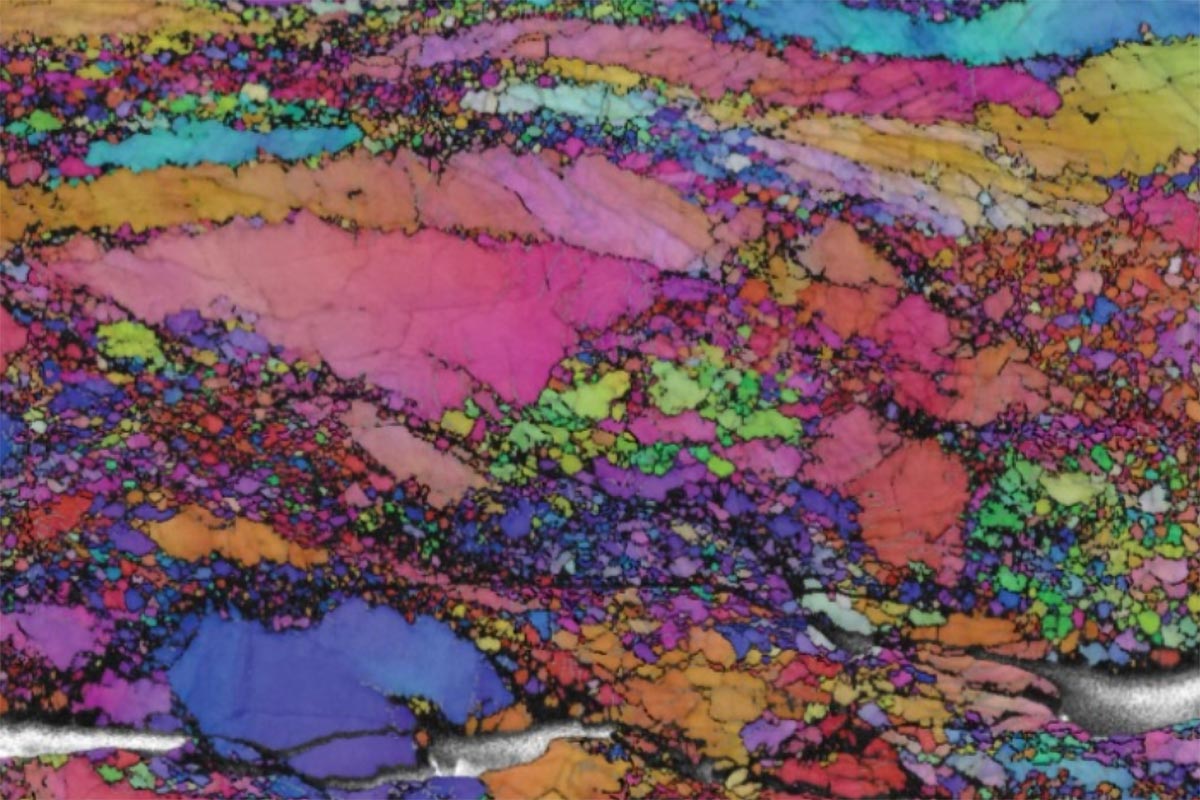
    The team used Electron Backscatter Diffraction (EBSD), an advanced microscopy method that maps subtle differences in crystal orientation at a microscopic scale.

    Their analysis showed that about 17% of the crystals examined displayed deformation linked to the previously underestimated “b” dislocations.

    To confirm this result, the researchers turned to Transmission Electron Microscopy (TEM), which can directly image dislocations. By focusing on regions flagged by EBSD as showing “b” slip, they captured detailed images that verified these structures were indeed present.
    Crystal Deformation Olivine
    Map of color-coded crystal orientation in olivine from electron microscopy characterization. Smooth colour variations show the presence of dislocations. Credit: University of Liverpool

    Professor John Wheeler, George Herdman Professor of Geology at the University of Liverpool and lead author of the study published in Geophysical Research Letters, said:

    “Our findings suggest that these dislocations may be more widespread than previously thought, improving our understanding of how the Earth’s mantle deforms.

    “Their presence may be influenced by pressure, temperature, and stress levels. Measuring ‘b’ dislocations in natural samples could therefore help scientists determine the depth of deformation and the conditions experienced during it.”

    Broader Applications and Future Research

    The study also highlights how EBSD can quickly pinpoint areas within crystals that are worth closer examination. Researchers can then use higher resolution tools like TEM to investigate those regions in greater detail.

    Professor Wheeler added: “The approach we’ve used could help scientists develop a better understanding of geological processes inside the Earth. It may also have wider applications in materials science. For instance, olivine has crystal similarities to perovskites which have numerous industrial uses. Some materials such as semiconductors contain dislocations because of the manufacturing process which are deleterious to performance, so their abundance and arrangements need to be investigated. ”

    Reference: “Olivine Deformation: To B Slip or Not to B Slip, That Is the Question” by J. Wheeler, S. Hunt, A. Eggeman, J. Donoghue, A. Gholinia, Y. Li, E. Tillotson and S. J. Haigh, 17 December 2025, Geophysical Research Letters.
    DOI: 10.1029/2025GL117138

    Never miss a breakthrough: Join the SciTechDaily newsletter.
    Follow us on Google and Google News.

    Earth Science Geology Geophysics University of Liverpool
    Share. Facebook Twitter Pinterest LinkedIn Email Reddit

    Related Articles

    Geologists Crack 134-Million-Year-Old Mystery of Amethyst Geode Formation

    Earth’s Crust Is Dripping? An Underground Anomaly Is Causing Turkey’s Konya Basin To Sink

    Lab Experiments Provide New Details Into How Magma Feeds Volcanic Eruptions

    Arctic Sea Ice Loss is Impacting Atlantic Ocean Water Circulation System

    Yale Researchers Find a Soft Spot in the Nazca Plate

    New Research Reveals Earth’s Inner Core Was Formed 1 – 1.5 Billion Years Ago

    Flat-Slab Subduction in South America Mirrors Formation of Rocky Mountains

    New Calculations Challenge Assumptions about Rigid Lithosphere

    Unusual Indian Ocean Earthquakes May Signal Tectonic Breakup

    Leave A Reply Cancel Reply

    • Facebook
    • Twitter
    • Pinterest
    • YouTube

    Don't Miss a Discovery

    Subscribe for the Latest in Science & Tech!

    Trending News

    New Study Reveals Why Ozempic Works Better for Some People Than Others

    Climate Change Is Altering a Key Greenhouse Gas in a Way Scientists Didn’t Expect

    New Study Suggests Gravitational Waves May Have Created Dark Matter

    Scientists Discover Why the Brain Gets Stuck in Schizophrenia

    Scientists Engineer “Tumor-Eating” Bacteria That Devour Cancer From Within

    Even “Failed” Diets May Deliver Long-Term Health Gains, Study Finds

    NIH Scientists Discover Powerful New Opioid That Relieves Pain Without Dangerous Side Effects

    Collapsing Plasma May Hold the Key to Cosmic Magnetism

    Follow SciTechDaily
    • Facebook
    • Twitter
    • YouTube
    • Pinterest
    • Newsletter
    • RSS
    SciTech News
    • Biology News
    • Chemistry News
    • Earth News
    • Health News
    • Physics News
    • Science News
    • Space News
    • Technology News
    Recent Posts
    • This 15,000-Year-Old Discovery Changes What We Know About Early Human Creativity
    • 35-Million-Year-Old Mystery: Strange Arachnid Discovered Preserved in Amber
    • Revolutionary Gas Turbine Generates Power Without Air Compression
    • Is AI Really Just a Tool? It Could Be Altering How You See Reality
    • JWST Reveals a “Forbidden” Planet With a Baffling Composition
    Copyright © 1998 - 2026 SciTechDaily. All Rights Reserved.
    • Science News
    • About
    • Contact
    • Editorial Board
    • Privacy Policy
    • Terms of Use

    Type above and press Enter to search. Press Esc to cancel.