
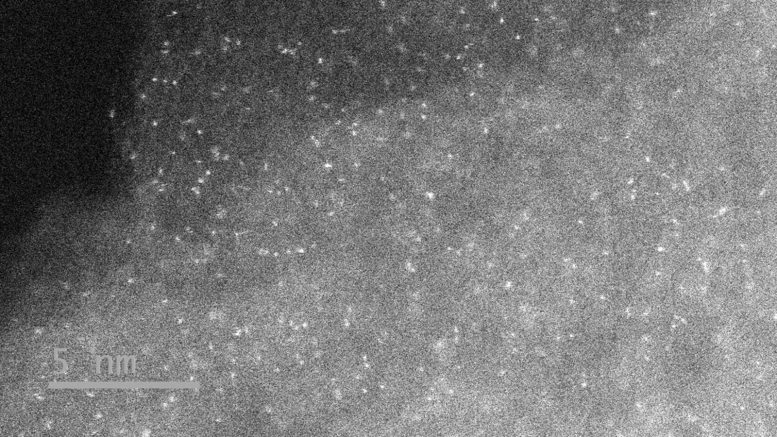
Single atoms work great as catalysts, but they usually don’t stay single for long. Argonne scientists are part of a team that uses high-temperature shock waves to keep them in their place.
A current hot topic in catalysis research is the development of single-atom catalysts — those whose atoms are not bound to each other. The increase in exposure of single-atom catalysts maximizes atom-use efficiency for catalytic performance, aiding crucial processes such as the manufacturing of fuel and pharmaceuticals.
Synthesizing stable single-atom catalysts proves challenging because many of the most useful catalytic reactions, such as the conversion of methane, can only occur at high temperatures. To remain in a stable state, single atoms often cluster together when high temperatures introduce an increase in instability to the system, causing a decline in their catalytic performance.
“We don’t want to stop here. We want to study this novel method in common reactions and then generalize it to other materials.” — Tianpin Wu, Argonne scientist
Scientists at the U.S. Department of Energy’s (DOE) Argonne National Laboratory, along with partners from multiple universities, have demonstrated that exposing a catalyst and substrate to repeated high-temperature shock waves breaks the catalyst into single atoms and allows the system to remain stable for unprecedented periods of time.
In this pivotal discovery, the scientists used platinum for the catalyst and carbon for the substrate. Platinum serves as a catalyst for many important reactions, such as driving fuel cells and converting natural gas to more useful forms.
The study, which recently appeared in Nature Nanotechnology, took advantage of interdisciplinary collaboration between multiple national labs and universities. Computer models of the system during heat pulsing came from the University of Maryland. The predictions for how the system would behave closely matched the actual results obtained during reaction tests at Johns Hopkins University and X-ray absorption spectroscopy at Argonne’s Advanced Photon Source (APS), a DOE Office of Science User Facility. In situ stability testing using atomic resolution microscopy was performed at University of Illinois at Chicago and at the Environmental Molecular Sciences Laboratory, another DOE Office of Science User Facility at Pacific Northwest National Laboratory.
The APS beamline operated by the X-ray Science division Spectroscopy group specializes in X-ray absorption spectroscopy, and it hosts a wide variety of users from fields such as energy storage, catalysis and environmental science. The technique they employed for the system in this study is able to uniquely characterize single-atom catalysis. The scientists were able to show that after 10 shock waves, there were virtually no platinum-platinum bonds, and that the platinum was binding with the carbon substrate, which is important in explaining the boosted performance of the system.
The scientists dispersed platinum atoms over a carbon surface, and at low temperatures, the platinum clustered together instead of binding as individual atoms with the carbon. After one high temperature shock wave — or pulse of heat — the platinum islands began to break apart and, after 10 pulses, the platinum was uniformly dispersed and planted in the carbon.
These experiments were performed using shock waves at record-high temperatures of up to 2000 K, a temperature higher than even the hottest magma below Earth’s surface, establishing a stable catalytic environment ripe with potential for reaction. The system remained stable for more than 50 hours after synthesis.
The shock wave method bypasses the common problem of single atoms binding with themselves because when you heat atoms to high temperatures, the splash of energy causes them to move around and break their pre-existing bonds. This instability disrupts platinum-platinum bonds and makes the platinum spread out over the carbon, providing energy-stable opportunities for it to bind with the carbon molecules. With each additional shock wave, the platinum atoms spread out more and more.
“The bonds between platinum and carbon are strong, so if you separate the platinum from itself and it binds with carbon, it will stay there,” said Tianpin Wu of the Spectroscopy group, an Argonne scientist on the study. “The carbon is like soil and the platinum is like a flower with strong roots — the system is very stable.”
Using thermal shock waves as a method of synthesizing single-atom catalysts is a time-efficient and widely applicable way of achieving catalytic environments that are conventionally challenging. The team plans to use this method to synthesize other important catalysts such as ruthenium and cobalt with substrates of carbon nitride and titanium dioxide to gain a more general theory of how the method works.
“We don’t want to stop here,” said Wu. “We want to study this novel method in common reactions and then generalize it to other materials.”
“We compared the performance of our high-temperature single-atom platinum catalyst with conventional platinum nanoparticles in methane conversion, and we saw a significant improvement in selectivity and thermal stability over long periods of time,” said Wu.
The team went further to test the thermal stability of the system by treating the single atoms with shock waves up to 3000 K. The result was still a sea of single atoms, allowing for maximized atom-use efficiency.
“This work was like a puzzle, and all of the collaborators’ contributions were necessary to get a detailed picture of the system,” said Wu. “Not any one of the techniques could have told the story alone, but together we showed that this method is as successful as it is.”
###
Reference: “High temperature shockwave stabilized single atoms” by Yonggang Yao, Zhennan Huang, Pengfei Xie, Lianping Wu, Lu Ma, Tangyuan Li, Zhenqian Pang, Miaolun Jiao, Zhiqiang Liang, Jinlong Gao, Yang He, Dylan Jacob Kline, Michael R. Zachariah, Chongmin Wang, Jun Lu, Tianpin Wu, Teng Li, Chao Wang, Reza Shahbazian-Yassar and Liangbing Hu, 12 August 2019, Nature Nanotechnology.
DOI: 10.1038/s41565-019-0518-7
Argonne National Laboratory seeks solutions to pressing national problems in science and technology. The nation’s first national laboratory, Argonne conducts leading-edge basic and applied scientific research in virtually every scientific discipline. Argonne researchers work closely with researchers from hundreds of companies, universities, and federal, state and municipal agencies to help them solve their specific problems, advance America’s scientific leadership and prepare the nation for a better future. With employees from more than 60 nations, Argonne is managed by UChicago Argonne, LLC for the U.S. Department of Energy’s Office of Science.
The U.S. Department of Energy’s Office of Science is the single largest supporter of basic research in the physical sciences in the United States and is working to address some of the most pressing challenges of our time.
Never miss a breakthrough: Join the SciTechDaily newsletter.
Follow us on Google and Google News.