
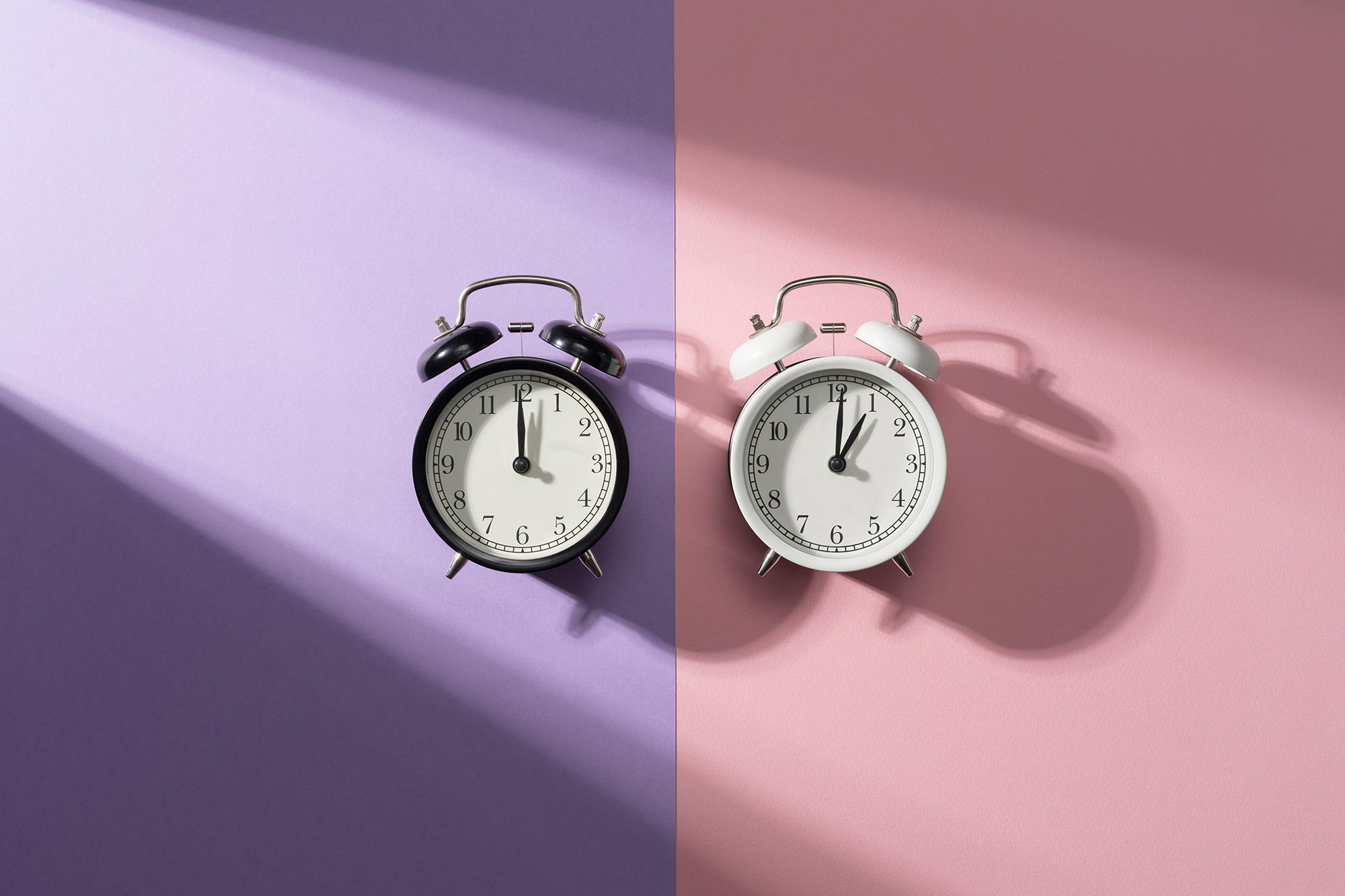
A new analysis from Stanford Medicine scientists shows that shifting clocks twice a year disrupts circadian rhythms and is linked to higher risks of stroke and obesity.
Each spring, Americans move their clocks forward for daylight saving time, and each fall, they set them back to standard time — a routine that few enjoy. Beyond being inconvenient, this twice-yearly change has been shown to negatively affect health. Losing an hour of sleep on the second Sunday in March has been associated with increases in heart attacks and fatal car accidents in the days that follow.
Now, Stanford Medicine researchers report that the risks go beyond short-term effects — and that healthier alternatives exist.
The team analyzed how three possible time policies — year-round standard time, year-round daylight saving time, and the current twice-yearly shift — influence circadian rhythms and, in turn, public health across the United States. Circadian rhythm refers to the body’s natural 24-hour cycle that regulates numerous biological functions.
From this perspective, the researchers concluded that the current system is the least favorable. They found that permanent standard time or permanent daylight saving time would both be healthier, with standard time offering the greatest overall benefits.
Using county-level data on light exposure, circadian effects, and health patterns, the study estimated that adopting permanent standard time could prevent about 300,000 strokes annually and reduce obesity by 2.6 million cases. Permanent daylight saving time would provide roughly two-thirds of those same benefits.

“We found that staying in standard time or staying in daylight saving time is definitely better than switching twice a year,” said Jamie Zeitzer, PhD, professor of psychiatry and behavioral sciences and senior author of the study published on September 15 in the Proceedings of the National Academy of Sciences. The lead author is Lara Weed, a graduate student in bioengineering.
A theory lacking data
Even among those who agree that seasonal clock changes should end, there is little consensus on which system should replace them.
“You have people who are passionate on both sides of this, and they have very different arguments,” said Zeitzer.
Advocates for permanent daylight saving time argue that extended evening light can reduce energy use, discourage crime, and provide more time for recreation after work. Industries such as golf courses and outdoor shopping centers strongly favor this approach, Zeitzer noted. Yet when the United States briefly adopted permanent daylight saving time in 1974, it proved so unpopular that the policy was reversed within a year. Many parents, for example, objected to children heading to school before sunrise.
Still, daylight saving time was later lengthened from six to seven months, and since 2018, lawmakers have introduced bills almost every year to make it permanent, though none have passed.
On the other side, supporters of permanent standard time emphasize that morning light is more beneficial for overall health. Groups including the American Academy of Sleep Medicine, the National Sleep Foundation, and the American Medical Association have all publicly endorsed standard time as the year-round option.
“It’s based on the theory that early morning light is better for our overall health,” Zeitzer said of these endorsements. “The problem is that it’s a theory without any data. And finally, we have data.”
Syncing to 24 hours
The human circadian cycle is not exactly 24 hours — for most people, it’s about 12 minutes longer — but it can be modulated by light.
“When you get light in the morning, it speeds up the circadian cycle. When you get light in the evening, it slows things down,” Zeitzer said. “You generally need more morning light and less evening light to keep well synchronized to a 24-hour day.”
An out-of-sync circadian cycle has been associated with a range of poor health outcomes.
“The more light exposure you get at the wrong times, the weaker the circadian clock. All of these things that are downstream — for example, your immune system, your energy — don’t match up quite as well,” Zeitzer said.
The researchers used a mathematical model to translate light exposure under each time policy, based on local sunrise and sunset times, to circadian burden — essentially, how much a person’s innate clock has to shift to keep up with the 24-hour day.
They found that over a year, most people would experience the least circadian burden under permanent standard time, which prioritizes morning light. The benefits vary somewhat by a person’s location within a time zone and their chronotype — whether they prefer early mornings, late nights or something in between.
Counterintuitively, people who are morning larks, who make up about 15% of the population and tend to have circadian cycles shorter than 24 hours, would experience the least circadian burden under permanent daylight savings time, as more evening light would extend their circadian cycles closer to 24 hours.
Health implications
To link circadian burden to specific health outcomes, the researchers analyzed county-level data from the Centers for Disease Control and Prevention on the prevalence of arthritis, cancer, chronic obstructive pulmonary disease, coronary heart disease, depression, diabetes, obesity, and stroke.
Their models show that permanent standard time would lower the nationwide prevalence of obesity by 0.78% and the prevalence of stroke by 0.09%, conditions influenced by circadian health. These seemingly small percentage changes in common conditions would amount to 2.6 million fewer people with obesity and 300,000 fewer cases of stroke. Under permanent daylight time, the nationwide prevalence of obesity would decrease by 0.51%, or 1.7 million people, and stroke by 0.04%, or 220,000 cases.
As expected, the models predicted no significant difference in conditions such as arthritis that have no direct link to circadian rhythms.
Not the last word
The study might be the most evidence-based analysis of the long-term health implications of different time policies, but it’s far from the last word, Zeitzer said.
For one thing, the researchers didn’t account for many factors that could influence real-life light exposure, including weather, geography, and human behavior.
In their calculations, the researchers assumed consistent and relatively circadian-friendly light habits, including a 10 p.m. to 7 a.m. sleep schedule, sunlight exposure before and after work and on weekends, and indoor light exposure from 9 a.m. to 5 p.m. and after sunset. But in reality, many people have erratic sleep schedules and spend more time indoors.
“People’s light habits are probably much worse than what we assume in the models,” Zeitzer said. “Even in California, where the weather is great, people spend less than 5% of their day outside.”
Moreover, though circadian health seems to favor permanent standard time, the results are not conclusive enough to overshadow other considerations. Zeitzer hopes the study will encourage similar evidence-based analyses from other fields, such as economics and sociology.
He also points out that time policy is simply choosing which clock hours represent sunrise and sunset, not altering the total amount of light there is. No policy will add light to the dark winter months.
“That’s the sun and the position of Earth,” he said. “We can’t do anything about that.”
Reference: “Circadian-informed modeling predicts regional variation in obesity and stroke outcomes under different permanent US time policies” by Lara Weed and Jamie M. Zeitzer, 15 September 2025, Proceedings of the National Academy of Sciences.
DOI: 10.1073/pnas.2508293122
The study received funding from the National Institutes of Health (grant F31HL170715).
Never miss a breakthrough: Join the SciTechDaily newsletter.
Follow us on Google and Google News.
2 Comments
It doesn’t take a scientist to tell you that jumping hours back and forth is mind-wrecking. But I’m glad they’re on our side for once.
Now, when will the rulers take notice?
I don’t get it. I live in AZ where we ignore Daylight Saving stuff and don’t change the clocks. But I used to live in NY and CA and I never had any problem with changing the clocks. I never noticed or felt a difference. But I have poor sleep quality and a lot of trouble sleeping, so I guess I’m always sleep deprived. But, come on, people. You can’t handle one hour’s difference in your sleep twice a year? You all wouldn’t last two days if you had to live in my body.