

An École Polytechnique Fédérale de Lausanne (EPFL) Bachelor’s student has solved a mystery that has puzzled scientists for 100 years. He discovered why gas bubbles in narrow vertical tubes seem to remain stuck instead of rising upwards. According to his research and observations, an ultra-thin film of liquid forms around the bubble, preventing it from rising freely. And he found that, in fact, the bubbles are not stuck at all – they are just moving very, very slowly.
Air bubbles in a glass of water float freely up to the surface, and the mechanisms behind this are easily explained by the basic laws of science. However, the same laws of science cannot explain why air bubbles in a tube a few millimeters thick don’t rise the same way.
Physicists first observed this phenomenon nearly a century ago, but couldn’t come up with an explanation – in theory, the bubbles shouldn’t encounter any resistance unless the fluid is in motion; thus a stuck bubble should encounter no resistance.
Back in the 1960s, a scientist named Bretherton developed a formula based on the bubbles’ shape to explain this phenomenon. Other researchers have since postulated that the bubble doesn’t rise due to a thin film of liquid that forms between the bubbles and the tube wall. But these theories cannot fully explain why the bubbles don’t rise upwards.
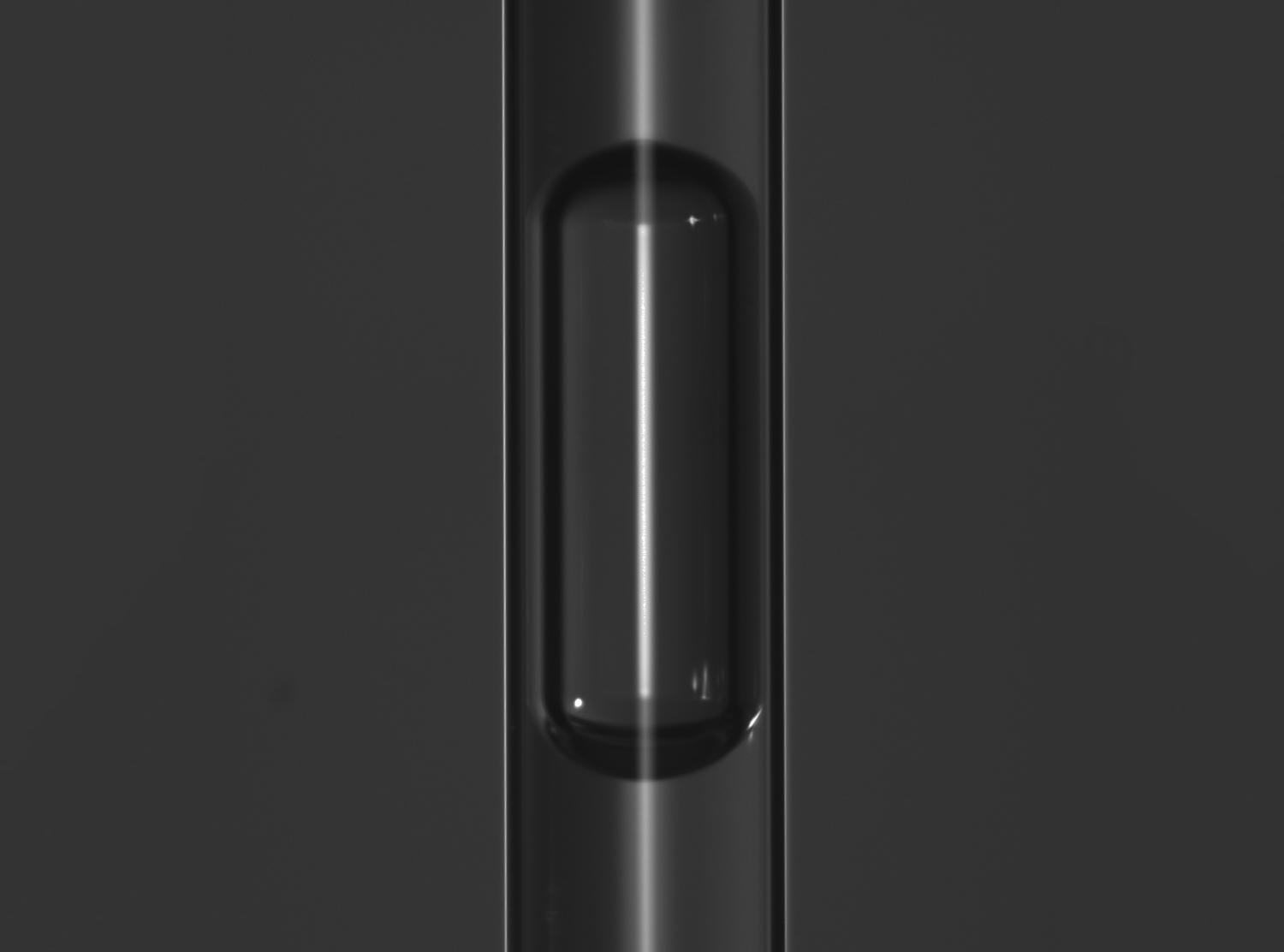
While a Bachelor’s student at the Engineering Mechanics of Soft Interfaces laboratory (EMSI) within EPFL’s School of Engineering, Wassim Dhaouadi was able to not only view the thin film of liquid, but also measure it and describe its properties – something that had never been done before. His findings showed that the bubbles weren’t stuck, as scientists previously thought, but actually moving upwards extremely slowly. Dhaouadi’s research, which was published recently in Physical Review Fluids, marked the first time that experimental evidence was provided to test earlier theories.
Dhaouadi and EMSI lab head, John Kolinski, used an optical interference method to measure the film, which they found to be only a few dozen nanometers (1 x 10⁻⁹ meters) thick. The method involved directing light onto an air bubble inside a narrow tube and analyzing the reflected light intensity. Using the interference of the light reflected from the tube’s inner wall and from the bubble’s surface, they precisely measured the film’s thickness.
Dhaouadi also discovered that the film changes shape if heat is applied to the bubble and returns to its original shape once the heat is removed. “This discovery disproves the most recent theories that the film would drain to zero thickness,” says John Kolinski.
These measurements also show that the bubbles are actually moving, albeit too slowly to be seen by the human eye. “Because the film between the bubble and the tube is so thin, it creates a strong resistance to flow, drastically slowing the bubbles’ rise,” according to Kolinski.
These findings relate to fundamental research but could be used to study fluid mechanics on a nanometric scale, especially for biological systems.
Dhaouadi joined the lab as a summer research assistant during his Bachelor’s. He made rapid progress, and continued the work of his own volition. “He essentially participated out of his interest in the research, and wound up publishing a paper from his work that brings to rest a centuries-old puzzle”, says Kolinski.
“I was happy to carry a research project early in my curriculum. It is a new way of thinking and learning and was quite different from a Homework set where you know there is a solution, although it may be hard to find. At first, We did not know if there would even be a solution to this problem.,” says Dhaouadi, who is now completing a Master’s degree at ETH Zurich. Kolinski adds: “Wassim made an exceptional discovery at our lab. We were happy to have him working with us.”
Reference: “Bretherton’s buoyant bubble” by Wassim Dhaouadi and John M. Kolinski, 2 December 2019, Physical Review Fluids.
DOI: 10.1103/PhysRevFluids.4.123601
Never miss a breakthrough: Join the SciTechDaily newsletter.
Follow us on Google and Google News.
13 Comments
A different manifestation of the Magnus effect. https://www.norwegiancreations.com/wp-content/uploads/2019/02/magnus_force.png
nice intelligent finding
This is fascinating.
I would be more appreciative of the report itself, if John Kolinski had used the words “dramatically” or “significantly” instead of the word “drastically” (violently) especially as the extreme slow movement seems anything but violent. I would also have appreciated it if the author had used “sic” indicating that the word choice was less than appropriate.
Does research say why bubbles in middle of glass raise up and only bubbles near surface of container more very slowly upwards?
Does research say why bubbles in middle of container raise up and only bubbles near surface of container move very slowly upwards?
Good Question Lancy… Here’s my take.
The pressure of the liquid in the middle of the tube is higher than at the top. This change of pressure automatically reduces the velocity of the bubble. This happens in a normal glass of water as well. That’s why we see bubbles from below catch-up with the ones at the top before they burst…
So… It’s actually more about pressure and every bubble has a layer not just the ones in a small tube. That’s why the air bubble in water is in the water but never has any water inside it. Air forms a layer and so does water which obviously doesn’t want to mingle with air.
1. Is this research possibly funded by the coca cola company ?
2. Now I’m sure the new right theory would be applied to this new empirical result (althou the measurement method was nice – suitable for a James Bond movie)
3. It is curious that while we are bound to descifer the secrets of the Universe with quantum mechanics (which almost nobody understands), we are still surprised by a Navier-Stokes particular results. We even stoped understanding flight the moment we’ve got the supercomputers. No surprise that even these days science coexist beautifully with religions, even the most stupid ones
The pulling force that causes surface tension becomes stronger when particle size is smaller, like when outer-space is becoming inner-space.
I agree with many of the comments here. If the cross section of tube is significantly small the ‘no slip’ condition due to walls of tube may extend almost middle of tube and any pressure difference causing the movement of fluid around bubble,will also be retarded which eventually slows the bubble too. I am not an expert though and believe the researcher surely has a purpose here.
@here better ask the bubble once just to confirm.
I wanna say one question to all guys that when we put the leave of Tulsi in near of glass of water we observe that the Tulsi leave sinks into the water why it happens send me answer on this email ID [email protected]
Bikram I am not an expert as well as I am a student.I want to answer you that Tulsi which is the holly plant of Hindus.Its leaves have spongy nature and minute hairlike structure to grab or absorb water particles so it sinks
Wow great and this information such very great because these students have worked so well and we need this type of student. Gustavo Woltmann