
By applying a machine-learning algorithm, scientists at the Niels Bohr Institute, University of Copenhagen, have developed a method to classify all gamma-ray bursts (GRBs), rapid highly energetic explosions in distant galaxies, without needing to find an afterglow – by which GRBs are presently categorized. This breakthrough, initiated by first-year B.Sc. students, may prove key in finally discovering the origins of these mysterious bursts. The result is now published in Astrophysical Journal Letters.
Ever since gamma-ray bursts (GRBs) were accidentally picked up by Cold War satellites in the 70s, the origin of these rapid bursts have been a significant puzzle. Although many astronomers agree that GRBs can be divided into shorter (typically less than 1 second) and longer (up to a few minutes) bursts, the two groups are overlapping. It has been thought that longer bursts might be associated with the collapse of massive stars, while shorter bursts might instead be caused by the merger of neutron stars. However, without the ability to separate the two groups and pinpoint their properties, it has been impossible to test these ideas.
So far, it has only been possible to determine the type of a GRB about 1% of the time, when a telescope was able to point at the burst location quickly enough to pick up residual light, called an afterglow. This has been such a crucial step that astronomers have developed worldwide networks capable of interrupting other work and repointing large telescopes within minutes of the discovery of a new burst. One GRB was even detected by the LIGO Observatory using gravitational waves, for which the team was awarded the 2017 Nobel Prize.
Breakthrough achieved using machine-learning algorithm
Now, scientists at the Niels Bohr Institute have developed a method to classify all GRBs without needing to find an afterglow. The group, led by first-year B.Sc. Physics students Johann Bock Severin, Christian Kragh Jespersen, and Jonas Vinther, applied a machine-learning algorithm to classify GRBs. They identified a clean separation between long and short GRB’s. Their work, carried out under the supervision of Charles Steinhardt, will bring astronomers a step closer to understanding GRB’s.
This breakthrough may prove the key to finally discovering the origins of these mysterious bursts. As Charles Steinhardt, Associate Professor at the Cosmic Dawn Center of the Niels Bohr Institute explains, “Now that we have two complete sets available, we can start exploring the differences between them. So far, there had not been a tool to do that.”
From algorithm to visual map
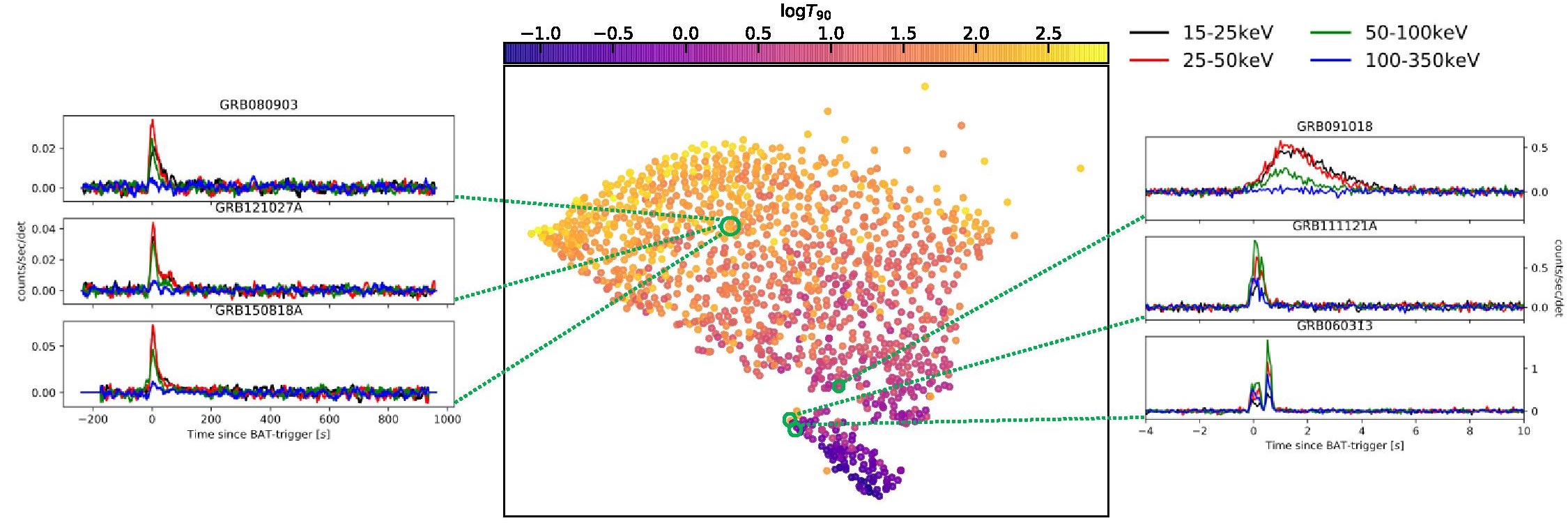
Instead of using a limited set of summary statistics, as was typically done until then, the students decided to encode all available information on GRB’s using the machine learning algorithm t-SNE. The t-distributed Stochastic neighborhood embedding algorithm takes complex high-dimensional data and produces a simplified and visually accessible map. It does so without interfering with the structure of the dataset. “The unique thing about this approach,” explains Christian Kragh Jespersen, “is that t-SNE doesn’t force there to be two groups. You let the data speak for itself and tell you how it should be classified.”
Shining light on the data
The preparation of the feature space – the input you give the algorithm – was the most challenging part of the project, says Johann Bock Severin. Essentially, the students had to prepare the dataset in such a way that its most important features would stand out. “I like to compare it to hanging your data points from the ceiling in a dark room,” explains Christian Kragh Jespersen. “Our main problem was to figure out from what direction we should shine a light on the data to make the separations visible.”
“Step 0 in understanding GRB’s”
The students explored the t-SNE machine-learning algorithm as part of their 1st Year project, a 1st year course in the Bachelor of Physics. “By the time we got to the end of the course, it was clear we had quite a significant result”, their supervisor Charles Steinhardt says. The students’ mapping of the t-SNE cleanly divides all GRB’s from the Swift observatory into two groups. Importantly, it classifies GRB’s that previously were difficult to classify. “This essentially is step 0 in understanding GRB’s,” explains Steinhardt. “For the first time, we can confirm that shorter and longer GRB’s are indeed completely separate things.”
Without any prior theoretical background in astronomy, the students have discovered a key piece of the puzzle surrounding GRB’s. From here, astronomers can start to develop models to identify the characteristics of these two separate classes.
Reference: “An Unambiguous Separation of Gamma-Ray Bursts into Two Classes from Prompt Emission Alone” by Christian K. Jespersen, Johann B. Severin, Charles L. Steinhardt, Jonas Vinther, Johan P. U. Fynbo, Jonatan Selsing and Darach Watson, 15 June 2020, The Astrophysical Journal Letters.
DOI: 10.3847/2041-8213/ab964d
arXiv: 2005.13554
Never miss a breakthrough: Join the SciTechDaily newsletter.
Follow us on Google and Google News.