
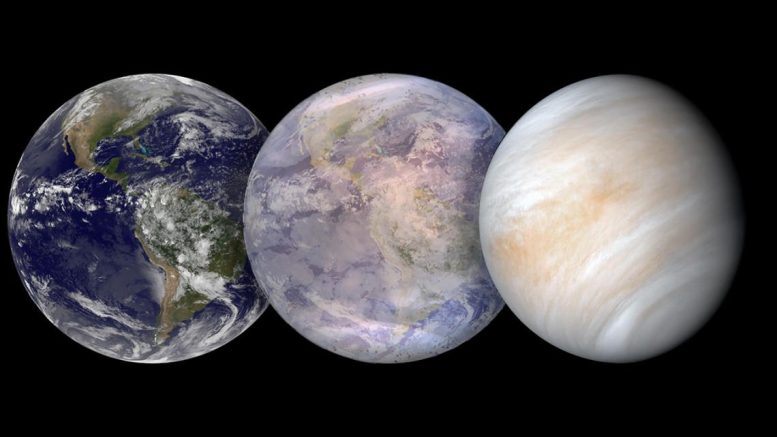
The exoplanet LP 890-9c, orbiting near the inner edge of its habitable zone, offers scientists a unique chance to study planetary evolution and determine how long rocky planets can retain water before becoming barren.
How close can a rocky planet be to a star, and still sustain water and life? A recently discovered exoplanet may be key to solving that mystery.
“Super-Earth” LP 890-9c, also referred to as SPECULOOS-2c, is offering valuable information concerning the conditions at the inner boundary of a star’s habitable zone and explaining the contrasting development of Earth and Venus. The research was led by Lisa Kaltenegger, an associate professor of astronomy at Cornell University.
Her team found LP 890-9c, which orbits close to the inner edge of its solar system’s habitable zone, would look vastly different depending on whether it still had warm oceans, a steam atmosphere, or if it had lost its water – assuming it once had oceans like Earth’s.
A Window into Earth’s Future?
“Looking at this planet will tell us what’s happening on this inner edge of the habitable zone – how long a rocky planet can maintain habitability when it starts to get hot,” Kaltenegger said. “It will teach us something fundamental about how rocky planets evolve with increasing starlight, and about what will one day happen to us and Earth.”
Kaltenegger is the lead author of “Hot Earth or Young Venus? A Nearby Transiting Rocky Planet Mystery,” published in Monthly Notices of the Royal Astronomical Society: Letters.
LP 890-9c is one of two super-Earths orbiting a red dwarf star located 100 light years from Earth, researchers announced last year. (NASA’s Transiting Exoplanet Survey Satellite had previously identified LP 890-9b.) They said liquid water or an atmosphere rich in water vapor was possible on LP 890-9c, which is about 40% larger than Earth and circles the small, cool star in 8.5 days.
Those criteria suggested it to be one of the best targets for JWST to study among the known, potentially habitable terrestrial planets, in addition to the TRAPPIST-1 system.
The team’s models are the first to detail differences in the chemical signatures generated by rocky planets near the habitable zone’s interior boundary, based on variables including the planet’s size, mass, chemical makeup, surface temperature and pressure, atmospheric height, and cloud cover. The calculations were key to estimating how much time JWST would need to confirm the basic composition of an atmosphere – if there is one.
The models span several scenarios thought to reflect stages of rocky planets’ evolution, ranging from a “hot Earth” where life might still be possible, to a desolate Venus featuring a carbon dioxide atmosphere. In between are phases Earth is expected to experience as the sun grows brighter and hotter with age, causing the oceans to gradually evaporate and fill the atmosphere with steam before boiling off entirely.
A Rare Opportunity to Study Planetary Evolution
How long those processes might take is unknown, and the astronomers say LP 890-9c provides a rare opportunity to explore that evolution.
“This planet is the first target where we can test these different scenarios,” Kaltenegger said. “If it’s still a hotter Earth – hot, but with liquid water and conditions for life – then the timeline is slower than we thought. If we see that it’s already a full-blown Venus, then the water gets lost fast.”
It’s possible that LP 890-9c has no atmosphere and hosts no life, or that it resembles a Venus with thick clouds that would block light from reflecting and thus yield little information. Deeper investigation promises to provide valuable clues, Kaltenegger said.
“We don’t know what this planet on the edge of habitability could be like, so we have to look,” she said. “This is what real exploration is about.”
Reference: “Hot Earth or Young Venus? A nearby transiting rocky planet mystery” by L Kaltenegger, R C Payne, Z Lin, J Kasting and L Delrez, 21 June 2023, Monthly Notices of the Royal Astronomical Society.
DOI: 10.1093/mnrasl/slad064
Never miss a breakthrough: Join the SciTechDaily newsletter.
Follow us on Google and Google News.