
Update (January 10, 2020): A team of astronomers from the Universities of Erlangen-Nürnberg and Potsdam discovered that this object may not be a black hole at all.
Our Milky Way Galaxy is estimated to contain 100 million stellar black holes – cosmic bodies formed by the collapse of massive stars and so dense even light can’t escape. Until now, scientists had estimated the mass of an individual stellar black hole in our Galaxy at no more than 20 times that of the Sun. But the discovery of a huge black hole by a Chinese-led team of international scientists has toppled that assumption.
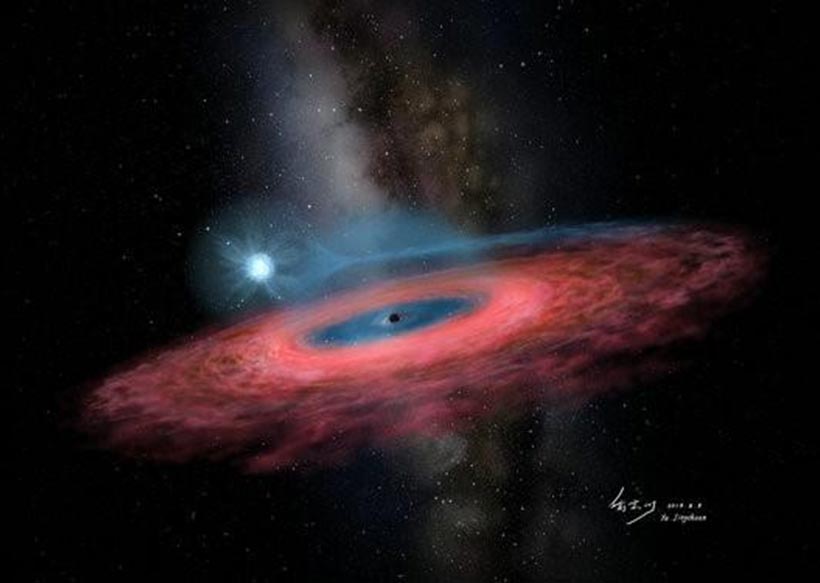
The team, headed by Prof. LIU Jifeng of the National Astronomical Observatory of China of the Chinese Academy of Sciences (NAOC), spotted a stellar black hole with a mass 70 times greater than the Sun. The monster black hole is located 15 thousand light-years from Earth and has been named LB-1 by the researchers. The discovery is reported in the latest issue of Nature.
The discovery came as a big surprise. “Black holes of such mass should not even exist in our Galaxy, according to most of the current models of stellar evolution,” said Prof. LIU. “We thought that very massive stars with the chemical composition typical of our Galaxy must shed most of their gas in powerful stellar winds, as they approach the end of their life. Therefore, they should not leave behind such a massive remnant. LB-1 is twice as massive as what we thought possible. Now theorists will have to take up the challenge of explaining its formation.”
Until just a few years ago, stellar black holes could only be discovered when they gobbled up gas from a companion star. This process creates powerful X-ray emissions, detectable from Earth, that reveal the presence of the collapsed object.
The vast majority of stellar black holes in our Galaxy are not engaged in a cosmic banquet, though, and thus don’t emit revealing X-rays. As a result, only about two dozen Galactic stellar black holes have been well identified and measured.
To counter this limitation, Prof. LIU and collaborators surveyed the sky with China’s Large Sky Area Multi-Object Fiber Spectroscopic Telescope (LAMOST), looking for stars that orbit an invisible object, pulled by its gravity.
This observational technique was first proposed by the visionary English scientist John Michell in 1783, but it has only become feasible with recent technological improvements in telescopes and detectors.
Still, such a search is like looking for the proverbial needle in a haystack: only one star in a thousand may be circling a black hole.
After the initial discovery, the world’s largest optical telescopes – Spain’s 10.4-m Gran Telescopio Canarias and the 10-m Keck I telescope in the United States – were used to determine the system’s physical parameters. The results were nothing short of fantastic: a star eight times heavier than the Sun was seen orbiting a 70-solar-mass black hole, every 79 days.
The discovery of LB-1 fits nicely with another breakthrough in astrophysics. Recently, the Laser Interferometer Gravitational-Wave Observatory (LIGO) and Virgo gravitational wave detectors have begun to catch ripples in spacetime caused by collisions of black holes in distant galaxies. Intriguingly, the black holes involved in such collisions are also much bigger than what was previously considered typical.
The direct sighting of LB-1 proves that this population of over-massive stellar black holes exists even in our own backyard. “This discovery forces us to re-examine our models of how stellar-mass black holes form,” said LIGO Director Prof. David Reitze from the University of Florida in the U.S.
“This remarkable result along with the LIGO-Virgo detections of binary black hole collisions during the past four years really points towards a renaissance in our understanding of black hole astrophysics,” said Reitze.
Reference: “A wide star–black-hole binary system from radial-velocity measurements” by Jifeng Liu, Haotong Zhang, Andrew W. Howard, Zhongrui Bai, Youjun Lu, Roberto Soria, Stephen Justham, Xiangdong Li, Zheng Zheng, Tinggui Wang, Krzysztof Belczynski, Jorge Casares, Wei Zhang, Hailong Yuan, Yiqiao Dong, Yajuan Lei, Howard Isaacson, Song Wang, Yu Bai, Yong Shao, Qing Gao, Yilun Wang, Zexi Niu, Kaiming Cui, Chuanjie Zheng, Xiaoyong Mu, Lan Zhang, Wei Wang, Alexander Heger, Zhaoxiang Qi, Shilong Liao, Mario Lattanzi, Wei-Min Gu, Junfeng Wang, Jianfeng Wu, Lijing Shao, Rongfeng Shen, Xiaofeng Wang, Joel Bregman, Rosanne Di Stefano, Qingzhong Liu, Zhanwen Han, Tianmeng Zhang, Huijuan Wang, Juanjuan Ren, Junbo Zhang, Jujia Zhang, Xiaoli Wang, Antonio Cabrera-Lavers, Romano Corradi, Rafael Rebolo, Yongheng Zhao, Gang Zhao, Yaoquan Chu and Xiangqun Cui, 27 November 2019, Nature.
DOI: 10.1038/s41586-019-1766-2
This work was made possible by LAMOST (Xinglong, China), the Gran Telescopio Canarias (Canary Islands, Spain), the W. M. Keck Observatory (Hawaii, United States), and the Chandra X-ray Observatory (United States). The research team comprised scientists from China, the United States, Spain, Australia, Italy, Poland, and the Netherlands.
Never miss a breakthrough: Join the SciTechDaily newsletter.
Follow us on Google and Google News.
1 Comment
The problem with the expectation that black holes must be a certain size has its foundation in the expectation of it being a positive density mass [ordinary matter] gravitational singularity, in accordance with the Schwartzchild radius calculations. However if we apply the understanding of a black hole as being a negative density mass [dark mater] gravitational well, the size is of no consequence because dark matter is expected to be more energy dense than ordinary matter. This consideration is better understood by thinking of gravity a bit differently. Where the universe’s total energy is broken down to as 68% dark energy, 27% mass-energy via dark matter, and 5% mass-energy via ordinary matter, the percentage of energy distribution suggests a differing evolution. Wherein matter, as a whole, is composed of ordinary matter, or positive density matter, and dark matter, or negative density matter, a black hole is not infinitely dense but rather it is a degree of negative density mass.
If we assume that dark energy, being the largest distribution of total energy, represents the foundation for space-time and provides for a net zero inclusion of matter as a whole, then it starts as 100% of the total energy. Upon the advent of matter, as a whole, the distribution of total energy is shared among the universal components. It is a process that maintains the concept of retaining a zero sum net gain, by redistributing this total energy with the complementarily paired positive and negative density matter. This evolutionary distribution also takes on other aspects of universal purpose: dark energy being responsible for the increasing universal expansion of the newly created matter, dark matter insulating the ordinary matter from being torn apart within its dark energy medium, and ordinary matter building and evolving into whatever it can. In effect, dark matter is the ‘force’ created to insulate ordinary matter, or positive density mass, by warping the space-time fabric of dark energy away from its complementary partner, ordinary matter.
Subsequently when this complementary relationship is severed, ordinary matter is disintegrated as discarded out back into the cosmos, leaving dark matter to remain as a displacement in space-time. This is what happens when matter, as a whole, is separated upon the event horizon of a black hole. Upon this conjecture the black hole does not need to be infinitely dense ordinary matter, but rather it can form to become part of a gravitational well of dark matter. As a degree of negative density mass, the greater the negative mass density then the greater the space-time displacement (or warping). Currently there is no known calculation as to what degree of negative mass density displacement is considered to much or too little. The greater the space-time warp, the deeper the gravitational well and the greater the force of gravitational acceleration. So black holes can be very small or really chock-full of dark matter.
If you would like to explore this relationship better, read ‘The Evolutioning of Creation: Volume 2’. Note ramifications of this theory in the science fiction novel, ‘Shadow-Forge Revelations’.