
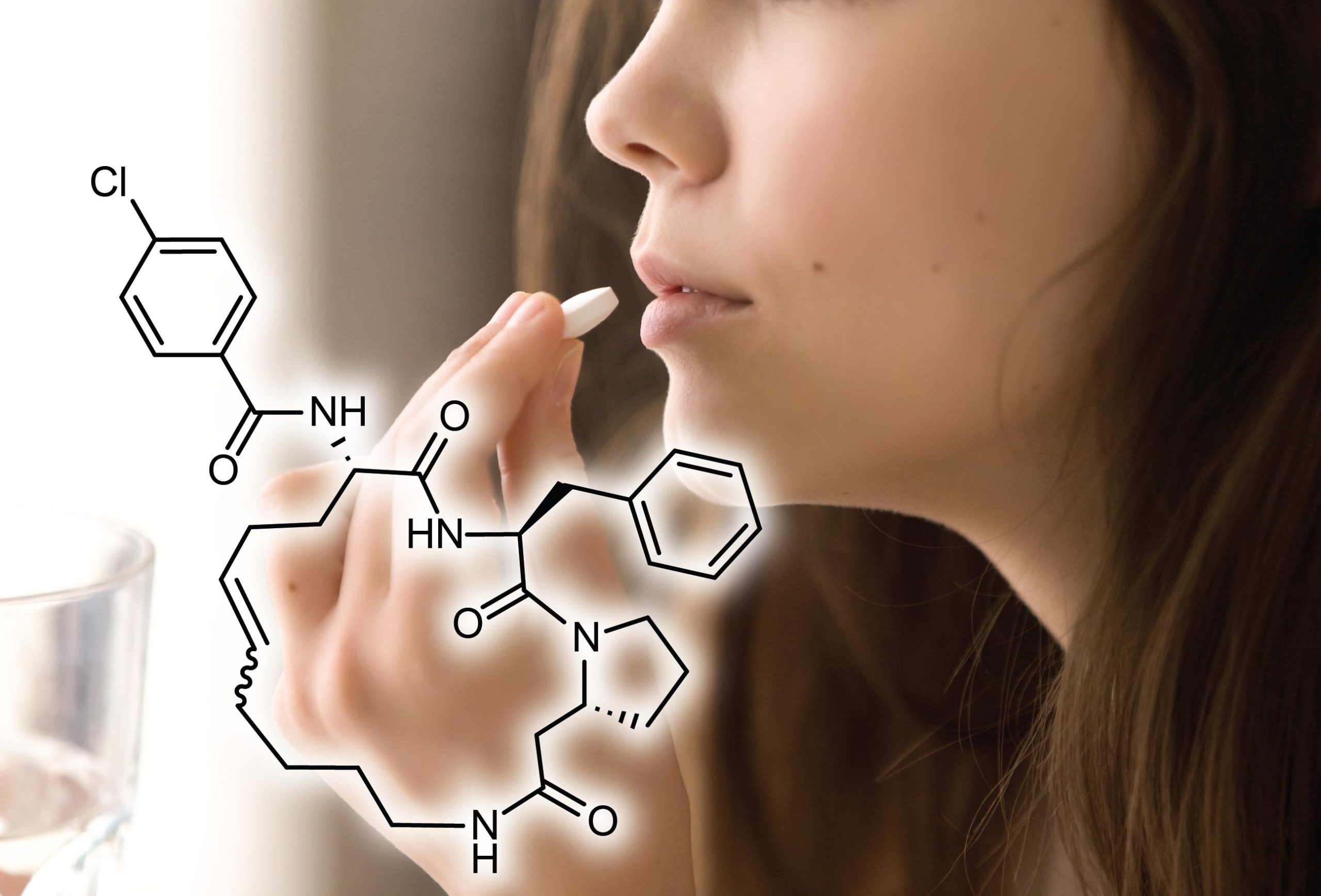
A groundbreaking study at EPFL has led to the development of orally available cyclic peptides, offering new possibilities in drug development for various diseases, especially cancer.
For decades, a substantial number of proteins, vital for treating various diseases, have remained elusive to oral drug therapy. Traditional small molecules often struggle to bind to proteins with flat surfaces or require specificity for particular protein homologs. Typically, larger biologics that can target these proteins demand injection, limiting patient convenience and accessibility.
In a new study published in the journal Nature Chemical Biology, scientists from the laboratory of Professor Christian Heinis at EPFL have achieved a significant milestone in drug development. Their research opens the door to a new class of orally available drugs, addressing a long-standing challenge in the pharmaceutical industry.
“There are many diseases for which the targets were identified but drugs binding and reaching them could not be developed,” says Heinis. “Most of them are types of cancer, and many targets in these cancers are protein-protein interactions that are important for the tumor growth but cannot be inhibited.”
The study focused on cyclic peptides, which are versatile molecules known for their high affinity and specificity in binding challenging disease targets. At the same time, developing cyclic peptides as oral drugs has proven difficult because they are rapidly digested or poorly absorbed by the gastrointestinal tract.
“Cyclic peptides are of great interest for drug development as these molecules can bind to difficult targets for which it has been challenging to generate drugs using established methods,” says Heinis. “But the cyclic peptides cannot usually be administered orally – as a pill – which limits their application enormously.”
Cyclizing Breakthrough
The research team targeted the enzyme thrombin, which is a critical disease target because of its central role in blood coagulation; regulating thrombin is key to preventing and treating thrombotic disorders like strokes and heart attacks.
To generate cyclic peptides that can target thrombin and are sufficiently stable, the scientists developed a two-step combinatorial synthesis strategy to synthesize a vast library of cyclical peptides with thioether bonds, which enhance their metabolic stability when taken orally.
“We have now succeeded in generating cyclic peptides that bind to a disease target of our choice and can also be administered orally,” says Heinis. “To this end, we have developed a new method in which thousands of small cyclic peptides with random sequences are chemically synthesized on a nanoscale and examined in a high-throughput process.”
Two Steps, One Pot
The new method process involves two steps, and takes place in the same reactive container, a feature that chemists refer to as “one pot”.
The first step is to synthesize linear peptides, which then undergo a chemical process of forming a ring-like structure – in technical terms, being “cyclized.” This is done with using “bis-electrophilic linkers” – chemical compounds used to connect two molecular groups together – to form stable thioether bonds.
In the second phase, the cyclized peptides undergo acylation, a process that attaches carboxylic acids to them, further diversifying their molecular structure.
The technique eliminates the need for intermediate purification steps, allowing for high-throughput screening directly in the synthesis plates, combining the synthesis and screening of thousands of peptides to identify candidates with high affinity for specific disease targets – in this case, thrombin.
Using the method, the PhD student leading the project, Manuel Merz, was able to generate a comprehensive library of 8,448 cyclic peptides with an average molecular mass of about 650 Daltons (Da), only slightly above the maximum limit of 500 Da recommended for orally available small molecules.
The cyclic peptides also showed a high affinity for thrombin.
When tested on rats, the peptides showed oral bioavailability up to 18%, which means that when the cyclic peptide drug is taken orally, 18% of it successfully enters the bloodstream and to have a therapeutic effect. Considering that orally administered cyclic peptides generally show a bioavailability below 2%, increasing that number to 18% is a substantial advance for drugs in the biologics category – which includes peptides.
Setting Targets
By enabling the oral availability of cyclic peptides, the team has opened up possibilities for treating a range of diseases that have been challenging to address with conventional oral drugs. The method’s versatility means it can be adapted to target a wide array of proteins, potentially leading to breakthroughs in areas where medical needs are currently unmet.
“To apply the method to more challenging disease targets, such as protein-protein interactions, larger libraries will likely need to be synthesized and studied,” says Manuel Merz. “By automating further steps of the methods, libraries with more than one million molecules seem to be within reach.”
In the next step of this project, the researchers will target several intracellular protein-protein interaction targets for which it has been difficult to develop inhibitors based on classical small molecules. They are confident that orally applicable cyclic peptides can be developed for at least some of them.
Reference: “De novo development of small cyclic peptides that are orally bioavailable” by Manuel L. Merz, Sevan Habeshian, Bo Li, Jean-Alexandre G. L. David, Alexander L. Nielsen, Xinjian Ji, Khaled Il Khwildy, Maury M. Duany Benitez, Phoukham Phothirath and Christian Heinis, 28 December 2023, Nature Chemical Biology.
DOI: 10.1038/s41589-023-01496-y
Never miss a breakthrough: Join the SciTechDaily newsletter.
Follow us on Google and Google News.