
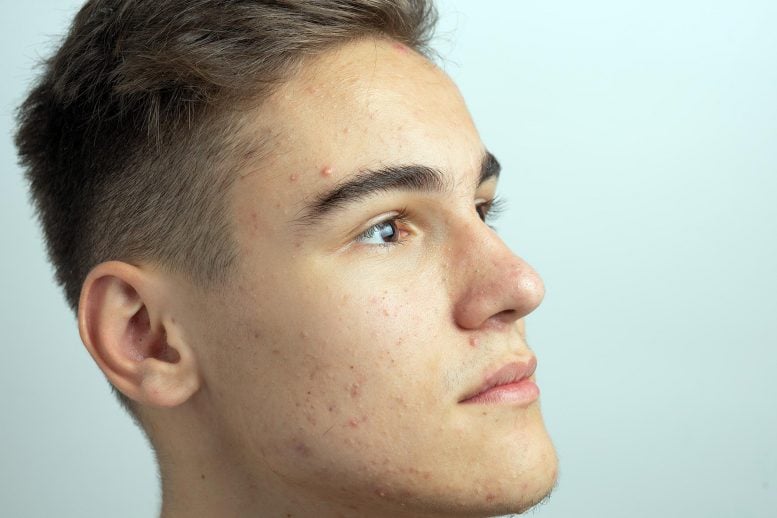
Adolescent acne does not always result in a pathological condition; rather, it may be a natural, transient inflammatory state occurring when the maturing facial skin is exposed to new microbes and enhanced production of an oily substance called sebum, according to a Forum article published on September 26 in the journal Trends in Immunology. The authors argue that their novel framework suggests that the development of new treatments should focus on promoting mechanisms that restore homeostasis between facial skin and its microbial and chemical milieu.
“The main take-home message is that, instead of considering acne as an accidentally occurring disease accompanied by pathological processes, we propose that acne is unavoidable inflammation precipitated by physiological changes of sebaceous skin during adolescence,” says first author Andrea Szegedi of the University of Debrecen in Hungary.
Among various inflammatory skin diseases, acne vulgaris is unique because of its specific localization on skin regions rich in sebum-producing sebaceous glands, its occurrence within a narrow age range associated with puberty, its high prevalence in teenagers, and its frequent resolution. For example, spontaneous remission of acne vulgaris occurs in up to 50% of affected patients, in contrast to other inflammatory skin diseases such as psoriasis and rosacea, which have chronic intermittent courses.
In the short Forum article, Szegedi and her colleagues propose a new concept that might explain why acne is characterized by strong regional and age specificity, prevalent occurrence, and resolution. Based on immunological and dermatological data, they hypothesize that the sudden changes in the composition of the microbiota composition within sebaceous-gland-rich skin during adolescence, accompanied by increased sebum production, may result in an inflammatory response that replaces the previous homeostatic host-microbiota crosstalk, thus leading to acne manifestation.
“Our hypothesis, that acne is a naturally developing, transient inflammation state, rather than a pathological skin disease, challenges conventional thinking,” Szegedi says. “This hypothesis incorporates recent scientific data and may explain special clinical characteristics of acne.”
The authors cite evidence in mice showing that even a short-term encounter with new commensal microbes on the skin can initiate the robust accumulation of T lymphocyte white blood cells producing pro-inflammatory cytokines, including interleukin 17 and interferon-gamma. They also highlight messenger RNA data showing that acne lesions contain more pro-inflammatory cytokines characteristic of host-microbiota interactions than healthy skin.
Moreover, acne-associated bacteria can induce both homeostatic and inflammatory states. For example, Cutibacterium acnes strains associated with acne are capable of activating T cells that produce interleukin 17 and interferon gamma, whereas other C. acnes strains associated with healthy skin promote protective immune responses.
The authors argue that high sebum production in teenagers seems to be essential for the otherwise commensal C. acnes community to initiate inflammation. For example, human macrophages treated with different sebum components secrete significantly elevated concentrations of pro-inflammatory cytokines such as interleukin-1β and tumor necrosis factor-alpha in the presence of C. acnes.
Consistent with their hypothesis, genome-wide association data in adolescents with severe acne suggest that polymorphisms in inflammatory genes, and genes playing a role in the initiation of tolerance, are associated with disease manifestation. However, one limitation of their framework is that it only applies to acne in adolescence, not in childhood or adulthood.
According to the authors, future research should focus on identifying how acne spontaneously resolves, for example, through reduced sebum production, compositional changes in C. acnes strains, the regulation of the skin immune system, or improved skin barrier integrity. “We are convinced that this research will be highly instrumental for the development of new and innovative treatments for acne,” Szegedi says. “Moreover, the mechanisms that initiate, amplify, resolve, or perpetuate acne might have common pathways with diseases that develop in other organ systems, and the knowledge gained on a broader scale on this front may help to better understand a variety of pathological conditions.”
###
This work is supported by a Hungarian Research Grant, the European Union, the European Regional Development Fund, the European Social Fund, the János Bolyai research scholarship of the Hungarian Academy of Sciences, and the UNKP-18-4 New National Excellence Program of the Ministry of Human Capacities.
Reference: “Acne: Transient Arrest in the Homeostatic Host-Microbiota Dialog?” by Andrea Szegedi, Zsolt Dajnoki, Tamás Bíró, Lajos Kemény and Dániel Törőcsik, 26 September 2019, Trends in Immunology.
DOI: 10.1016/j.it.2019.08.006
Never miss a breakthrough: Join the SciTechDaily newsletter.
Follow us on Google and Google News.