
Low tryptophan diets in the elderly disrupt gut health, trigger inflammation, and accelerate aging effects. Tailored microbial metabolites could offer a powerful anti-aging solution.
With age, a diet lacking in the essential amino acid tryptophan — which has a key role in our mood, energy level, and immune response — makes the gut microbiome less protective and increases inflammation body-wide, investigators report.
In a normally reciprocal relationship that appears to go awry with age, sufficient tryptophan, which we consume in foods like milk, turkey, chicken, and oats, helps keep our microbiota healthy.
A healthy microbiota, in turn, helps ensure that tryptophan mainly results in good things for us like producing the neurotransmitter serotonin, which reduces depression risk, and melatonin, which aids a good night’s sleep, says Dr. Sadanand Fulzele, an aging researcher in the Medical College of Georgia Department of Medicine.
Microbiome Disruption and Inflammatory Consequences
But in aged mice, just eight weeks on a low-tryptophan diet results in some unhealthy changes in the trillions of bacteria that comprise the gut microbiota and higher levels of systemic inflammation, they report in the International Journal of Molecular Sciences.
Diet has been directly linked to microbiota composition in humans and rodents, they write, and they were able to document impactful shifts.
For example, when tryptophan levels are low, the MCG investigators found lower levels of Clostridium sp., the bacterium that metabolizes the essential amino acid enabling production of good products like serotonin in the gut, and a threefold increase in the bacterium Acetatifactor, which is associated with intestinal inflammation.
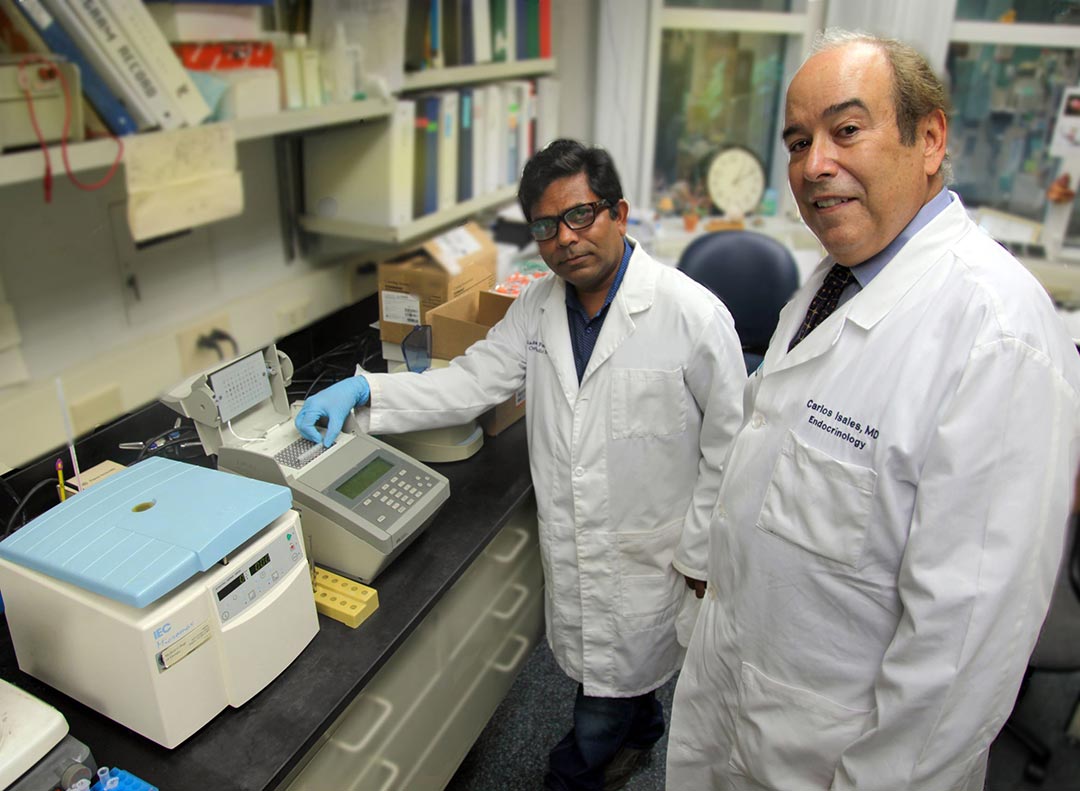
“We think the microbiome plays an important role in the aging process and we think one of those players in the aging is tryptophan, which produces metabolites that affect every organ function,” says Dr. Carlos M. Isales, co-director of the MCG Center for Healthy Aging and chief of the MCG Division of Endocrinology, Diabetes and Metabolism. “We also have evidence that the composition of the bacteria that utilize tryptophan changes so even if you eat more tryptophan, you may not use it correctly,” he says.
Fulzele and Isales are co-corresponding authors of the new study further exploring the relationship between tryptophan, the gut microbiome, and the inflammatory response, in which they fed the aged mice three different diets for eight weeks — diets that were deficient, had recommended levels and high levels of tryptophan.
In the face of low tryptophan, they saw both a direct and indirect impact on the microbiota. These included changes like reduced levels of the bacterium Mucispirillum and Blautia, which play a big role in maintaining microbiota health in humans and animals. Some of these bacteria have also been found to be significantly decreased in patients with Crohn’s and colitis, where inflammation can be rampant. Mucispirillum, for example, resists oxidative “bursts” associated with inflammation and produces numerous factors associated with reducing reactive oxygen species and consequently inflammation.
Inflammatory Cytokines Spike with Deficient Diet
It was the unhealthy changes they saw in the microbiota that made Fulzele, Isales, and their colleagues also suspect increased release of inflammation-promoting signaling molecules called cytokines, hypothesizing that microbiota changes might induce release of the molecules body-wide. They looked specifically at the largely inflammation-promoting IL-17 and IL-1a as well as IL-6 and IL-27, which can both promote and suppress inflammation, in the blood of mice on a low tryptophan diet. They found significant increases of IL-6, IL-17A, and IL-1a and a significant decrease in IL-27, a cytokine that prevents transcription of inflammation-invoking IL-17 and helps do things like increase regulatory T cells in the gut, which suppress inflammation. Conversely, mice on a tryptophan-rich diet had higher levels of the calming IL-27.
Generally, the low-tryptophan diet sets the stage for inflammation body-wide, the investigators say.
When the aged mice resumed a healthy tryptophan intake, some of the unhealthy changes resolved in just a few days, Fulzele notes. But the reality that just increasing tryptophan did not always correct problems, and that some tryptophan metabolites are actually harmful, provides more evidence that a better option is giving select metabolites early on to help keep the microbiota functioning optimally, rather than attempting a tryptophan rescue, the investigators say.
Their current work is further exploring what a good metabolite mix would look like. “We want to define what products that the gut generates that are good versus bad,” Isales says.
The Microbiome’s Role in Aging and Chronic Disease
Each human has a unique microbiota that results from our birth mothers, and can change based on what we consume, breathe in or are otherwise exposed to over time. It is generally considered an organ system that enables us to digest food and has a key role in the immune response and our overall health. The microbiota also should help protect us from the ill effects of environmental exposures at all ages, and from the ravages of aging itself, Isales says.
Those ravages can include a reduced sense of smell, taste, and appetite, and related dietary changes like inadequate or poor nutrition. Also, stem cells throughout the body, which are designed to keep us functioning at a premium by repairing or replacing dysfunctional cells, become less functional because of the cumulative effect of toxins we are exposed to. In a bit of a vicious cycle, our body systems become less efficient, most of us lose lean muscle mass and gain fat, which produces inflammatory molecules, and our weight shifts around so we store more of that fat in and around our abdominal area where it tends to be the most inflammatory and lethal. Fat is also less efficient than lean muscle at burning calories so our metabolism slows, which should, in theory, slow aging, but in the face of other changes mostly cannot.
“Basically your immune system has been dysregulated, you have continued inflammation from damaged tissue by the processes that normally keep you healthy,” Isales says as chronic inflammation can replace the classic episodic immune response that fights infection and enables healing.
What Isales calls this “unnatural” process of aging, is associated with chronic disease conditions like impaired digestive health, declining cognitive function, and a compromised immune system, and he and Fulzele agree that the gut microbiota is a significant modulator of these.
Rethinking “Normal” Aging Through Gut Health
“We accept as normal that your organs stop working as well. We accept that the ejection fraction of your heart drops as you get older. We accept that your brain function decreases as you get older. We accept as normal what is not normal,” says Isales, who along with Fulzele and their other colleagues in the MCG Center for Healthy Aging want to help reestablish for most of us what they consider the ability to live a significantly longer and healthier life.
Amino acids like tryptophan are the building blocks for protein production, and proteins are the products our cells produce, which determine their function and ultimately the function of our organs and tissues.
Reference: “A Tryptophan-Deficient Diet Induces Gut Microbiota Dysbiosis and Increases Systemic Inflammation in Aged Mice” by Ibrahim Yusufu, Kehong Ding, Kathryn Smith, Umesh D. Wankhade, Bikash Sahay, G. Taylor Patterson, Rafal Pacholczyk, Satish Adusumilli, Mark W. Hamrick, William D. Hill, Carlos M. Isales and Sadanand Fulzele, 8 May 2021, International Journal of Molecular Sciences.
DOI: 10.3390/ijms22095005
The research was funded by the National Institute on Aging.
Never miss a breakthrough: Join the SciTechDaily newsletter.
Follow us on Google and Google News.
33 Comments
biota is plural..≥
PERFECT!
Thank you for stating how accepting not normal as normal just because you’re aging is upsidedown. It’s because you’ve lived a long time without balanced nutrition that your system is out of whack. Pills should not be the new normal. That targeted energy boost in chemical form is a stop gap until you’re righted again.
Diet is singular
What besides turkey gives us tryptophan
Sooo… Eating more meat will reduce inflammation. Sounds like a lie
..which we consume in foods like milk, turkey, chicken, and oats
What a interesting and informative article. Really readers, did you need to point out that the word diet is singular and biota is plural. Do you have something positive to say about this discovery? Your talents are being wasted here perhaps you should be tutoring a struggling high school student taking a writing class.
Milk chicken ,and oatmeal
Yes, please tell us what to eat to replace tryptophan in our lacking systems?
I do not eat meat. Thank you very much!
In paragraph 3, calling the Doctor “an aging researcher” is very rude. What is the purpose of pointing out the age of the researcher? The way the sentence is written basically says he is an old man.
“…an aging researcher…” implies he is a researcher on the topic of aging, not a researcher who is aging or getting older. Although, he is aging if he isn’t dead.
Hmm. Just thoughts…Tryptophan deficiency from a Priess-Handler view point, might also be called niacin deficiency. TRP is lost along niacin salvage pathway. Can’t increase blood TRP with TRP, only with niacin and NAM. Good TRP source important, niacin quintessential to acute, chronic dis-ease and cellular senescence. (Sirtuins, Parp etc).
Thanksgiving is medicinal
Tofu, squash, pumpkin seeds and salmon are great sources of tryptophan.
Almonds provide more tryptophan than turkey.
Too much info….who needs to know all this. The keto diet is what I do stay small and healthy. All this info I just read, I already knew naturally but everyone doesn’t understand and your the only way people know this
No support from others. Teach at our schools and I will be happy. Great work!
Plant-based sources of tryptophan include leafy greens, sunflower seeds, watercress, soybeans, pumpkin seeds, mushrooms, broccoli, and peas.
I feel like they dropped the story off right before the section telling us how to increase our digestive tryptophan, thereby improving our overall physical and mental health.
Hilarious comment section!
Healthy nutrition in meats??? Oh my the blasphemy!
You can thank your carnivore ancestors for the brain capacity allowing you to even form an opinion about it.
Belinda knew what she was doing was wrong and deadly she did the same thing to her sister Dolores and to my mother Dorthy Hence the purchase of Herbalife in the state of Illinois under the name Veronica Martinez. Veronica Flores participated in all 3 deaths. I’m alive by the grace of God because they tried killing me there’s even a life insurance in the state of Colorado with my name on it and my son and beneficiary and I never purchased it So it appears I’m next on the list.
Tryptophan deficiency is is the results of the hundreds of endocrine disruptor chemicals in herbicides, insecticides, pesticides, and countless other chemicals that saturate our food. Virtually 95% of all grains have residual toxins by the time they are consumed by humans or livestock. Glyphosate is the worst and most used in the world, billions of gallons used.
I don’t know why people on here are so rude?? Instead being grateful for the effort and hard working hours on the reaching, to benifit these idiots , and don’t cost them any money to get this information!! 🤬🤬 People want everything for free yet so dam rude!!! Go look at your attitudes it stinks!! You don’t desirve a longer healthy life
I just wonder why we are experimenting on mice to find these things out. If only people were in touch with their bodies and kept their own minds, they would know that a good heathy diet and listening to what your body needs is all that is required. We rely far too much on ‘experts’ to tell us the most obvious things these days. The lady that wants to know what to eat who is a vegetarian should eat natural yoghurt in moderation. If anyone has antibiotics, is suffering stress, sickness or diarrhoea should take acidophilus which is a natural healthy bacteria. When you experience any of the above your healthy gut bacteria is lessened or lost. Acidophilus is totally safe and bought from health food shops. Try it and see the difference it makes in just a few days. When you are better, stop taking it and keep in the fridge.
To avoid or minimize adverse effects of tryptophan metabolites vitamin B3 and B6 are crucial but also other elements (do a search for the article “Tryptophan Side Effects: L-Tryptophan Is Far From Harmless”).
They took this amino tryptophan out of most of our foods. That was years ago. Im so glad i found this page.
I got to a turkey farm once a week where they sell all natural turkey product soups, turkey cili, turkey pot pie turkey shephers pie, etc. I buy a few slices with no slime or chemicals roll em up and munch been told I look twenty yre younger even with tragedies I very been through and I have no depression. Slices are large and break up a bit but delicious!
Dear A K, they did not call a doctor an “aging researcher”. The person they refer to specializes in the study of aging, they are an aging researcher. Try not to be so literal and open up your small minds to a world not viewed as a constant threat to our less educated populace.
Seems people missed the crucial statement here ! In order for the guy to work optimally keeping the organism working optimally rather than attempting a “Rescue” by increasing consumption is the most efficient way to maintain gut health
“Dr. Sadanand Fulzele, an aging researcher” should be identified as “Dr. Sadanand Fulzele, a researcher in the study of aging”. As this is a report about science, the least we can do is identify the participants usefully.
Some people are rude because they don’t have another real contribution to offer.
To the persons who say don’t read just listen to your bodies, I hope you always live a healthy life without the help of science.
Is chicken equivalent to turkey? We seem to consume more chicken these day. This is a good topic to debate about meat eater vs the plants base eater😇😀😃😅😂🤣. It all boil down to what we eat and what the crap we added to the food to satisfy our extravagant fancy taste buds and life styles that eventually lead to destroy our guts!
What’s with the grammar lessons, anyway? I reread the article, and was unable to find “diet” not being singular, and as for “biota”, I think that it can be used a a collective noun, like “group”… the biota are, the biota is, depends on the rest of the sentence.