
Close Menu
    Facebook X (Twitter) Instagram
    SciTechDaily
    • Biology
    • Chemistry
    • Earth
    • Health
    • Physics
    • Science
    • Space
    • Technology
    Facebook X (Twitter) Pinterest YouTube RSS
    SciTechDaily
    Home»Space»The Blue Stars of Cluster NGC 2547
    Space

    The Blue Stars of Cluster NGC 2547

    By European Southern ObservatoryMarch 27, 2013No Comments4 Mins Read
    Facebook Twitter Pinterest Telegram LinkedIn WhatsApp Email Reddit
    Share
    Facebook Twitter LinkedIn Pinterest Telegram Email Reddit
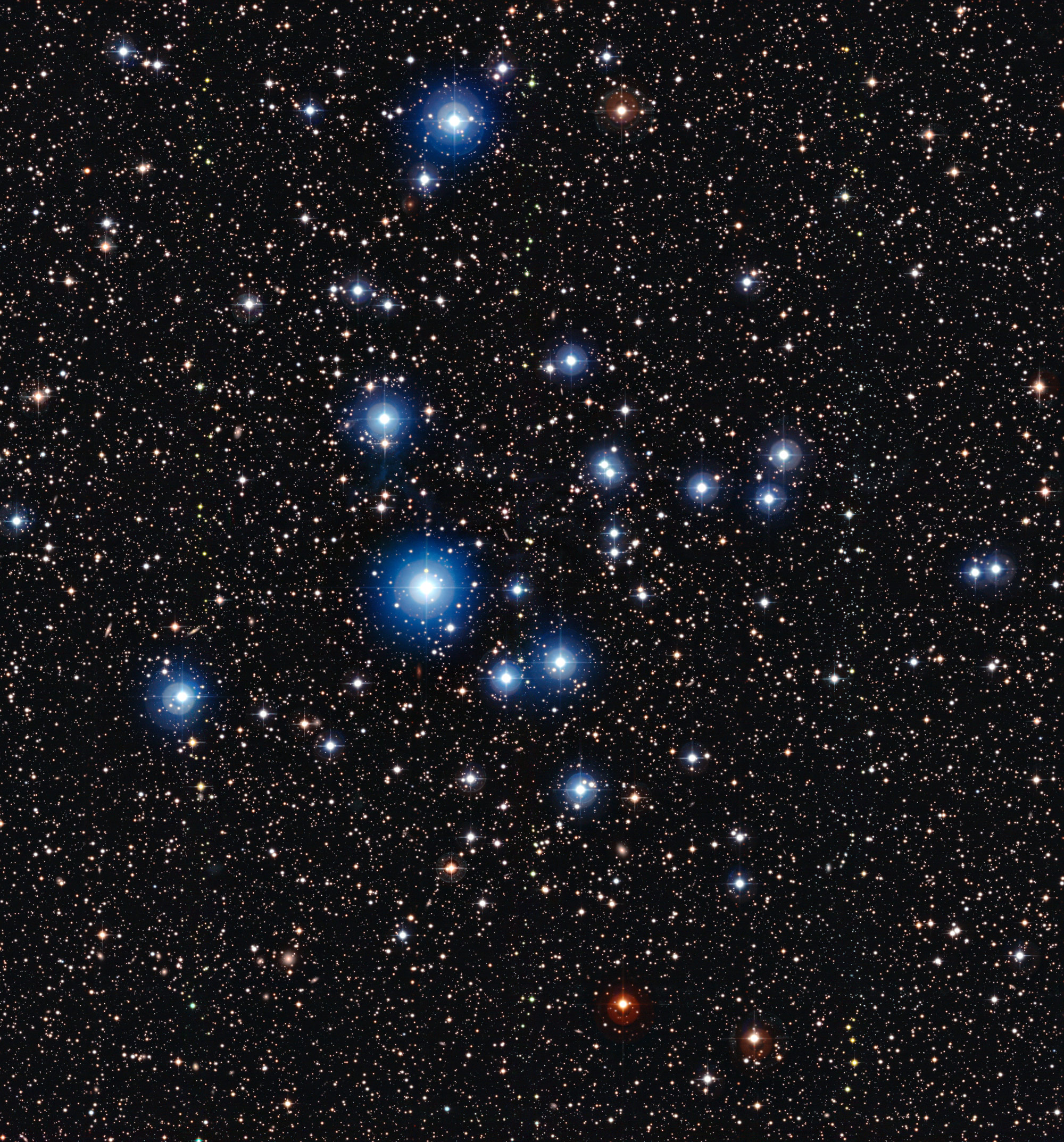
    The Bright Blue Stars of Cluster NGC 2547
    This image from the Wide Field Imager on the MPG/ESO 2.2-meter telescope at ESO’s La Silla Observatory in Chile, shows the bright open star cluster NGC 2547. Between the bright stars, far away in the background of the image, many remote galaxies can be seen, some with clearly spiral shapes. Credit: ESO

    ESO’s La Silla Observatory in Chile captured this new image of blue stars in the open star cluster NGC 2547.

    This pretty sprinkling of bright blue stars is the cluster NGC 2547, a group of recently formed stars in the southern constellation of Vela (The Sail). This image was taken using the Wide Field Imager on the MPG/ESO 2.2-meter (7.2-foot) telescope at ESO’s La Silla Observatory in Chile.

    The Universe is an old neighborhood — roughly 13.8 billion years old. Our galaxy, the Milky Way, is also ancient — some of its stars are more than 13 billion years old. Nevertheless, there is still a lot of action: new objects form, and others are destroyed. In this image, you can see some of the newcomers, the young stars forming the cluster NGC 2547.
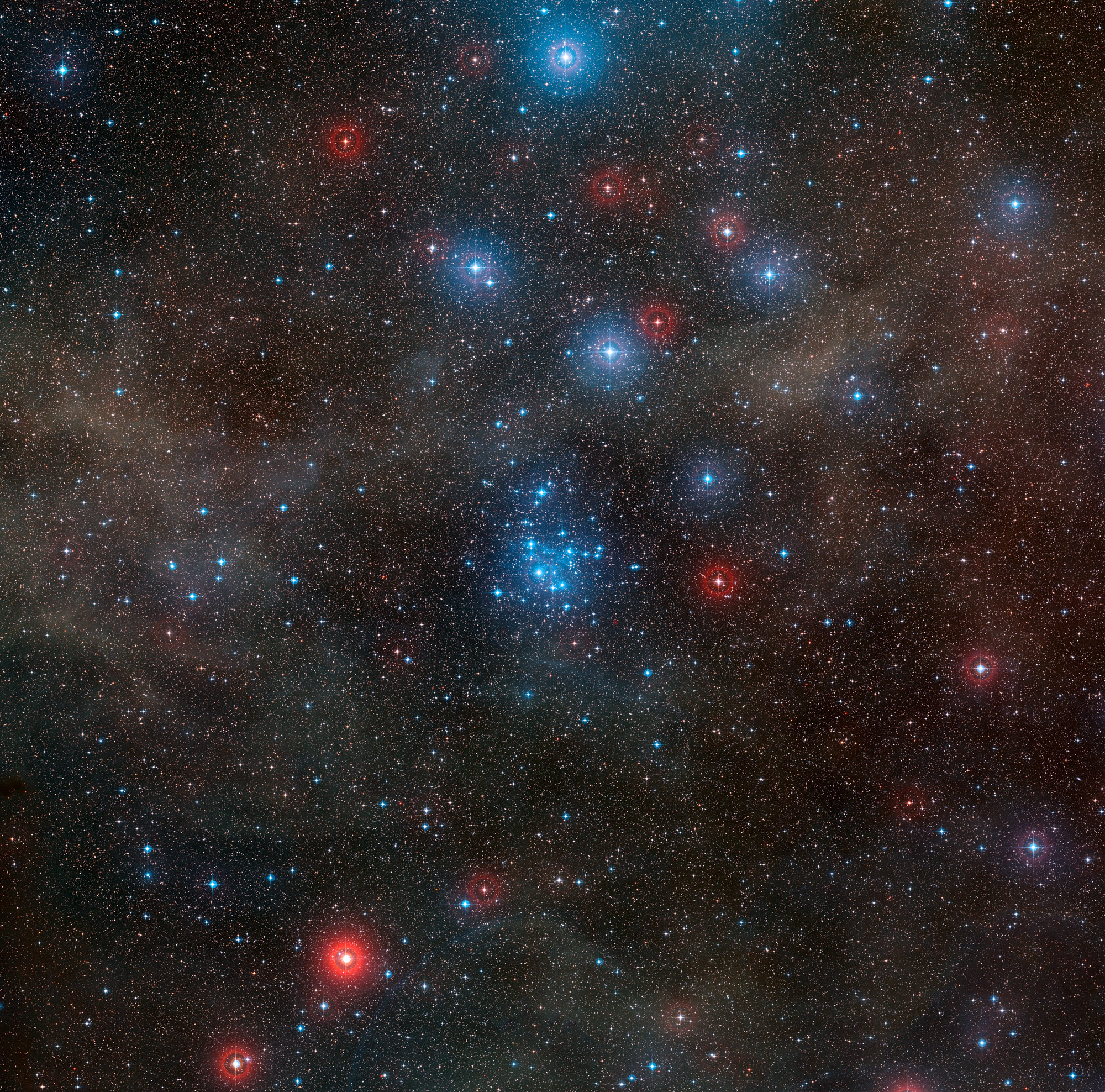
    Wide Field View of the Open Star Cluster NGC 2547
    This picture was created from images forming part of the Digitized Sky Survey 2. It shows the rich region of sky around the young open star cluster NGC 2547 in the southern constellation of Vela (The Sail). Credit: ESO/Digitized Sky Survey 2, Acknowledgment: Davide De Martin

    But, how young are these cosmic youngsters really? Although their exact ages remain uncertain, astronomers estimate that NGC 2547’s stars range from 20 to 35 million years old. That doesn’t sound all that young, after all. However, our Sun is 4,600 million years old and has not yet reached middle age. That means that if you imagine the Sun as a 40-year-old person, the bright stars in the picture are three-month-old babies.


    This video sequence starts with a view of the spectacular Milky Way. As we zoom in, we can see the constellation of Vela (The Sail) and then the bright stars of the cluster NGC 2547 as captured in an image from the MPG/ESO 2.2-meter telescope at ESO’s La Silla Observatory in Chile. Credit: ESO/Nick Risinger (skysurvey.org) Music: movetwo

    Most stars do not form in isolation, but in rich clusters with sizes ranging from several tens to several thousands of stars. While NGC 2547 contains many hot stars that glow bright blue, a telltale sign of their youth, you can also find one or two yellow or red stars that have already evolved to become red giants. Open star clusters like this usually only have comparatively short lives, of the order of several hundred million years, before they disintegrate as their component stars drift apart.

    Clusters are key objects for astronomers studying how stars evolve through their lives. The members of a cluster were all born from the same material at about the same time, making it easier to determine the effects of other stellar properties.


    This pan sequence takes a close look at a new image of the bright open star cluster NGC 2547 from the Wide Field Imager on the MPG/ESO 2.2-meter telescope at ESO’s La Silla Observatory in Chile. Between the bright stars and far away in the background of the image, many remote galaxies can be seen, among them some with clearly spiral shapes. Credit: ESO. Music: movetwo

    The star cluster NGC 2547 lies in the southern constellation of Vela (The Sail), about 1,500 light-years from Earth, and is bright enough to be easily seen using binoculars. It was discovered in 1751 by the French astronomer Nicolas-Louis de Lacaille during an astronomical expedition to the Cape of Good Hope in South Africa, using a tiny telescope of less than two centimeters aperture.

    Between the bright stars in this picture you can see plenty of other objects, especially when zooming in. Many are fainter or more distant stars in the Milky Way, but some, appearing as fuzzy extended objects, are galaxies, located millions of light-years beyond the stars in the field of view.

    Never miss a breakthrough: Join the SciTechDaily newsletter.
    Follow us on Google and Google News.

    Astronomy European Southern Observatory Popular
    Share. Facebook Twitter Pinterest LinkedIn Email Reddit

    Related Articles

    Stunning Galactic Fireworks: New ESO Images Reveal Spectacular Features of Nearby Galaxies

    Astronomers Were Puzzled by “Great Dimming” of Betelgeuse – Now the Mystery Is Solved

    “Big Surprise!” – Heavy Metal Vapors Unexpectedly Found in Comets Throughout Our Solar System – and Beyond

    Mysterious Interstellar Visitor May Be the Most Pristine Comet Ever Found

    Event Horizon Telescope Images Magnetic Fields at the Edge of M87’s Supermassive Black Hole

    “Meteorological Beast in Our Solar System” – Powerful Stratospheric Winds Measured on Jupiter for the First Time

    Astronomers Have Discovered the Most Distant Source of Radio Emission Ever Known – 13 Billion Light-Years Away

    Distant Colliding Galaxy Dying Out As It Loses the Ability to Form Stars – Ejecting 10,000 Suns-Worth of Gas a Year

    Puzzling Six-Exoplanet System Discovered With Resonant Rhythmic Movement

    Leave A Reply Cancel Reply

    • Facebook
    • Twitter
    • Pinterest
    • YouTube

    Don't Miss a Discovery

    Subscribe for the Latest in Science & Tech!

    Trending News

    Scientists Uncover Potential Brain Risks of Popular Fish Oil Supplements

    Scientists Discover a Surprising Way To Make Bread Healthier and More Nutritious

    After 60 Years, Scientists Uncover Unexpected Brain Effects of Popular Diabetes Drug Metformin

    New Research Uncovers Hidden Side Effects of Popular Weight-Loss Drugs

    Scientists Rethink Extreme Warming After Surprising Ocean Discovery

    Landmark Study Links Never Marrying to Significantly Higher Cancer Risk

    Researchers Discover Unknown Beetle Species Just Steps From Their Lab

    Largest-Ever Study Finds Medicinal Cannabis Ineffective for Anxiety, Depression, PTSD

    Follow SciTechDaily
    • Facebook
    • Twitter
    • YouTube
    • Pinterest
    • Newsletter
    • RSS
    SciTech News
    • Biology News
    • Chemistry News
    • Earth News
    • Health News
    • Physics News
    • Science News
    • Space News
    • Technology News
    Recent Posts
    • Scientists Uncover Dangerous Connection Between Serotonin and Heart Valve Disease
    • Scientists Discover a “Protector” Protein That Could Help Reverse Hair Loss
    • Powerful Lasers Reveal How Matter Becomes Plasma in Trillionths of a Second
    • A Simpler Path to Super-Resolution: Scientists Reinvent Microscopy
    • Scientists Uncover Hidden Genetic Cause of Diabetes in Babies
    Copyright © 1998 - 2026 SciTechDaily. All Rights Reserved.
    • Science News
    • About
    • Contact
    • Editorial Board
    • Privacy Policy
    • Terms of Use

    Type above and press Enter to search. Press Esc to cancel.