
Close Menu
    Facebook X (Twitter) Instagram
    SciTechDaily
    • Biology
    • Chemistry
    • Earth
    • Health
    • Physics
    • Science
    • Space
    • Technology
    Facebook X (Twitter) Pinterest YouTube RSS
    SciTechDaily
    Home»Space»Award Winning Image of the Reflection Nebula Messier 78
    Space

    Award Winning Image of the Reflection Nebula Messier 78

    By European Southern Observatory (ESO)February 12, 2013No Comments4 Mins Read
    Facebook Twitter Pinterest Telegram LinkedIn WhatsApp Email Reddit
    Share
    Facebook Twitter LinkedIn Pinterest Telegram Email Reddit
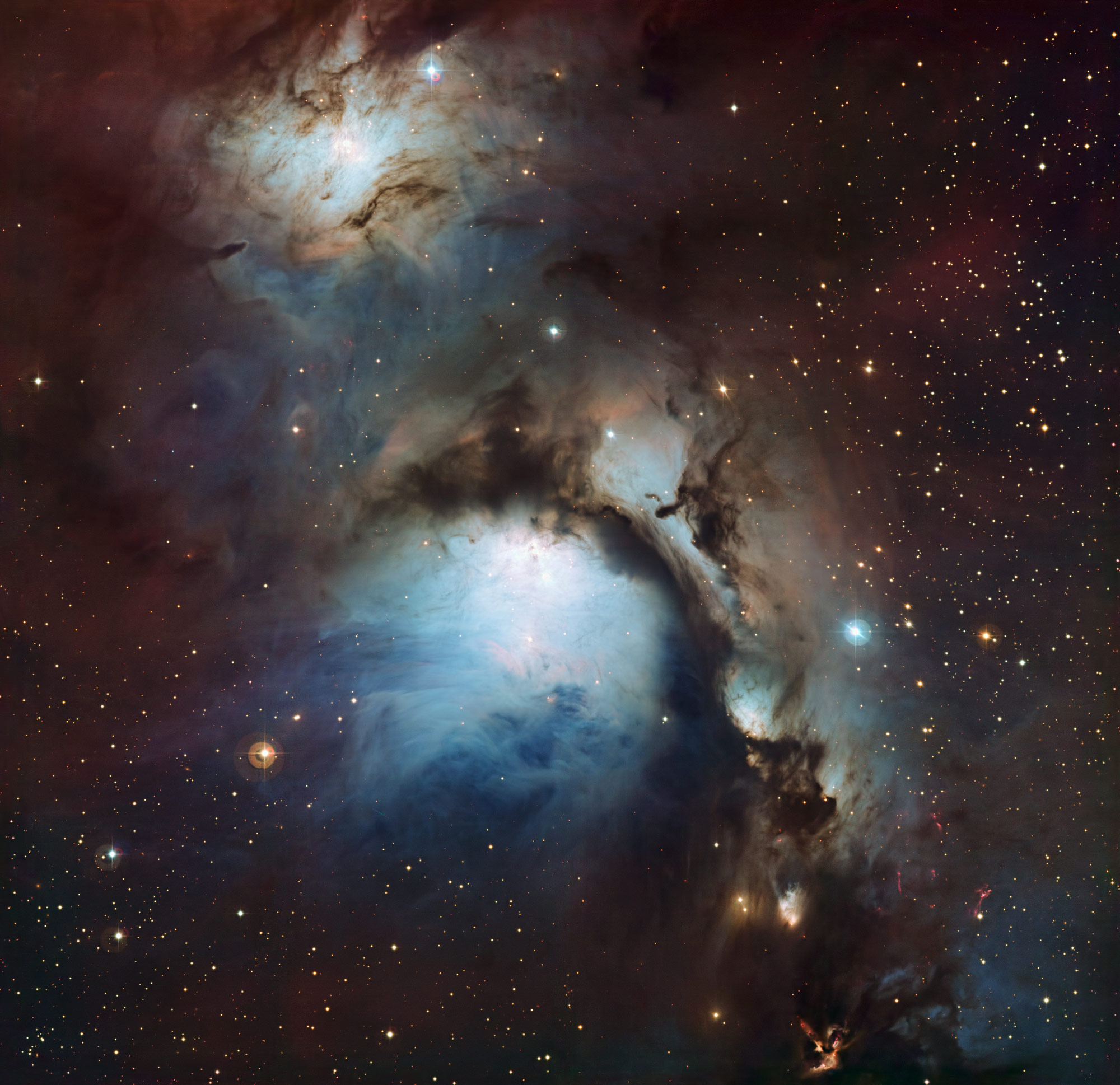
    Reflection Nebula Messier 78
    This new image of the reflection nebula Messier 78 was captured using the Wide Field Imager camera on the MPG/ESO 2.2-meter telescope at the La Silla Observatory, Chile. This color picture was created from many monochrome exposures taken through blue, yellow/green, and red filters, supplemented by exposures through a filter that isolates light from glowing hydrogen gas. The total exposure times were 9, 9, 17.5, and 15.5 minutes per filter, respectively. Credit: ESO/Igor Chekalin

    Based on data from the MPG/ESO 2.2-meter telescope at the La Silla Observatory in Chile, Igor Chekalin created this award-winning image of the reflection nebula Messier 78.

    The nebula Messier 78 takes center stage in this image taken with the Wide Field Imager on the MPG/ESO 2.2-meter telescope at the La Silla Observatory in Chile, while the stars powering the bright display take a backseat. The brilliant starlight ricochets off dust particles in the nebula, illuminating it with scattered blue light. Igor Chekalin was the overall winner of ESO’s Hidden Treasures 2010 astrophotography competition with his image of this stunning object.

    Messier 78 is a fine example of a reflection nebula. The ultraviolet radiation from the stars that illuminate it is not intense enough to ionize the gas to make it glow — its dust particles simply reflect the starlight that falls on them. Despite this, Messier 78 can easily be observed with a small telescope, being one of the brightest reflection nebulae in the sky. It lies about 1350 light-years away in the constellation of Orion (The Hunter) and can be found northeast of the easternmost star of Orion’s belt.

    This new image of Messier 78 from the MPG/ESO 2.2-meter telescope at the La Silla Observatory is based on data selected by Igor Chekalin in his winning entry to the Hidden Treasures competition.[1]

    The pale blue tint seen in the nebula in this picture is an accurate representation of its dominant color. Blue hues are commonly seen in reflection nebulae because of the way the starlight is scattered by the tiny dust particles that they contain: the shorter wavelength of blue light is scattered more efficiently than the longer wavelength red light.

    This image contains many other striking features apart from the glowing nebula. A thick band of obscuring dust stretches across the image from the upper left to the lower right, blocking the light from background stars. In the bottom right corner, many curious pink structures are also visible, which are created by jets of material being ejected from stars that have recently formed and are still buried deep in dust clouds.

    Two bright stars, HD 38563A and HD 38563B, are the main powerhouses behind Messier 78. However, the nebula is home to many more stars, including a collection of about 45 low-mass, young stars (less than 10 million years old) in which the cores are still too cool for hydrogen fusion to start, known as T Tauri stars. Studying T Tauri stars is important for understanding the early stages of star formation and how planetary systems are created.

    Remarkably, this complex of nebulae has also changed significantly in the last ten years. In February 2004 the experienced amateur observer Jay McNeil took an image of this region with a 75 mm telescope and was surprised to see a bright nebula — the prominent fan-shaped feature near the bottom of this picture — where nothing was seen on most earlier images. This object is now known as McNeil’s Nebula and it appears to be a highly variable reflection nebula around a young star.

    This color picture was created from many monochrome exposures taken through blue, yellow/green, and red filters, supplemented by exposures through an H-alpha filter that shows light from glowing hydrogen gas. The total exposure times were 9, 9, 17.5, and 15.5 minutes per filter, respectively.

    Notes

    1. Igor Chekalin from Russia uncovered the raw data for this image of Messier 78 in ESO’s archives in the competition Hidden Treasures (eso1102). He processed the raw data with great skill, claiming first prize in the contest for his final image (Flickr link). ESO’s team of in-house image processing experts then independently processed the raw data at full resolution to produce the image shown here.

    Never miss a breakthrough: Join the SciTechDaily newsletter.
    Follow us on Google and Google News.

    Astronomy European Southern Observatory Popular
    Share. Facebook Twitter Pinterest LinkedIn Email Reddit

    Related Articles

    Stunning Galactic Fireworks: New ESO Images Reveal Spectacular Features of Nearby Galaxies

    Astronomers Were Puzzled by “Great Dimming” of Betelgeuse – Now the Mystery Is Solved

    “Big Surprise!” – Heavy Metal Vapors Unexpectedly Found in Comets Throughout Our Solar System – and Beyond

    Mysterious Interstellar Visitor May Be the Most Pristine Comet Ever Found

    Event Horizon Telescope Images Magnetic Fields at the Edge of M87’s Supermassive Black Hole

    “Meteorological Beast in Our Solar System” – Powerful Stratospheric Winds Measured on Jupiter for the First Time

    Astronomers Have Discovered the Most Distant Source of Radio Emission Ever Known – 13 Billion Light-Years Away

    Distant Colliding Galaxy Dying Out As It Loses the Ability to Form Stars – Ejecting 10,000 Suns-Worth of Gas a Year

    Puzzling Six-Exoplanet System Discovered With Resonant Rhythmic Movement

    Leave A Reply Cancel Reply

    • Facebook
    • Twitter
    • Pinterest
    • YouTube

    Don't Miss a Discovery

    Subscribe for the Latest in Science & Tech!

    Trending News

    Breakthrough Bowel Cancer Trial Leaves Patients Cancer-Free for Nearly 3 Years

    Natural Compound Shows Powerful Potential Against Rheumatoid Arthritis

    100,000-Year-Old Neanderthal Fossils in Poland Reveal Unexpected Genetic Connections

    Simple “Gut Reset” May Prevent Weight Gain After Ozempic or Wegovy

    2.8 Days to Disaster: Scientists Warn Low Earth Orbit Could Suddenly Collapse

    Common Food Compound Shows Surprising Power Against Superbugs

    5 Simple Ways To Remember More and Forget Less

    The Atomic Gap That Could Cost the Semiconductor Industry Billions

    Follow SciTechDaily
    • Facebook
    • Twitter
    • YouTube
    • Pinterest
    • Newsletter
    • RSS
    SciTech News
    • Biology News
    • Chemistry News
    • Earth News
    • Health News
    • Physics News
    • Science News
    • Space News
    • Technology News
    Recent Posts
    • Powerful Antioxidant Found To Play a Key Role in Proper Protein Folding
    • MIT Laser Breakthrough Lets Scientists Watch Drugs Enter the Brain in Real Time
    • Study Reveals Malaria’s Hidden Role in Human Evolution
    • Scientists Print Artificial Neurons That Can Talk to the Brain
    • Bowel and Ovarian Cancers Are Dramatically Rising in Young Adults and Scientists Aren’t Sure Why
    Copyright © 1998 - 2026 SciTechDaily. All Rights Reserved.
    • Science News
    • About
    • Contact
    • Editorial Board
    • Privacy Policy
    • Terms of Use

    Type above and press Enter to search. Press Esc to cancel.