
Close Menu
    Facebook X (Twitter) Instagram
    SciTechDaily
    • Biology
    • Chemistry
    • Earth
    • Health
    • Physics
    • Science
    • Space
    • Technology
    Facebook X (Twitter) Pinterest YouTube RSS
    SciTechDaily
    Home»Space»ESA’s Rosetta Spacecraft Gets First Glimpse of Comet Churyumov-Gerasimenko
    Space

    ESA’s Rosetta Spacecraft Gets First Glimpse of Comet Churyumov-Gerasimenko

    By Max Planck InstituteApril 1, 2014No Comments4 Mins Read
    Facebook Twitter Pinterest Telegram LinkedIn WhatsApp Email Reddit
    Share
    Facebook Twitter LinkedIn Pinterest Telegram Email Reddit
    Rosetta Views Comet Churyumov Gerasimenko
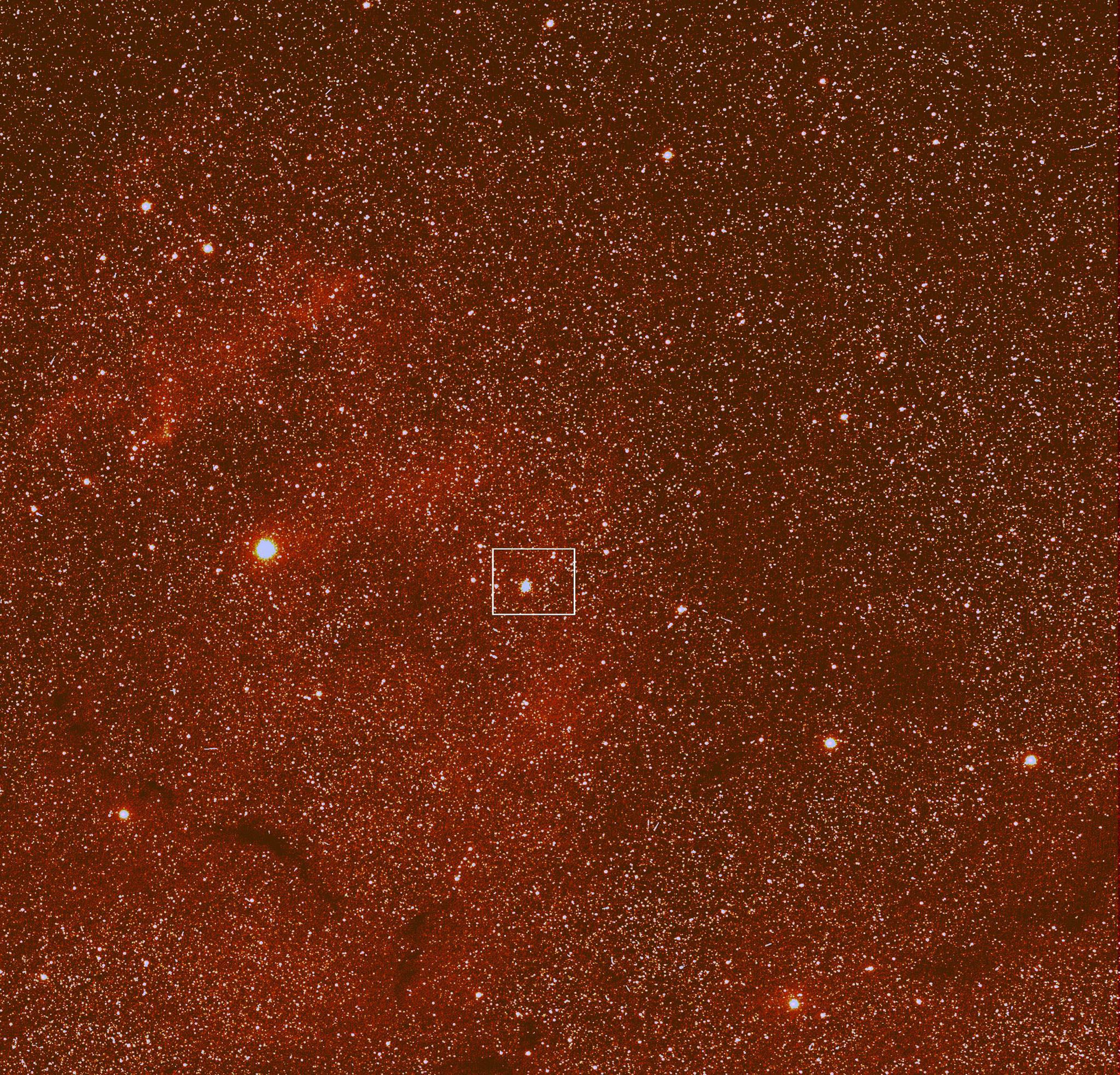
    Compet in sight: these images show the comet 67P/Churymov-Gerasimenko in the constellation Ophiuchus. The top image was taken with the Wide Angle Camera on March 20 shows a wide field 25 times larger than the diameter of the full moon. The color composite shows a background of hydrogen gas and dust clouds in the constellation Ophiuchus. The white box indicates the position of the close-up taken with the Narrow Angle Camera (right). Bottom: A zoom into an image taken with the Narrow Angle Camera on March 21. The comet is indicated by the small circle next to the bright globular star cluster M107. The images were taken from about 5 million kilometers (3 million miles) distance to the comet. Rosetta was at a distance of approx. 660 million kilometers from Earth. Credit: ESA / 2014 MPS for OSIRIS-Team MPS/UPD/LAM/IAA/SSO/INTA/UPM/DASP/IDA

    Researchers use the scientific imaging system on board ESA’s Rosetta spacecraft to get the first glimpse of comet Churyumov-Gerasimenko.

    A little more than four months before the arrival of ESA’s spacecraft Rosetta at the comet 67P/Churyumov-Gerasimenko researchers led by the Max Planck Institute for Solar System Research (MPS) have successfully commissioned OSIRIS, the space probe’s scientific imaging system. Since June 2011 the instrument had been switched off in order to save energy during the last part of Rosetta’s ten-year journey through space. Now, OSIRIS is again providing the researchers with images. In the first shots, however, the target comet covers only a fraction of a pixel.

    After the wake-up call on 20 January 2014 tore Rosetta from its more than 30 months of hibernation, all technical systems and scientific instruments are gradually being awakened to life. In the past days, it was the turn of the orbiter’s scientific imaging system OSIRIS. “The instrument has apparently survived its time-out in good shape. Everything is working as expected”, says Principal Investigator Holger Sierks from the MPS.

    The first images of comet 67P/Churyumov-Gerasimenko confirm this. At this point, more than five million kilometers are still separating comet and spacecraft. The comet therefore fills only a fraction of a pixel. Since, in addition, the body is still rather dim, long exposures of 60 to 300 seconds and additional steps of image processing were necessary in order to make it visible.

    “Finally seeing our target after a ten year’s journey through space is an incredible feeling”, says Sierks. “These first images taken from such a huge distance show us that OSIRIS is ready for the upcoming adventure. Soon we will see the comet’s activity awakening”, he adds.

    During its long journey through the solar system, OSIRIS has already demonstrated its capabilities on several occasions: the instrument provided impressive images during flybys of Earth and Mars and was able to scientifically study the asteroids Steins and Lutetia.

    In the coming months, OSIRIS will again allow insights into a new world: At first, the shots will help to assess the comet’s activity by its brightness; from mid-July the images will allow to assess the body’s shape.

    During the mission, the camera system will visualize structures in the so-called coma, the atmosphere of the comet, and examine the topography and composition of the comet’s surface. As of the summer of this year, one of the main focuses will be on the search for a suitable landing site for Rosetta’s lander Philae. Philae is scheduled to touch-down on the comet’s surface in November 2014.

    More info:

    Rosetta is an ESA mission with contributions from its member states and NASA. Rosetta will be the first mission in history to rendezvous with a comet, escort it as it orbits the Sun, and deploy a lander to its surface.

    The scientific imaging system OSIRIS was built by a consortium led by the Max Planck Institute for Solar System Research (Germany) in collaboration with CISAS, University of Padova (Italy), the Laboratoire d’Astrophysique de Marseille (France), the Instituto de Astrofísica de Andalucia, CSIC (Spain), the Research and Scientific Support Department of the European Space Agency (The Netherlands), the Instituto Nacional de Técnica Aeroespacial (Spain), the Universidad Politéchnica de Madrid (Spain), the Department of Physics and Astronomy of Uppsala University (Sweden), and the Institute of Computer and Network Engineering of the TU Braunschweig (Germany).

    Never miss a breakthrough: Join the SciTechDaily newsletter.
    Follow us on Google and Google News.

    Astronomy Comet European Space Agency Max Planck Institute
    Share. Facebook Twitter Pinterest LinkedIn Email Reddit

    Related Articles

    Philae Lander Makes Soft Landing on Comet 67P

    Rosetta Spacecraft Picks Up a Mysterious “Song” From Comet 67P

    How to Land on a Comet Moving 40 Times Faster Than a Speeding Bullet

    High-Resolution Images Reveal Surface of Comet 67P/Churyumov-Gerasimenko

    Rosetta Orbiter Delivers First Batch of Science Data

    ESA Identifies Five Candidate Landing Sites on Comet 67P

    Rosetta Becomes the First Spacecraft to Rendezvous with a Comet

    ESA’s Rosetta Spacecraft Witnesses the Awakening of the Mission’s Target Comet

    Rainbow-Like Light Phenomenon Observed on Venus for the First Time

    Leave A Reply Cancel Reply

    • Facebook
    • Twitter
    • Pinterest
    • YouTube

    Don't Miss a Discovery

    Subscribe for the Latest in Science & Tech!

    Trending News

    Largest-Ever Study Finds Medicinal Cannabis Ineffective for Anxiety, Depression, PTSD

    250-Million-Year-Old Egg Solves One of Evolution’s Biggest Mysteries

    Living With Roommates Might Be Changing Your Gut Microbiome Without You Knowing

    Century-Old Cleaning Chemical Linked to 500% Increased Risk of Parkinson’s Disease

    What if Your Memories Never Happened? Physicists Take a New Look at the Boltzmann Brain Paradox

    One of the Universe’s Largest Stars May Be Getting Ready To Explode

    Scientists Discover Enzyme That Could Supercharge Ozempic-Like Weight Loss Drugs

    Popular Sweetener Linked to DNA Damage – “It’s Something You Should Not Be Eating”

    Follow SciTechDaily
    • Facebook
    • Twitter
    • YouTube
    • Pinterest
    • Newsletter
    • RSS
    SciTech News
    • Biology News
    • Chemistry News
    • Earth News
    • Health News
    • Physics News
    • Science News
    • Space News
    • Technology News
    Recent Posts
    • A Simpler Path to Super-Resolution: Scientists Reinvent Microscopy
    • Scientists Uncover Hidden Genetic Cause of Diabetes in Babies
    • Amazonian Chocolate Could Become the Next Superfood, Scientists Say
    • Challenging the Narrative: New Study Shows U.S. Life Expectancy Is Rising Across All States
    • Mystery Illness Kills 5 in Burundi As Doctors Scramble for Answers
    Copyright © 1998 - 2026 SciTechDaily. All Rights Reserved.
    • Science News
    • About
    • Contact
    • Editorial Board
    • Privacy Policy
    • Terms of Use

    Type above and press Enter to search. Press Esc to cancel.