
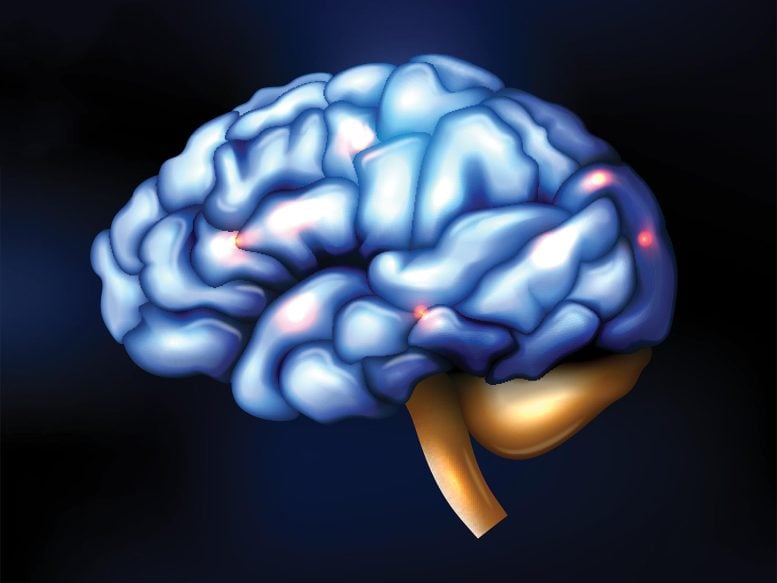
An international team of scientists has identified a gene in the brain linked to anxiety symptoms, with modifications to this gene shown to reduce anxiety levels.
A gene in the brain driving anxiety symptoms has been identified by an international team of scientists. Critically, modification of the gene is shown to reduce anxiety levels, offering an exciting novel drug target for anxiety disorders. The discovery, led by researchers at the Universities of Bristol and Exeter, was published on April 25 in the journal Nature Communications.
Anxiety disorders are common with 1 in 4 people diagnosed with a disorder at least once in their lifetime. Severe psychological trauma can trigger genetic, biochemical, and morphological changes in neurons in the brain’s amygdala — the brain region implicated in stress-induced anxiety, leading to the onset of anxiety disorders, including panic attacks and post-traumatic stress disorder.
However, the efficacy of currently available anti-anxiety drugs is low with more than half of patients not achieving remission following treatment. Limited success in developing potent anxiolytic (anti-anxiety) drugs is a result of our poor understanding of the neural circuits underlying anxiety and molecular events resulting in stress-related neuropsychiatric states.
Uncovering Molecular Events Behind Anxiety
In this study, scientists sought to identify the molecular events in the brain that underpin anxiety. They focused on a group of molecules, known as miRNAs in animal models. This important group of molecules, also found in the human brain, regulates multiple target proteins controlling the cellular processes in the amygdala.
Following acute stress, the team found an increased amount of one type of molecule called miR483-5p in a mouse amygdala. Importantly, the team showed that increased miR483-5p suppressed the expression of another gene, Pgap2, which in turn drives changes to neuronal morphology in the brain and behavior associated with anxiety. Together, the researchers showed that miR-483-5p acts as a molecular brake that offsets stress-induced amygdala changes to promote anxiety relief.
The discovery of a novel amygdala miR483-5p/Pgap2 pathway through which the brain regulates its response to stress is the first stepping stone towards the discovery of novel, more potent, and much-needed treatments for anxiety disorders that will enhance this pathway.
Dr. Valentina Mosienko, one of the study’s lead authors and an MRC Fellow and Lecturer in Neuroscience in Bristol’s School of Physiology, Pharmacology and Neuroscience, said: “Stress can trigger the onset of a number of neuropsychiatric conditions that have their roots in an adverse combination of genetic and environmental factors. While low levels of stress are counterbalanced by the natural capacity of the brain to adjust, severe or prolonged traumatic experiences can overcome the protective mechanisms of stress resilience, leading to the development of pathological conditions such as depression or anxiety.
“miRNAs are strategically poised to control complex neuropsychiatric conditions such as anxiety. But the molecular and cellular mechanisms they use to regulate stress resilience and susceptibility were until now, largely unknown. The miR483-5p/Pgap2 pathway we identified in this study, activation of which exerts anxiety-reducing effects, offers a huge potential for the development of anti-anxiety therapies for complex psychiatric conditions in humans.”
Reference: “miR-483-5p offsets functional and behavioural effects of stress in male mice through synapse-targeted repression of Pgap2 in the basolateral amygdala” by Mariusz Mucha, Anna E. Skrzypiec, Jaison B. Kolenchery, Valentina Brambilla, Satyam Patel, Alberto Labrador-Ramos, Lucja Kudla, Kathryn Murrall, Nathan Skene, Violetta Dymicka-Piekarska, Agata Klejman, Ryszard Przewlocki, Valentina Mosienko and Robert Pawlak, 25 April 2023, Nature Communications.
DOI: 10.1038/s41467-023-37688-2
The research was funded by the Medical Research Council, Academy of Medical Sciences, Leverhulme Trust, Marie Sklodowska-Curie, and the Polish National Science Centre.
Never miss a breakthrough: Join the SciTechDaily newsletter.
Follow us on Google and Google News.