
Close Menu
    Facebook X (Twitter) Instagram
    SciTechDaily
    • Biology
    • Chemistry
    • Earth
    • Health
    • Physics
    • Science
    • Space
    • Technology
    Facebook X (Twitter) Pinterest YouTube RSS
    SciTechDaily
    Home»Space»The James Webb Space Telescope at Orbital Destination L2 [Video]
    Space

    The James Webb Space Telescope at Orbital Destination L2 [Video]

    By NASA's Goddard Space Flight CenterJanuary 26, 2022No Comments2 Mins Read
    Facebook Twitter Pinterest Telegram LinkedIn WhatsApp Email Reddit
    Share
    Facebook Twitter LinkedIn Pinterest Telegram Email Reddit
    Webb Wallpaper
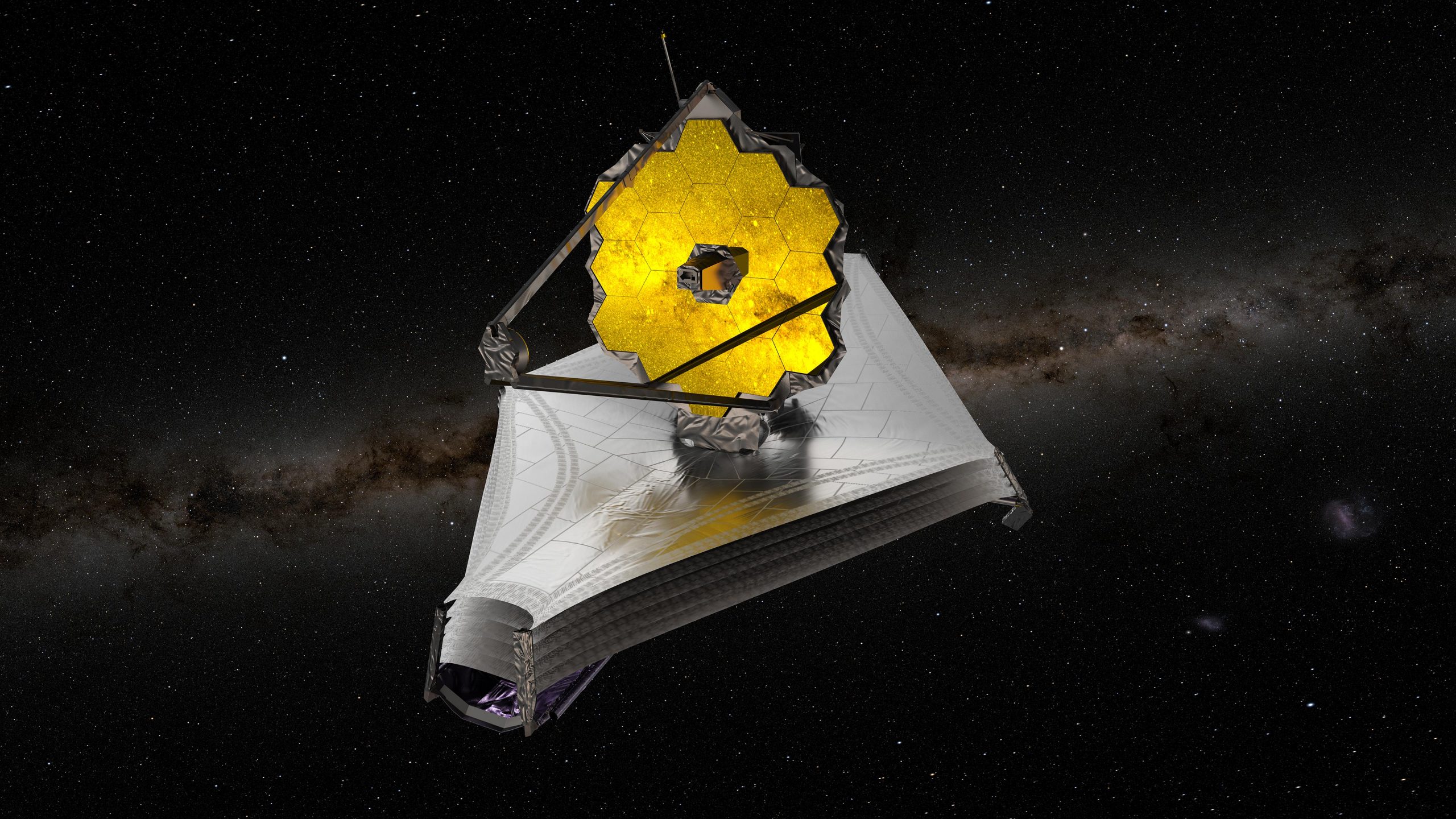
    The James Webb Space Telescope is the next great space science observatory following Hubble, designed to answer outstanding questions about the Universe and to make breakthrough discoveries in all fields of astronomy. Webb will see farther into our origins: from the formation of stars and planets, to the birth of the first galaxies in the early Universe. Credit: ESA/ATG medialab

    After launch, the James Webb Space Telescope traveled to its orbital destination. Webb will perform its science mission while orbiting a location in space, called the second Lagrange point, or L2 for short. L2 is located one million miles from Earth.

    As Webb orbits L2, the telescope stays in line with Earth as it travels around the Sun. L2 is a point where the gravitational influences of the Earth and Sun balance the centripetal force of a small object orbiting with them.

    The telescope’s optics and instruments need to be kept very cold to be able to observe the very faint infrared signals of very distant objects clearly. This location is perfect for Webb’s sunshield to block out light and heat from the Sun, Earth, and Moon. Unlike the Hubble Space Telescope, Webb’s orbit keeps the spacecraft out of the Earth’s shadow making L2 a thermally stable location for the observatory to operate at.

    Webb will operate within its field of regard. The “field of regard” refers to the angles the telescope can move while staying in the shadow of the Sun. Each of Webb’s instruments has its own field of view. The field of view is the area of sky an instrument can observe. Webb’s fine steering mirror is moved so that an object can be observed by the different instruments. This prevents the whole telescope from having to repoint itself to do so.

    The Webb Telescope’s commissioning process will be complete approximately six months after launch, at which time Webb start its science mission. Helping to uncover more of the mysteries of our Universe.

    Never miss a breakthrough: Join the SciTechDaily newsletter.
    Follow us on Google and Google News.

    Astronomy James Webb Space Telescope NASA NASA Goddard Space Flight Center
    Share. Facebook Twitter Pinterest LinkedIn Email Reddit

    Related Articles

    NASA’s Webb Telescope Reveals an Eerie Nebula That Looks Like a Giant Brain

    Webb Telescope Uncovers Star Birth Struggles in a Magnetic Maze at the Milky Way’s Core

    Webb Space Telescope Uncovers Star Birth Secrets at Galaxy’s Edge

    NASA’s James Webb Space Telescope Completes First Full Systems Evaluation

    NASA Gravity Assist: Puffy Planets and Powerful Telescopes

    NASA’s James Webb Space Telescope Fully Stowed in Launch Configuration

    NASA’s New $10 Billion Space Telescope Successfully Deploys Massive Mirror

    NASA’s New Star-Watching Technology Has Thousands of Tiny Shutters

    NASA’s Webb Telescope Will Penetrate Space Dust to Reveal Milky Way’s Center

    Leave A Reply Cancel Reply

    • Facebook
    • Twitter
    • Pinterest
    • YouTube

    Don't Miss a Discovery

    Subscribe for the Latest in Science & Tech!

    Trending News

    Largest-Ever Study Finds Medicinal Cannabis Ineffective for Anxiety, Depression, PTSD

    250-Million-Year-Old Egg Solves One of Evolution’s Biggest Mysteries

    Living With Roommates Might Be Changing Your Gut Microbiome Without You Knowing

    Century-Old Cleaning Chemical Linked to 500% Increased Risk of Parkinson’s Disease

    What if Your Memories Never Happened? Physicists Take a New Look at the Boltzmann Brain Paradox

    One of the Universe’s Largest Stars May Be Getting Ready To Explode

    Scientists Discover Enzyme That Could Supercharge Ozempic-Like Weight Loss Drugs

    Popular Sweetener Linked to DNA Damage – “It’s Something You Should Not Be Eating”

    Follow SciTechDaily
    • Facebook
    • Twitter
    • YouTube
    • Pinterest
    • Newsletter
    • RSS
    SciTech News
    • Biology News
    • Chemistry News
    • Earth News
    • Health News
    • Physics News
    • Science News
    • Space News
    • Technology News
    Recent Posts
    • Scientists Find Way to Reverse Fatty Liver Disease Without Changing Diet
    • Could Humans Regrow Limbs? New Study Reveals Promising Genetic Pathway
    • Black Hole Jets Pack Power of 10,000 Suns, Stunning New Study Reveals
    • A Cosmic Crash Turned This Nearby Galaxy Into Chaos
    • This Alien Solar System Doesn’t Follow the Rules – and Scientists Are Intrigued
    Copyright © 1998 - 2026 SciTechDaily. All Rights Reserved.
    • Science News
    • About
    • Contact
    • Editorial Board
    • Privacy Policy
    • Terms of Use

    Type above and press Enter to search. Press Esc to cancel.