
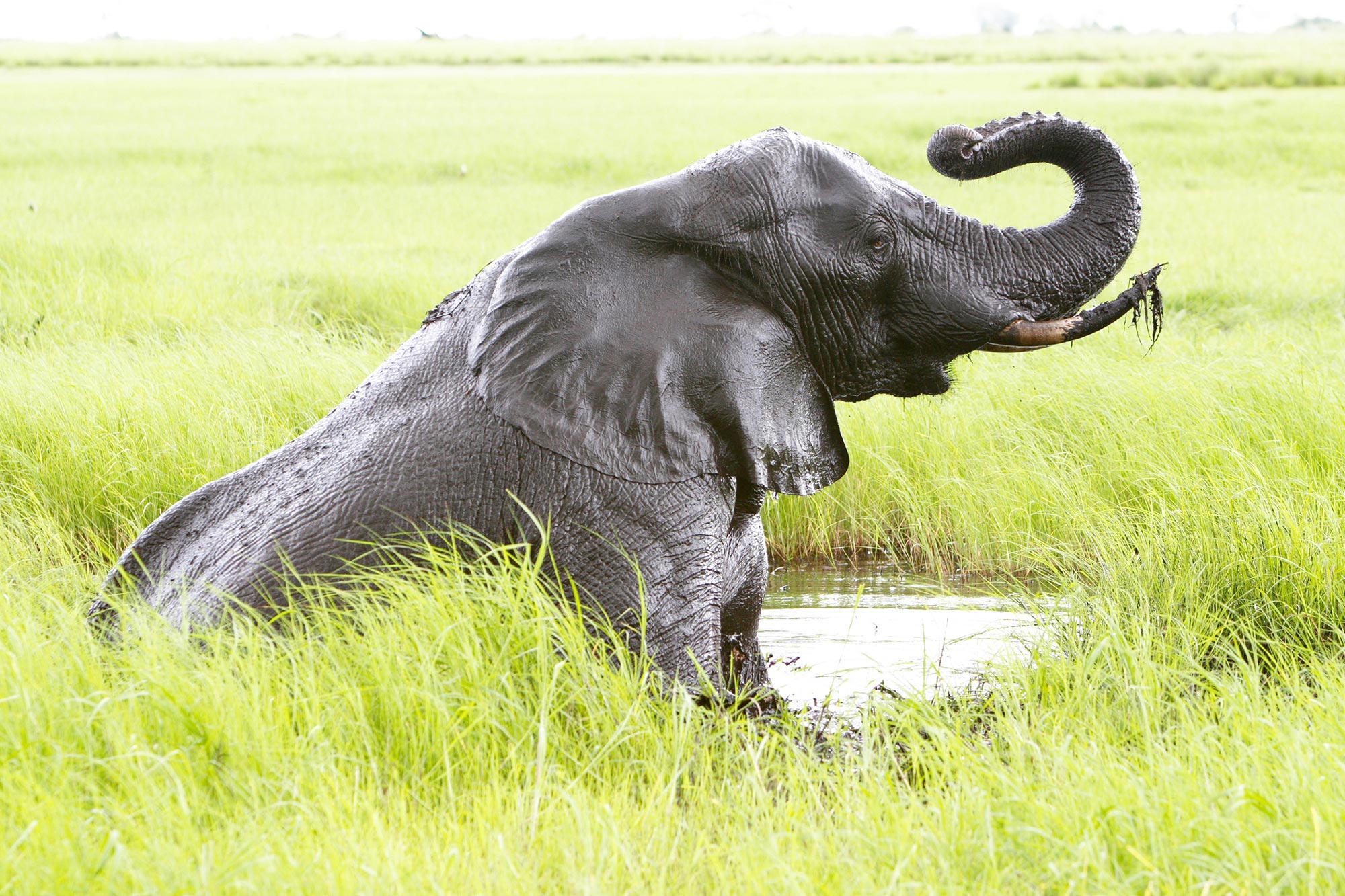
Male elephants in Etosha National Park, Namibia, use “let’s go” rumbles to coordinate group departures, a complex vocal behavior previously attributed only to females.
This discovery, based on a 20-year study, highlights the intricate social structures and vocal abilities of male elephants, suggesting a deeper level of communication and learning within their groups.
Elephant Communication at the Waterhole
The bull elephants gather in the evening coolness to drink. After a spell, a senior male lifts his head and turns from the waterhole. With ears flapping gently, he lets out a deep, resonant rumble.
One by one, the others respond, their voices overlapping in a sonorous, infrasonic chorus that whispers across the savanna. This elephant barbershop quartet conveys a clear message: It’s time to move on.
Gradually, the elephants shift, their massive bodies swaying as they follow their rumbling leader to the next stop on their nocturnal wanderings.
For the first time, scientists from Stanford University and other institutions have documented male elephants using “let’s go” rumbles to signal the start of group departures from the Mushara waterhole in Etosha National Park, Namibia. The vocalizations are initiated by the most socially integrated, and often the most dominant, males in close-knit social groups.
The findings, detailed in the open-access journal PeerJ, are surprising because this behavior was previously thought to be exclusive to female elephants in family groups.
“We were astonished to find that male elephants, typically considered to have loose social ties, engage in such sophisticated vocal coordination to trigger action,” said study lead author Caitlin O’Connell-Rodwell, a research associate at Stanford University’s Center for Conservation Biology. “These calls show us that there’s much more going on within their vocal communication than has previously been known.”
Listen to a recording of a male elephant Let’s Go Rumble. Credit: Caitlin O’Connell-Rodwell
A 20-Year Project
O’Connell-Rodwell first recorded the male “let’s go” rumble in 2004 while conducting fieldwork at night to understand how elephant vocalizations propagate through the ground. “I was so excited when I managed to record it,” she recalled. “It was thrilling to realize that these males were using complex vocal coordination like the females were.”
From 2005 to 2017, the team collected data at the Mushara waterhole, primarily during the dry seasons. They used high-tech recording equipment, including buried microphones and night-vision video cameras, to capture the infrasonic vocalizations, inaudible to human ears, and behaviors of male elephants.
The researchers analyzed the vocalizations for acoustic properties and patterns and used social network analysis to understand relationships and hierarchy among the males, noting which elephants initiated the rumbles, how others responded, and the sequence of events leading to the coordinated departures.
A Ritual Passed Down
The “let’s go” rumbles observed in male elephants bear striking similarities to those previously recorded in female elephants. In fact, O’Connell-Rodwell and her team hypothesize that male elephants likely learn the behavior when they are young.
“They grew up in a family where all the female leaders were engaging in this ritual,” O’Connell-Rodwell said. “We think that as they mature and form their own groups, they adapt and use these learned behaviors to coordinate with other males.”
In the case of both male and female elephants, the initiator’s call is followed by the next individual’s rumble, with each elephant waiting for the preceding call to nearly finish before adding their own voice. This creates a harmonious, turn-taking pattern akin to a barbershop quartet, O’Connell-Rodwell said.
“It’s very synchronized and ritualized. When one goes high, the other goes low, and they have this vocal space where they’re coordinating,” she explained.
This study follows another groundbreaking study that used AI to reveal that wild elephants have unique names for each other, indicating the use of nouns in their communication.
“In our paper, we show that elephants are using verbs in the form of this ‘let’s go’ rumble. If they are using noun-verb combinations together, that is syntax. That is language,” O’Connell-Rodwell said.
Elephant Mentoring
In addition to these linguistic insights, the study also reveals that some dominant male elephants play crucial roles within their social groups, helping to maintain cohesion and stability.
“These individuals take on mentoring roles,” O’Connell-Rodwell said. “They care about these young whippersnappers who are very needy and always wanting to be in physical contact. The older males are willing to take them under their wing, to guide them, share resources with them, and partake in their emotional ups and downs.”
In countries that allow hunting, care should thus be taken to avoid hunting older socially connected male elephants, she added, as their removal could disrupt social cohesion and mentoring structures within elephant populations.
The research also suggests that strong social bonds and interactions are essential for the well-being of captive and semi-captive male elephants, highlighting the need for environments that support these social structures.
“Our findings not only underscore the complexity and richness of the social lives of male elephants,” O’Connell-Rodwell said, “but also advance our understanding of how they use vocalizations in ritual and coordination and, really, move us closer to the idea of elephant language.”
Reference: “The use of vocal coordination in male African elephant group departures: evidence of active leadership and consensus” by Caitlin E. O’Connell-Rodwell, Jodie L. Berezin, Alessio Pignatelli and Timothy C. Rodwell, 22 July 2024, PeerJ.
DOI: 10.7717/peerj.17767
Never miss a breakthrough: Join the SciTechDaily newsletter.
Follow us on Google and Google News.