
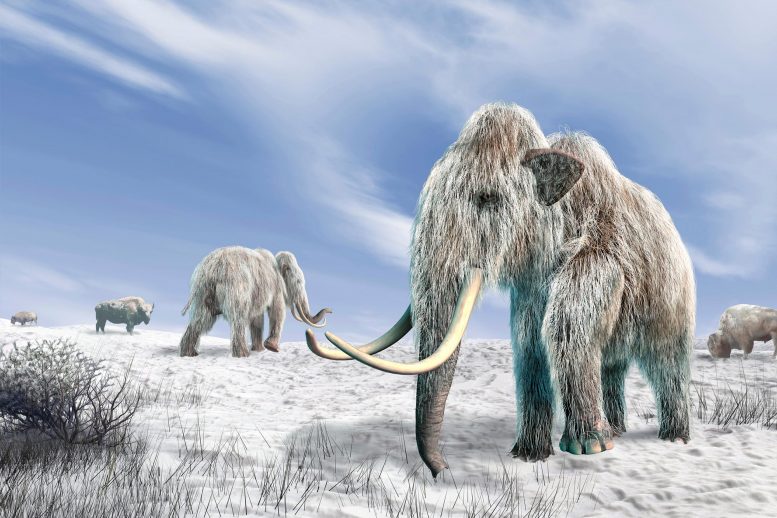
Isolation, extreme weather, and the possible arrival of humans may have killed off the holocene herbivores just 4,000 years ago.
The last woolly mammoths lived on Wrangel Island in the Arctic Ocean; they died out 4,000 years ago within a very short time. An international research team from the Universities of Helsinki and Tübingen and the Russian Academy of Sciences has now reconstructed the scenario that could have led to the mammoths’ extinction. The researchers believe a combination of isolated habitat and extreme weather events, and even the spread of prehistoric man may have sealed the ancient giants’ fate. The study has been published in the latest edition of Quaternary Science Reviews.
During the last ice age – some 100,000 to 15,000 years ago – mammoths were widespread in the northern hemisphere from Spain to Alaska. Due to the global warming that began 15,000 years ago, their habitat in Northern Siberia and Alaska shrank. On Wrangel Island, some mammoths were cut off from the mainland by rising sea levels; that population survived another 7000 years.
The team of researchers from Finland, Germany, and Russia examined the isotope compositions of carbon, nitrogen, sulfur, and strontium from a large set of mammoth bones and teeth from Northern Siberia, Alaska, the Yukon, and Wrangel Island, ranging from 40,000 to 4,000 years in age. The aim was to document possible changes in the diet of the mammoths and their habitat and find evidence of a disturbance in their environment. The results showed that Wrangel Island mammoths’ collagen carbon and nitrogen isotope compositions did not shift as the climate warmed up some 10,000 years ago. The values remained unchanged until the mammoths disappeared, seemingly from the midst of stable, favorable living conditions.
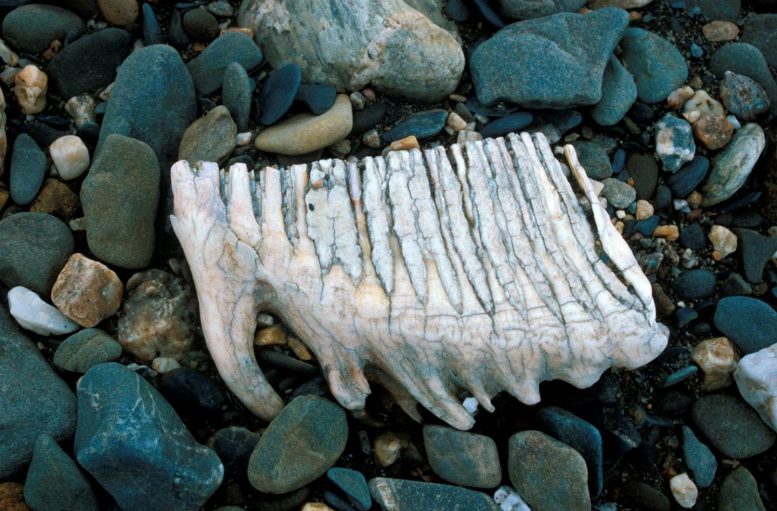
This result contrasts with the findings on woolly mammoths from the Ukrainian-Russian plains, which died out 15,000 years ago, and on the mammoths of St. Paul Island in Alaska, who disappeared 5,600 years ago. In both cases, the last representatives of these populations showed significant changes in their isotopic composition, indicating changes in their environment shortly before they became locally extinct.
Earlier aDNA studies indicate that the Wrangel Island mammoths suffered mutations affecting their fat metabolism. In this study, the team found an intriguing difference between the Wrangel Island mammoths and their ice-age Siberian predecessors: the carbonate carbon isotope values indicated a difference in the fats and carbohydrates in the populations’ diets. “We think this reflects the tendency of Siberian mammoths to rely on their reserves of fat to survive through the extremely harsh ice age winters, while Wrangel mammoths, living in milder conditions, simply didn’t need to”, says Dr. Laura Arppe from the Finnish Museum of Natural History Luomus, University of Helsinki, who led the team of researchers. The bones also contained levels of sulfur and strontium that suggested the weathering of bedrock intensified toward the end of the mammoth population’s existence. This may have affected the quality of the mammoths’ drinking water.
Why then did the last woolly mammoths disappear so suddenly? The researchers suspect that they died out due to short-term events. Extreme weather such as a rain-on-snow, i.e. an icing event could have covered the ground in a thick layer of ice, preventing the animals from finding enough food. That could have led to a dramatic population decline and eventually to extinction. “It’s easy to imagine that the population, perhaps already weakened by genetic deterioration and drinking water quality issues could have succumbed after something like an extreme weather event,” says professor Hervé Bocherens from the Senckenberg Center for Human Evolution and Palaeoenvironment at the University of Tübingen, a co-author of the study.
Another possible factor could have been the spread of humans. The earliest archaeological evidence of humans on Wrangel Island dates to just a few hundred years after the most recent mammoth bone. The chance of finding evidence that humans hunted Wrangel Island mammoths is very small. Yet a human contribution to the extinction cannot be ruled out.
The study shows how isolated small populations of large mammals are particularly at risk of extinction due to extreme environmental influences and human behavior. An important takeaway from this is that we can help preserve species by protecting the populations that are not isolated from one another.
Reference: “Thriving or surviving? The isotopic record of the Wrangel Island woolly mammoth population” by Laura Arppe, Juha A. Karhu, Sergey Vartanyan, Dorothée G. Drucker, Heli Etu-Sihvola and Hervé Bocherens, 13 September 2019, Quaternary Science Reviews.
DOI: 10.1016/j.quascirev.2019.105884
Never miss a breakthrough: Join the SciTechDaily newsletter.
Follow us on Google and Google News.