
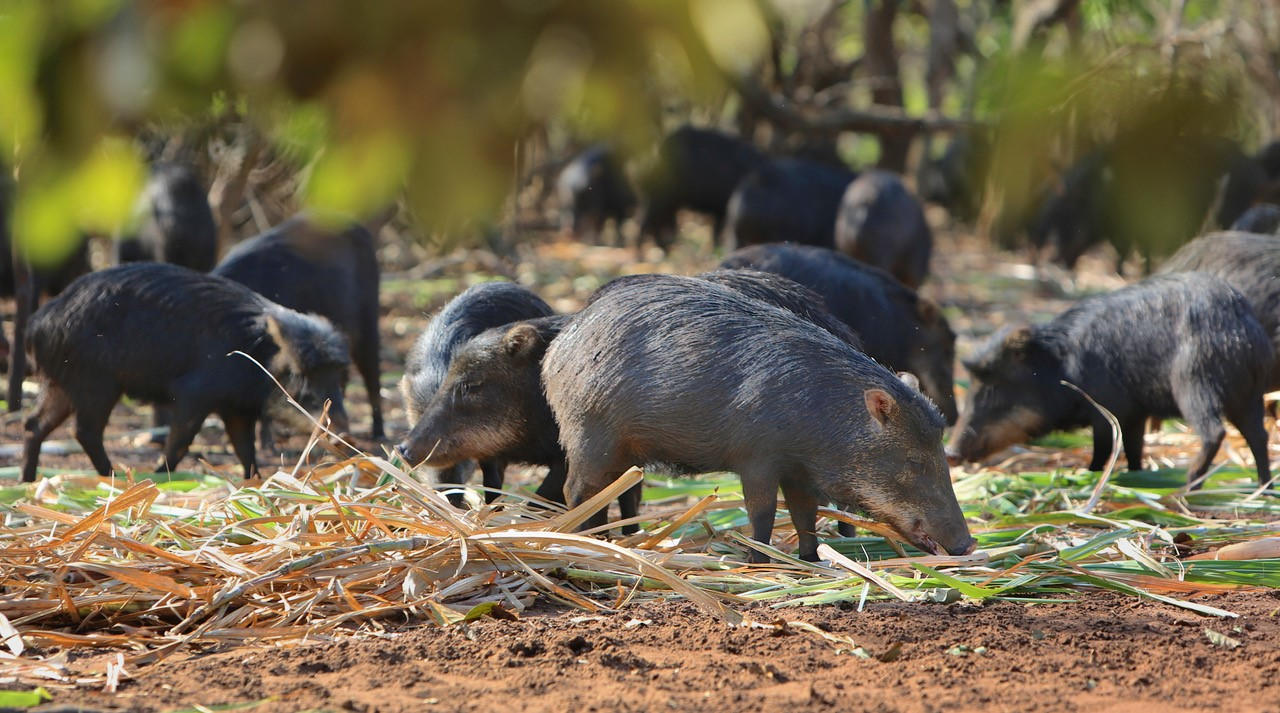
A new study documents large-scale white-lipped peccary disappearances and population cycling across their range in Latin America.
A collaborative study published in the journal PLOS ONE documents the periodic disappearance (and reappearance) of white-lipped peccaries in nine South and Central American nations. The population variations, according to the scientists, could be the first documented case of natural population cyclicity in a Neotropical mammal.
The report is co-authored by more than 20 organizations, including the Wildlife Conservation Society (WCS), and is led by the Department of Zoology of the University of Brasilia.
White-lipped peccaries (Tayassu pecari) are pig-like hoofed animals native to Central and South American tropical forests. They form enormous herds of up to hundreds of animals and are very social creatures. Researchers from Mexico to the Amazon have been puzzled by the unexpected disappearance of vast populations of white-lipped peccaries, as well as accounts of past disappearances and reappearances.
Population Troughs and Potential Triggers
The research demonstrates that the disappearances represent seven- to twelve-year troughs when peccaries disappear across 20–30–year population cycles. These may happen simultaneously at regional and perhaps continental spatial scales of 10,000-5 million square kilometers (3,861-1.9 million square miles).
The study suggests that the mysterious disappearances may be triggered by populations growing too big, and crashes are likely facilitated by different causes, including disease outbreaks, and underscores the need for more long-term studies to better understand the causes.
The ground-breaking study, which relies on collaboration and detective work to document 43 different disappearances at 38 sites in nine countries, also incorporates 88 years of commercial and subsistence harvest data from the Amazon. It confirms that this poorly-known species which is so ecologically important to neotropical forests, as well as culturally and socio-economically crucial to the Indigenous Peoples and local communities who live in these forests, has large-scale and long-term population cycles.
Ecological Importance of White-Lipped Peccaries
From an ecological perspective, the white-lipped peccaries are considered a keystone species as they influence forest regeneration and plant populations, especially palms, through seed predation and foraging, and turnover of leaf litter. They are also considered ecological engineers through their maintenance and expansion of forest mineral licks and wallows, which benefit many other wildlife species. In addition, they are the preferred prey of Latin America’s apex predator, the jaguar (Panthera onca). When peccaries disappear, jaguar populations decline.
White-lipped peccaries are immensely important from a socio-cultural perspective, as a preferred subsistence hunting target for Indigenous Peoples and riverine and rural communities across their range. This significance is reflected in the stories, oral history, and art of many of Latin America’s Indigenous Peoples. Indeed, some Indigenous Peoples have stories that refer to the peccaries disappearing and reappearing.
Insights and Implications for Conservation
The lead author of the study, Dr. Jose Fragoso from the Department of Zoology of the University of Brasilia, Brasilia, DF, Brazil, the Instituto Nacional de Pesquisas da Amazonia (INPA/MCTIC), Manaus, Brazil, and the California Academy of Sciences, San Francisco, California, said: “This analysis highlights the importance of very large, continuous natural areas that enable source-sink population dynamics and ensure re-colonization and local population persistence in time and space for perhaps the fundamental keystone species for neotropical forests. It also highlights how working with indigenous peoples can help resolve mysteries in biology. Our work also resolves a key question in tropical ecology, what happens to white-lipped peccaries when they disappear.”
Senior author Dr. Mariana Altricher, from the Environmental Studies Department, Prescott College, Arizona, believes that “this work clarifies an enduring mystery in tropical forests. It will help guide future research and conservation efforts in the tropics. Most importantly we must continue to monitor peccary populations, especially in fragmented protected areas”.
Dr. Harald Beck, Co-Chair of the IUCN Peccary Specialist Group, and one of the authors of the study said: “This unique publication has a large-scale focus (Central and South America), utilized historical and current data, and state-of-the-art new modeling methods to answer critical ecological questions about the spatial-temporal population fluctuations of the dominant Neotropical mammal, the white-lipped peccary. The paper will guide future research in the Neotropics, as well as influence conservation efforts and policies.”
Dr. Rob Wallace, Senior Conservation Scientist at WCS and one of the co-authors of the study remarked: “WCS remains committed to landscape-scale conservation at a series of Nature’s Strongholds in Latin America, which is fundamental for wide-ranging species like the white-lipped peccary, especially considering these population cycles. Understanding these natural population cycles will be crucial for interpreting our population monitoring efforts, which represents the gold standard for evaluating our conservation impact, not just for white-lipped peccaries themselves as a keystone species and socio-cultural touchstone, but also the other wildlife with which they coexist – lowland tapir, collared peccaries, leaf litter biodiversity, a number of palm species, plant diversity, and, of course, the jaguar.”
Reference: “Large-scale population disappearances and cycling in the white-lipped peccary, a tropical forest mammal” by José M. V. Fragoso, André P. Antunes, Kirsten M. Silvius, Pedro A. L. Constantino, Galo Zapata-Ríos, Hani R. El Bizri, Richard E. Bodmer, Micaela Camino, Benoit de Thoisy, Robert B. Wallace, Thais Q. Morcatty, Pedro Mayor, Cecile Richard-Hansen, Mathew T. Hallett, Rafael A. Reyna-Hurtado, H. Harald Beck, Soledad de Bustos, Alexine Keuroghlian, Alessandra Nava, Olga L. Montenegro, Ennio Painkow Neto and Mariana Altrichter, 20 October 2022, PLOS ONE.
DOI: 10.1371/journal.pone.0276297
Never miss a breakthrough: Join the SciTechDaily newsletter.
Follow us on Google and Google News.