
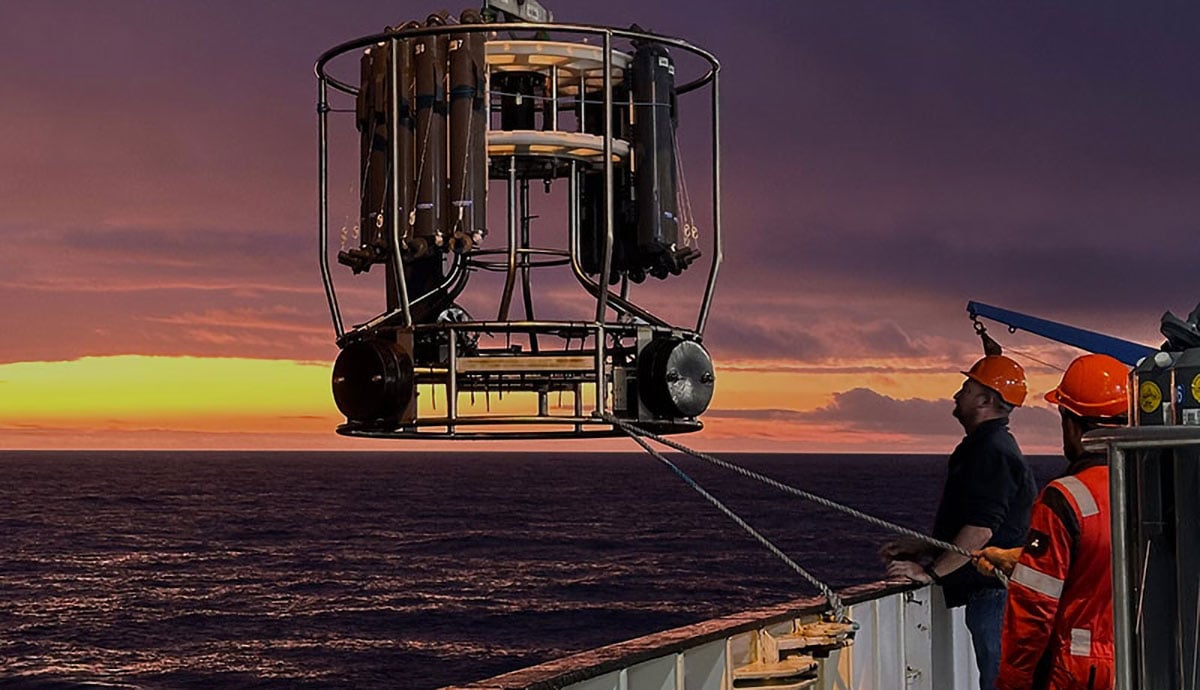
Rutgers University marine scientists are using New Jersey-developed tools to measure how iron shortages in Southern Ocean phytoplankton reduce photosynthetic efficiency and slow the conversion of light into oxygen.
With your next breath, remember that the ocean helps make it possible. Tiny algae carry out photosynthesis, and in many regions that work depends on iron-rich dust that reaches seawater.
A new Rutgers University study published in the Proceedings of the National Academy of Sciences takes a closer look at how this essential process operates and why iron matters.
Iron is a vital micronutrient for marine phytoplankton, microscopic algae that sit at the base of ocean food webs. Much of this iron arrives in the ocean as windblown dust from deserts and other dry landscapes, and it also comes from glacial meltwater.
“Every other breath you take includes oxygen from the ocean, released from phytoplankton,” said Paul G. Falkowski, the Bennett L. Smith Chair in Business and Natural Resources at Rutgers-New Brunswick and a co-author of the study. “Our research shows that iron is a limiting factor in phytoplankton’s ability to make oxygen in vast regions of the ocean.”
When Iron Runs Low
When iron levels drop or disappear, photosynthesis slows or can stop altogether. Photosynthesis – the process of turning light energy into chemical energy, with oxygen as a byproduct – becomes less effective, which can limit phytoplankton growth. It also reduces how efficiently they use sunlight and draw carbon dioxide out of the atmosphere.
Falkowski said evidence indicates climate change is reshaping ocean circulation in ways that may reduce how much iron reaches the sea. He added that people will still be able to breathe normally, since lower iron in the oceans will not cause humans to suffocate. Even so, he said the shift could have major consequences for marine ecosystems.
“Phytoplankton are the primary source of food for krill, the microscopic shrimp that are the main source of food in the Southern Ocean for virtually every animal, including penguins, seals, walruses and whales,” Falkowski said. “When iron levels drop and the amount of food available for these upper-level animals is lower, the result will be fewer of these majestic creatures.”
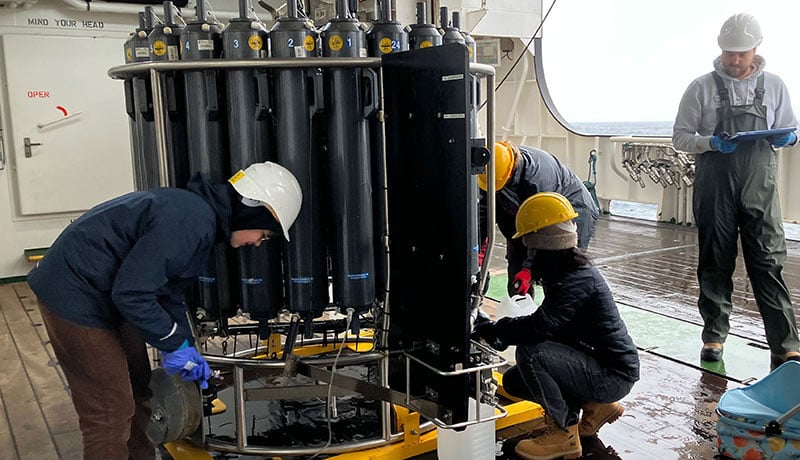
Researchers have long suspected that iron is crucial to photosynthesis, but little is known about how the process is affected in nature. Most previous studies have been conducted only in the laboratory.
To address this gap, Heshani Pupulewatte, a graduate research assistant in the Department of Chemistry and Chemical Biology conducting research in Falkowski’s lab and lead author of the study, spent 37 days in 2023 and 2024 aboard a British research vessel sailing through the South Atlantic Ocean and Southern Ocean, covering a transect from the South African coast to the marginal ice zone of the Weddell Gyre and back.
Seeing Photosynthesis Falter in Real Time
Using custom fluorometers built by Max Gorbunov from the Falkowski Lab on Cook Campus in New Brunswick, Pupulewatte tested samples for fluorescence – a measure of energy re-released by phytoplankton when the photosynthesis process breaks down. She then added nutrients to samples collected along the route to determine if doing so could restart the photosynthesis process.
“We wanted to know what really happens to the energy transfer process at the molecular level of phytoplankton in natural environments,” she said.
What she found was that iron limitation causes up to 25% of light-harvesting proteins to become “uncoupled” from the energy-producing centers, effectively reducing energy conversion. When iron is resupplied, phytoplankton reconnect their internal light-harvesting systems, improving their efficiency and potential for growth.
“We demonstrated the results of iron stress on phytoplankton out in the ocean, without even bringing back samples to the lab to perform molecular extractions using fluorescence measurements carried out at sea,” she said. “By doing so, we were able to show that much more energy is wasted as fluorescence when iron is limiting.”
Understanding how iron influences photosynthesis at the molecular level could help scientists predict future ocean productivity and global carbon cycles, she added.
Reference: “Coupling of excitation energy to photochemistry in natural marine phytoplankton communities under iron stress” by Heshani Pupulewatte, Maxim Y. Gorbunov, C. Mark Moore, Corday R. Selden, Thomas J. Ryan-Keogh, Joe Furby, Ruth Hawley, Maeve C. Lohan, Thomas S. Bibby and Paul G. Falkowski, 29 July 2025, Proceedings of the National Academy of Sciences.
DOI: 10.1073/pnas.2511916122
Funding: Natural Environment Research Council, Department of Science and Innovation
Never miss a breakthrough: Join the SciTechDaily newsletter.
Follow us on Google and Google News.
1 Comment
Photosynthesis does NOT convert light into oxygen. It converts carbon dioxide into oxygen and carbon.