

New research shows that socioeconomic factors play a larger role than climate.
A study has found that socioeconomic conditions, rather than climate factors, are the primary drivers of global migration. Utilizing a new high-resolution dataset, the research indicates that migration patterns are complex and vary significantly within countries, challenging common perceptions about migration and climate change.
While public discussions often focus on climate change driving people to emigrate, new research published in Nature Human Behaviour shows that net-migration patterns around the world are actually more strongly linked with socioeconomic factors. The study also provides a new, high-resolution dataset of net-migration over the past two decades to inform policy-making and fuel further research.
“Our findings don’t really match the narrative that’s repeated by the public about climate-induced migration,” says Venla Niva, a postdoctoral researcher at Aalto University who was lead author of the study. “When you look at the different factors together, the analysis shows that human development factors are more important drivers than climate.”
Societal Factors Override Climate Considerations
The research group, which included researchers from Aalto University, International Institute for Applied Systems Analysis, and the University of Bologna, published similar research last year covering the period 1990-2000. The new analysis covers the past two decades, 2000-2019. The high-resolution dataset they prepared makes it possible to answer questions that can’t be addressed with coarser data, such as national averages. “There was a real need for a dataset like this, but it didn’t exist. So we decided to make it ourselves,” says Niva. The new dataset is openly available and can be easily explored through an online interactive map.
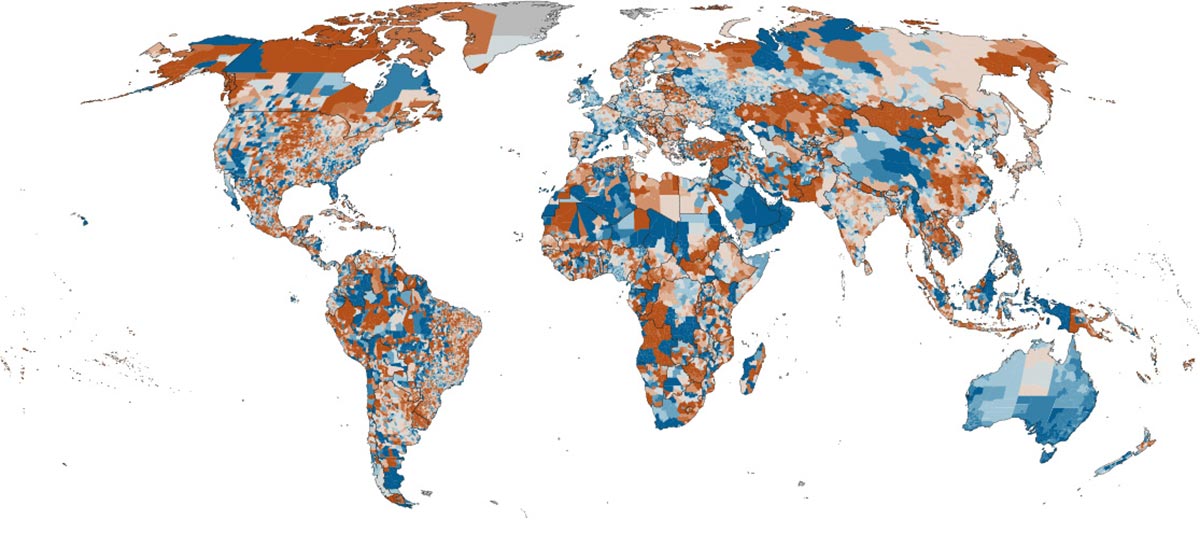
The team combined birth and death rates with overall population growth to estimate net migration. The role of socioeconomics and climate were incorporated through the Human Development Index (HDI) and the aridity index.
By starting with sub-national death and birth ratios and scaling them down to 10 km resolution, the researchers produced a net-migration dataset of unprecedented resolution. This makes it possible to address questions that can’t be answered using national aggregates. “Climate factors don’t follow administrative boundaries, so data like this is needed if you want to study these patterns,” explains Niva.
The researchers found high levels of emigration in regions that were on the middle of the scale in both HDI and aridity, such as areas in Central America, northeast Brazil, Central Africa and southeast Asia. “It’s not the poorest of the poor who are fleeing environmental disasters or environmental changes. Migration is an adaptation method used by people who have the capacity to move,” says Niva.
By the same token, areas with a high HDI experienced positive net migration regardless of their climate condition. For example, regions in the Arabian Peninsula, North America, Australia, and the North Mediterranean are net receivers despite their aridity.
“Decision-makers should pay attention to this. Rather than focusing solely on border closures and combating migration, we should work to support and empower individuals in economically disadvantaged countries. That would help reduce the drivers that compel people to migrate in search of better opportunities,” says Matti Kummu, associate professor of global water and food issues at Aalto and senior author of the study.
National Averages Mask Local Patterns
The granularity of the new dataset reveals complexities in migration patterns that are hidden when national data is used. “In France and Italy, for example, there are really interesting differences between north and south, and in Spain there’s an east-west difference. There are so many patterns that national experts could look into, and of course, the reasons behind them might be different for each country,” says Kummu.
Unexpected patterns also showed up in urban-rural migration. “There’s a very common belief that urban areas are pulling the people from the rural areas, but that wasn’t the case everywhere. For example, there are a lot of places for example in Europe where the opposite is true,” says Kummu. Migration from cities to rural areas was also evident in parts of Indonesia, Congo, Venezuela, and Pakistan, and when the analysis is done of the level of communities, the picture becomes even more complex.
“Overall, migration is more complex than people tend to think,” says Niva. “Our findings contribute to the discussion of where and how migration is happening – it’s not actually a Eurocentric phenomenon, because most migration happens elsewhere in the world.”
Researchers can use the new dataset to understand migration more precisely than through national averages, which don’t capture the whole story. “We’ve already shared the data with other researchers and with, for example, the UN International Organization for Migration,” says Kummu. “We’ve also made an interactive map available so people can go explore these patterns for themselves.”
Reference: “World’s human migration patterns in 2000–2019 unveiled by high-resolution data” by Venla Niva, Alexander Horton, Vili Virkki, Matias Heino, Maria Kosonen, Marko Kallio, Pekka Kinnunen, Guy J. Abel, Raya Muttarak, Maija Taka, Olli Varis and Matti Kummu, 7 September 2023, Nature Human Behaviour.
DOI: 10.1038/s41562-023-01689-4
Never miss a breakthrough: Join the SciTechDaily newsletter.
Follow us on Google and Google News.
3 Comments
Proving the obvious only because of the “scientists” current obsession with climate change and the desire to pin something on that.
Nowhere in this paper does it deal with the question of whether the climate catastrophe is causing the socioeconomic conditions that cause people to move!
Why would someone get up and move due to climate change, without socioeconomic reasons?
Are they seriously proposing that people would leave a place where they are doing economically well “because of climate change”?
How would this even go? “I’m going to close my profitable business here and move, as a statement about climate change.” Who would find that believable?
This is just garbage. I should have realized when the “scientist” writing this paper used the term “narrative” right up front.
Your study leaves out the sole driver of the Islamic view of global domination which is MIGRATION. Islam measures its birth not from the birth of Mohammad but from the migration from Mecca to Medina. Your study is seriously flawed by not studying this anomaly to your migration theories.