
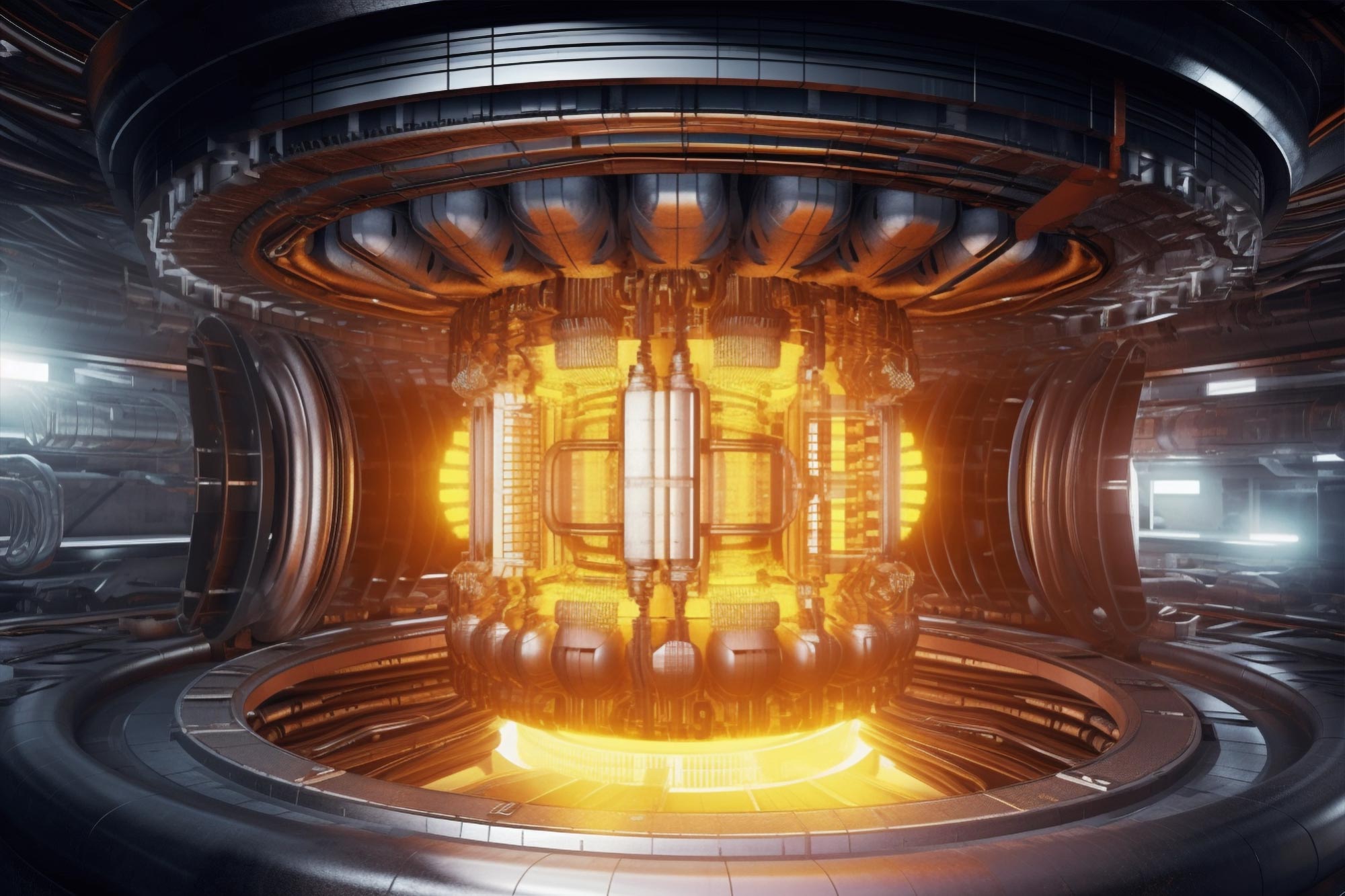
Scientists have simulated a groundbreaking solution to boost fusion efficiency by eliminating “slow modes,” unhelpful waves that waste energy during plasma heating.
Using 2D simulations, researchers demonstrated how a slight tilt in the Faraday screen can enhance energy transfer, bringing us closer to sustainable fusion energy.
Heating Plasma for Fusion: The Challenge
Heating plasma to the extreme temperatures required for fusion reactions is no simple task. One method involves using electromagnetic waves, similar to those in microwave ovens, to heat the plasma. However, while generating the desired heating waves, another type of wave — called a slow mode — can sometimes form. These slow modes do not contribute to heating the plasma and instead waste valuable energy.
To address this challenge, scientists at the U.S. Department of Energy’s Princeton Plasma Physics Laboratory (PPPL) conducted advanced computer simulations. They confirmed a technique that prevents the formation of these inefficient slow modes, allowing more energy to heat the plasma effectively. This breakthrough increases the efficiency of fusion reactions, bringing us closer to achieving practical fusion energy.
“This is the first time scientists have used 2D computer simulations to explore how to reduce slow modes,” said Eun-Hwa Kim, a PPPL principal research physicist and lead author of the paper reporting the results in Physics of Plasmas. “The results could lead to more efficient plasma heating and possibly an easier path to fusion energy.”

Aligning Faraday Screens for Optimal Performance
The team, which included researchers from General Atomics who use the DIII-D tokamak fusion facility, determined that positioning a metal grate known as a Faraday screen at a slight five-degree slant with respect to the antenna producing the heating waves, also known as helicon waves, stops the production of the slow modes.
Researchers want to avoid creating slow modes because, unlike helicon waves, they cannot penetrate the magnetic field lines confining the plasma to heat the core, where most fusion reactions occur. In addition, the slow modes are easily damped or snuffed out by the plasma itself. Therefore, any energy used to create slow modes is energy that is not used to heat the plasma and foster fusion reactions.
Simulating Success with Petra-M
The researchers simulated the production of helicon waves and slow modes using the Petra-M computer code, a powerful and versatile program used to model electromagnetic waves in fusion devices and space plasmas.
The simulations replicated conditions in the DIII-D tokamak, a doughnut-shaped plasma device operated by General Atomics for the DOE. The team performed a series of virtual experiments to test which of the following had the greatest effect on the production of slow modes — the antenna’s alignment, the Faraday screen’s alignment, or the density of small particles known as electrons in front of the antenna.
The simulations confirmed suggestions made by previous researchers indicating that when the Faraday screen was aligned at an angle of five degrees or less from the orientation of the antenna, the screen, in effect, short-circuits the slow modes, making them fizzle out before they propagate into the plasma.
Sensitivity of Slow Modes to Screen Alignment
The suppression of slow modes depends greatly on how much the Faraday screen leans to the side. “We found that when the screen’s orientation exceeds five degrees by only a little bit, the slow modes grow by a great deal,” said PPPL principal research physicist Masayuki Ono, one of the paper’s authors. “We were surprised by how sensitive the development of slow modes was to the screen alignment.”
Scientists could use this information to tweak the design of new fusion facilities to make their heating more powerful and efficient.
Future Directions for Fusion Efficiency
In the future, the scientists plan to increase their understanding of how to prevent slow modes by running computer simulations that consider more of the plasma’s properties and factor in more information about the antenna.
Reference: “Full-wave simulations on helicon and parasitic excitation of slow waves near the edge plasma” by E.-H. Kim, M. Ono, S. Shiraiwa, N. Bertelli, M. Poulos, B. Van Compernolle, A. Bortolon and R. I. Pinsker, 2 October 2024, Physics of Plasmas.
DOI: 10.1063/5.0222413
This research was supported by the DOE’s Office of Science (Fusion Energy Sciences) under contracts DE-AC20-09CH11466 and DE-FC02-04ER54698 and the DOE’s Scientific Discovery through Advanced Computing program under contract DE-SC0024369. Simulations were performed using the National Energy Research Scientific Computing Center, a DOE user facility at Lawrence Berkeley National Laboratory under contract DE-AC02-05CH11231 and the award FES-ERCAP0027700.
Never miss a breakthrough: Join the SciTechDaily newsletter.
Follow us on Google and Google News.
12 Comments
Help Humanity First
That is the whole point of trying to solve the challenge of controlled thermonuclear fusion! Is that not evident to you? Do you think that one can just wave a magic wand and solve the world’s problems?
My definition of a liberal is someone who is out of touch with reality.
I concur with you. As being part of older generation we should have paid more attention to what our kids, back than, were watching.on TV. A brain washed generation that is now grown up. I’m sorry but Captain Planet cannot save you! After all he was just a cartoon……
He sounds like the worst kind, idealist liberal.
In the future, the scientists plan to increase their understanding of how to prevent slow modes by running computer simulations that consider more of the plasma’s properties and factor in more information about the antenna.
Please ask researchers to think deeply:
1. Can natural phenomena only be understood through algebra, formulas, or fractions?
2. Is using geometric or topological shapes to understand natural phenomena pseudoscience?
3. Is nature algebra, formulas, or fractions?
Humans understand natural phenomena through complex neural networks processing of perceptual inputs; language and mathematics are a part of constructing a model of that can be empirically tested and communicated to other humans. Pseudoscience lacks empirical testing and validation.
Which approach holds greater credibility: verification or falsification?
While the appearance of some discovery may be undeniable, the methodologies and principles underlying scientific research often hold greater significance.
Ask the researchers:
In the human senses, what are the differences between a mirages and physical reality?
It’s amazing how much fusion progress seems to have been made in the last 24 months! Why did it take 50 years to break out?
Fusion is only ten years away yadda yadda you know the joke.
Some jokes get stale over time.
Oscillators are often seen to derive from symmetry, like an astable multivibrator, and breaking the symmetry kills the oscillations.