
Close Menu
    Facebook X (Twitter) Instagram
    SciTechDaily
    • Biology
    • Chemistry
    • Earth
    • Health
    • Physics
    • Science
    • Space
    • Technology
    Facebook X (Twitter) Pinterest YouTube RSS
    SciTechDaily
    Home»Technology»Thermal Cloak Molds the Flow of Heat Around an Object
    Technology

    Thermal Cloak Molds the Flow of Heat Around an Object

    By Karlsruhe Institute of TechnologyMay 8, 2013No Comments3 Mins Read
    Facebook Twitter Pinterest Telegram LinkedIn WhatsApp Email Reddit
    Share
    Facebook Twitter LinkedIn Pinterest Telegram Email Reddit
    Researchers Develop Invisibility Cloak for Thermal Flow
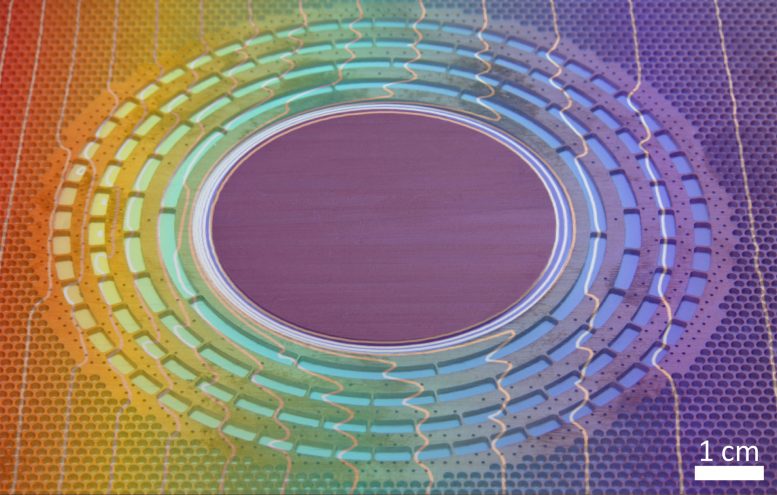
    Thermal invisibility cloak: Heat is passed around the central area from the left to the right. Temperature characteristics (white lines) remain parallel. Credit: R. Schittny/KIT

    Scientists from the Karlsruhe Institute of Technology have constructed a micro-structured thermal cloak that molds the flow of heat around an object.

    By means of special metamaterials, light and sound can be passed around objects. KIT researchers now succeeded in demonstrating that the same materials can also be used to specifically influence the propagation of heat. A structured plate of copper and silicon conducts heat around a central area without the edge being affected. The results will be presented in the Physical Review Letters journal.

    “For the thermal invisibility cloak, both materials have to be arranged smartly,” explains Robert Schittny from KIT, the first author of the study. Copper is a good heat conductor, while the silicon material used, called PDMS, is a bad conductor. “By providing a thin copper plate with annular silicon structures, we produce a material that conducts heat in various directions at variable speeds. In this way, the time needed for passing around a hidden object can be compensated.”

    If a simple, solid metal plate is heated at the left edge, heat migrates uniformly to the right side. The temperature of the plate decreases from the left to the right. Exactly the same behavior is exhibited by the new metamaterial consisting of copper and silicon outside of the annular structure. No heat penetrates inside. Outside, there is no indication of what happens inside.

    “These results impressingly reveal that transformation optics methods can be transferred to the highly different area of thermodynamics,” says Martin Wegener, Head of the Institute of Applied Physics of KIT. Here, the first three-dimensional invisibility cloak for visible light was developed. While optics and acoustics are based on the propagation of waves, heat is a measure of the unordered movement of atoms. Still, basic mathematical descriptions can be used to calculate the structures having the effect of an invisibility cloak. With the methods of so-called transformation optics, a distortion of the describing coordinate system is calculated. Arithmetically speaking, an extended object disappears in an infinitely small point. This virtual distortion can be mapped to a real metamaterial structure that passes incident light around the object to be hidden, as if it was not even existing.

    “I hope that our work will be the basis of many further developments in the field of thermodynamic metamaterials,” Wegener says. Thermal invisibility cloaks are a rather new field in fundamental research. In the long term, they might be applied in areas needing effective heat management, such as in microchips, electric components, or machines.

    Reference: “Experiments on Transformation Thermodynamics: Molding the Flow of Heat” by Robert Schittny, Muamer Kadic, Sebastien Guenneau and Martin Wegener, 10 May 2013, Physical Review Letters.
    DOI: 10.1103/PhysRevLett.110.195901

    Never miss a breakthrough: Join the SciTechDaily newsletter.
    Follow us on Google and Google News.

    Invisibility Karlsruhe Institute of Technology Materials Science Metamaterials Optics Thermodynamics
    Share. Facebook Twitter Pinterest LinkedIn Email Reddit

    Related Articles

    160x More Power From a Twist: The Metamaterial Breakthrough Redefining Energy Storage

    The Magic Behind True One-Way Glass: A Breakthrough in Optical Metamaterials

    ‘Digital Metamaterials’ Bring Invisibility Cloaks Closer to Reality

    Kit Researchers Create Mechanical Invisibility Cloak

    New Metamaterial Doubles the Range of Light That Can Be Manipulated

    Shape-Remembering Hydrogels Made Out of Synthetic DNA

    Duke University Creates “Perfect” Microwave Cloak

    Scientists Change the Color of Gold

    Scientists Make 3D Objects Invisible to Microwave Wavelengths

    Leave A Reply Cancel Reply

    • Facebook
    • Twitter
    • Pinterest
    • YouTube

    Don't Miss a Discovery

    Subscribe for the Latest in Science & Tech!

    Trending News

    New “Nanozyme Hypothesis” Could Rewrite the Story of Life’s Origins

    Anatomy Isn’t Finished: The Human Body Still Holds Secrets

    “Pretty Close to Home”: The Hidden Earthquake Threat Beneath Seattle

    The Surprising Reason You Might Want To Sleep Without a Pillow

    Scientists Say This Natural Hormone Reverses Obesity by Targeting the Brain

    35-Million-Year-Old Mystery: Strange Arachnid Discovered Preserved in Amber

    Is AI Really Just a Tool? It Could Be Altering How You See Reality

    JWST Reveals a “Forbidden” Planet With a Baffling Composition

    Follow SciTechDaily
    • Facebook
    • Twitter
    • YouTube
    • Pinterest
    • Newsletter
    • RSS
    SciTech News
    • Biology News
    • Chemistry News
    • Earth News
    • Health News
    • Physics News
    • Science News
    • Space News
    • Technology News
    Recent Posts
    • Scientists Finally Crack the 100-Million-Year Evolutionary Mystery of Squid and Cuttlefish
    • This Algae Could One Day Pull Microplastics out of Your Drinking Water
    • Scientists Can Now Read Your Body Clock From a Single Hair
    • Beyond “Safe Levels”: Study Challenges What We Know About Pesticides and Cancer
    • Researchers Have Found a Dietary Compound That Increases Longevity
    Copyright © 1998 - 2026 SciTechDaily. All Rights Reserved.
    • Science News
    • About
    • Contact
    • Editorial Board
    • Privacy Policy
    • Terms of Use

    Type above and press Enter to search. Press Esc to cancel.