

Researchers have created a disk-like nanostructure that dramatically improves light frequency conversion efficiency. This innovation in photonics combines material and optical resonances in a compact form, paving the way for advanced optical and photonic applications.
Scientists at Chalmers University of Technology, in Sweden, have for the first time succeeded in combining two major research fields in photonics by creating a nanoobject with unique optical qualities. Since the object is a thousand times thinner than a human hair, yet very powerful, the breakthrough has great potential in the development of efficient and compact nonlinear optical devices. “My feeling is that this discovery has a great potential,” says Professor Timur Shegai, who led the study at Chalmers.
Harnessing Light With Advanced Photonics
Photonic applications harness the power of light-matter interactions to generate various intriguing phenomena. This has enabled major advances in communications, medicine, and spectroscopy, among others, and is also used in laser and quantum technologies. Now, researchers at the Department of Physics at Chalmers University of Technology have succeeded in combining two major research fields – nonlinear and high-index nanophotonics – in a single disk-like nanoobject.
“We were amazed and happy by what we managed to achieve. The disk-looking structure is much smaller than the wavelength of light, yet it’s a very efficient light frequency converter. It is also 10,000 times, or maybe even higher, more efficient than the unstructured material of the same kind, proving that nanostructuring is the way to boost efficiency,” says doctor Georgii Zograf, lead author of the article in Nature Photonics where the research results are presented.
Breakthrough in Nanostructure Fabrication
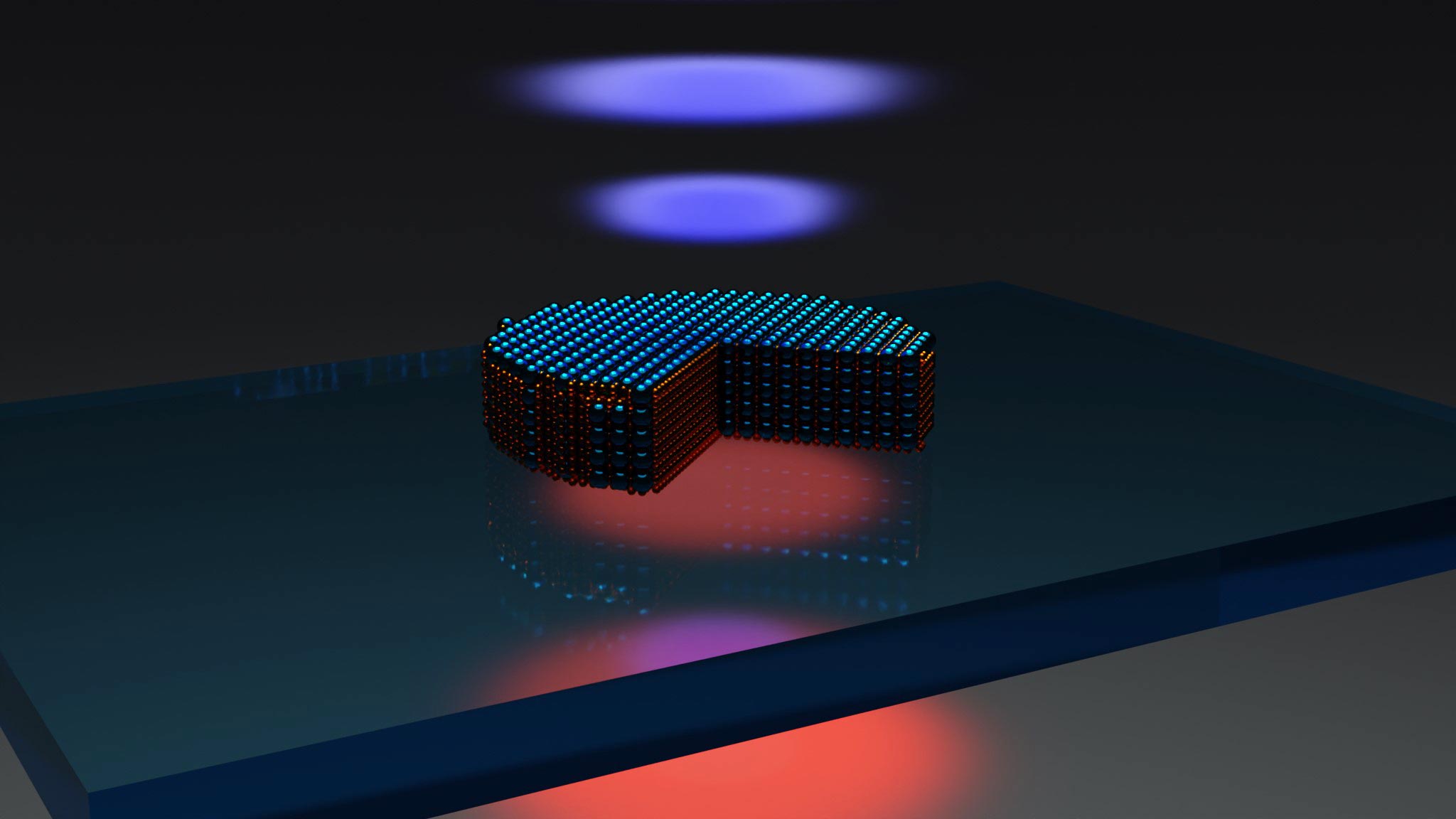
Somewhat simplified, it is a combination of material and optical resonances with the ability to convert light frequency through crystal’s non-linearity that the researchers have combined in the nanodisk. In its fabrication, they have used transition metal dichalcogenide (TMD), namely molybdenum disulfide, an atomically thin material that has outstanding optical properties at room temperature. The problem with the material is however that it is very difficult to stack without losing its nonlinear properties due to its crystalline lattice symmetry constraints.
“We have fabricated for the first time a nanodisk of specifically stacked molybdenum disulfide that preserves the broken inverse symmetry in its volume, and therefore maintains optical nonlinearity. Such a nanodisk can maintain the nonlinear optical properties of each single layer. This means that the material’s effects are both maintained and enhanced,” says Georgii Zograf.
Innovating Optics With Compact Design
The material has a high refractive index, meaning that light can be more effectively compressed in this medium. Furthermore, the material has the advantage of being transferable on any substrate without the need to match the atomic lattice with the underlying material. The nanostructure is also very efficient in localizing electromagnetic field and generating doubled frequency light out of it, an effect called second-harmonic generation. It’s a so-called nonlinear optical phenomenon, for example, similar to the sum- and difference-frequency generation effects used in high-energy pulsed laser systems.
Thus, this nanodisk combines extreme nonlinearity with high-refractive index in a single, compact structure.

Pioneering Future Optical Technologies
“Our proposed material and design are state-of-the-art due to extremely high inherent nonlinear optical properties and notable linear optical properties – a refractive index of 4.5 in the visible optical range. These two properties make our research so novel and potentially attractive even to the industry,” Georgii Zograf says.
“It really is a milestone, particularly due to the disk’s extremely small size. Second harmonic generation and other non-linearities are used in lasers every day, but the platforms that utilize them are typically on the centimeter scale. In contrast, the scale of our object is about 50 nanometers, so that’s about a 100,000 times thinner structure,” says research leader Professor Timur Shegai.
The researchers believe that the nanodisk’s work will push photonics research forward. In the long term, TMD materials’ incredibly compact dimensions, combined with their unique properties, could potentially be used in advanced optical and photonic applications. For example, these structures could be integrated into various kinds of optical circuits, or used in miniaturizations of photonics.
“We believe it can contribute towards future nonlinear nanophotonics experiments of various kinds, both quantum and classical. By having the ability to nanostructure this unique material, we could dramatically reduce the size and enhance efficiency of optical devices, such as nanodisk arrays and metasurfaces. These innovations could be used for applications in nonlinear optics and the generation of entangled photon pairs. This is a first tiny step, but a very important one. We are only just scratching the surface,” says Timur Shegai.
Reference: “Combining ultrahigh index with exceptional nonlinearity in resonant transition metal dichalcogenide nanodisks” by George Zograf, Alexander Yu. Polyakov, Maria Bancerek, Tomasz J. Antosiewicz, Betül Küçüköz and Timur O. Shegai, 13 June 2024, Nature Photonics.
DOI: 10.1038/s41566-024-01444-9
Never miss a breakthrough: Join the SciTechDaily newsletter.
Follow us on Google and Google News.
1 Comment
Thx