
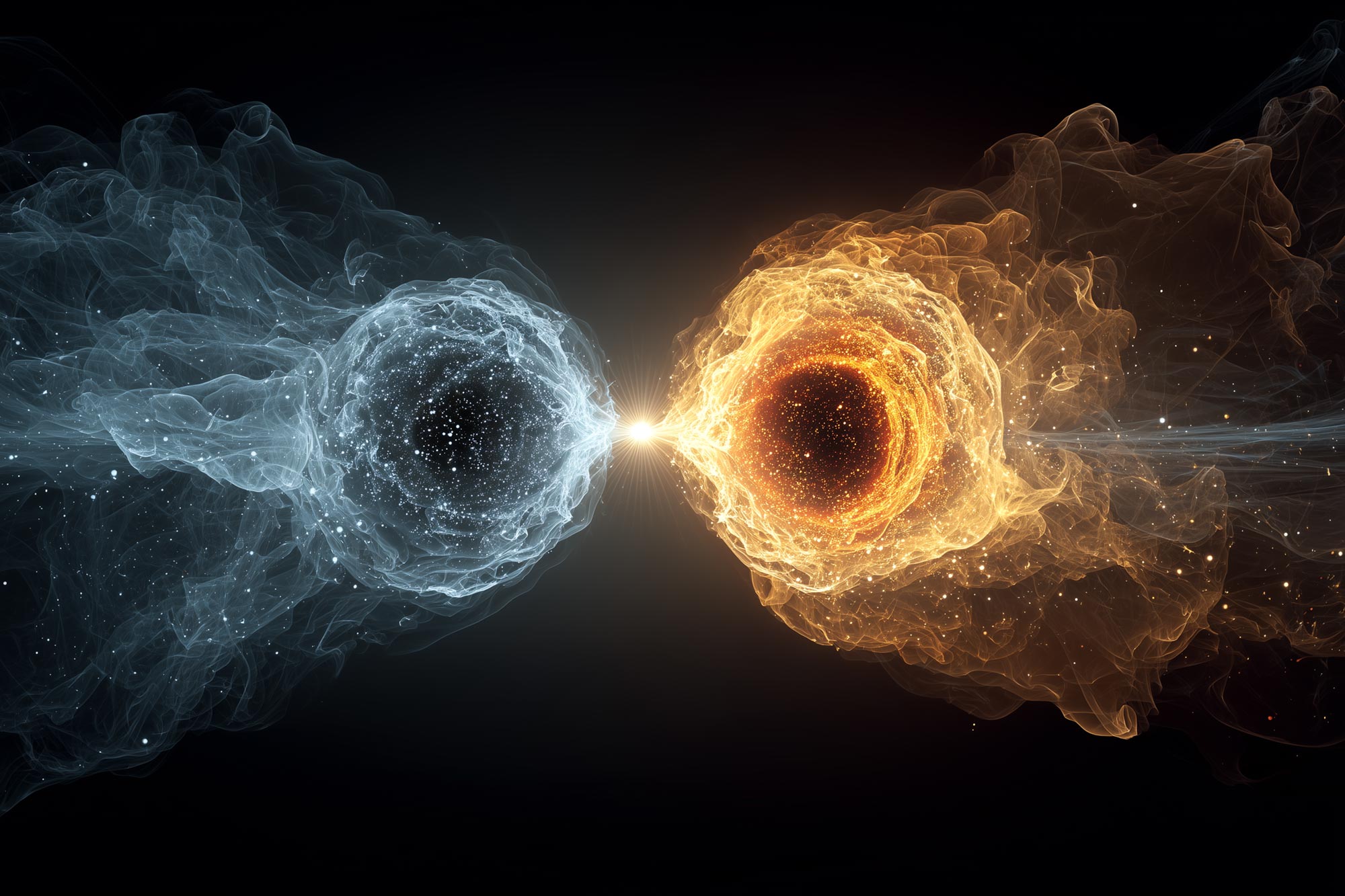
A new theory reveals how even “frozen” particles can spark the emergence of order inside quantum matter.
Researchers at the Institute for Theoretical Physics at Heidelberg University have introduced a new theory that links two major perspectives in modern quantum physics. The work focuses on how a single unusual particle behaves inside a many-body system filled with fermions, often referred to as a Fermi sea. In this environment, the particle can act either as something that moves through the system or as a nearly fixed impurity embedded within it.
The new framework explains how quasiparticles arise and connects two quantum states that were previously treated as separate. According to the Heidelberg team, this unified approach could significantly influence current experiments in quantum matter.
The Quasiparticle Model and the Fermi Polaron
Physicists have long debated how impurities, that is, exotic electrons or atoms, interact with large numbers of surrounding particles. In the widely accepted quasiparticle picture, a single particle travels through a sea of fermions, such as electrons, protons, or neutrons, and interacts continuously with its neighbors. As it moves, it pulls surrounding particles along with it, forming a combined entity known as a Fermi polaron. Although this composite behaves like an individual particle, it actually reflects the coordinated motion of the impurity and the particles around it.
As Eugen Dizer, a doctoral candidate at Heidelberg University’s Institute for Theoretical Physics, explains, this concept has become essential for understanding strongly interacting systems ranging from ultracold atomic gases to solid materials and even nuclear matter.

Anderson’s Orthogonality Catastrophe and Heavy Impurities
A very different situation occurs in what is known as Anderson’s orthogonality catastrophe. This effect appears when the impurity is extremely heavy and effectively immobile. Its presence alters the many-body system so profoundly that the wave functions of the surrounding fermions change completely. They lose their original form and create a complex background that prevents coordinated motion and blocks the formation of quasiparticles.
For decades, physicists did not have a theory that could bridge this static case with the mobile quasiparticle model. By applying a range of analytical techniques, the Heidelberg researchers have now brought these two descriptions together within a single framework.
How Slight Motion Enables Quasiparticles
“The theoretical framework we developed explains how quasiparticles emerge in systems with an extremely heavy impurity, connecting two paradigms that have long been treated separately,” says Eugen Dizer, a member of the Quantum Matter Theory group led by Prof. Dr. Richard Schmidt.
A central finding of the new theory is that even very heavy impurities are not perfectly motionless. As the surrounding environment adjusts, these particles undergo subtle movements. Those small shifts create an energy gap that allows quasiparticles to form despite the complex and strongly correlated background.
The researchers also demonstrated that this mechanism naturally accounts for the transition from polaronic quantum states to molecular quantum states.
Implications for Quantum Experiments and Materials
Prof. Schmidt notes that the results offer a versatile way to describe impurities across different spatial dimensions and types of interactions. “Our research not only advances the theoretical understanding of quantum impurities but is also directly relevant for ongoing experiments with ultracold atomic gases, two-dimensional materials, and novel semiconductors,” he says.
The findings were published in the journal Physical Review Letters.
Reference: “Mass-Gap Description of Heavy Impurities in Fermi Gases” by Xin Chen, Eugen Dizer, Emilio Ramos Rodríguez and Richard Schmidt, 6 November 2025, Physical Review Letters.
DOI: 10.1103/h2f7-dhjh
The study was conducted under the auspices of Heidelberg University’s STRUCTURES Cluster of Excellence and the ISOQUANT Collaborative Research Centre 1225.
Never miss a breakthrough: Join the SciTechDaily newsletter.
Follow us on Google and Google News.
2 Comments
Might be just a bad translation.
In this environment, the particle can act either as something that moves through the system or as a nearly fixed impurity embedded within it.
VERY GOOD!
Please ask researchers to think deeply:
Are particles in space derived from the topological evolution of space itself or from God?