
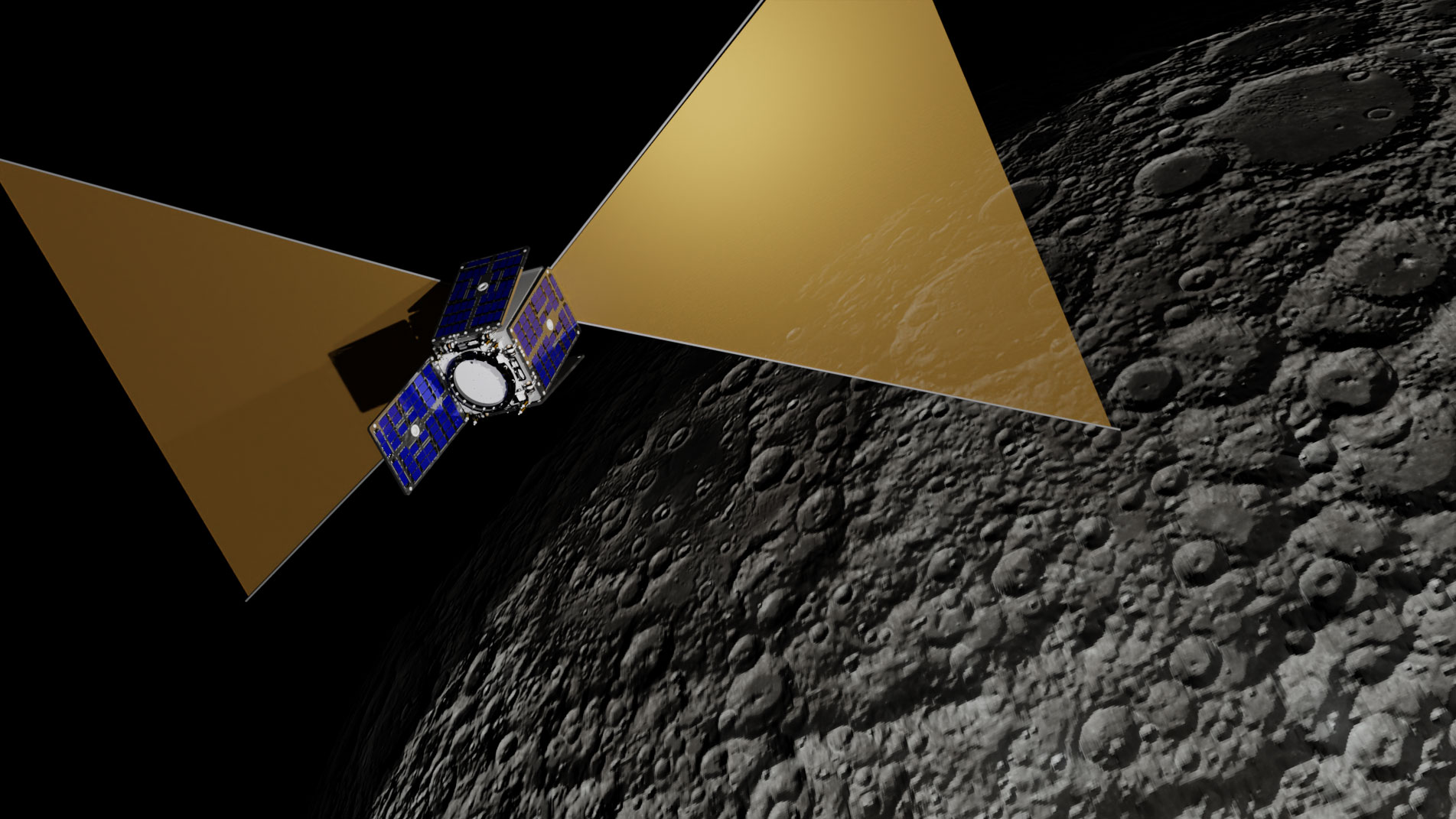
A suitcase-sized satellite could use the Moon’s far side to search for the first direct signal from the universe before stars existed.
A satellite no bigger than a small carry-on suitcase could help investigate a period of cosmic history that has never been directly observed. Developed in the UK, CosmoCube is designed to search for evidence of what happened during roughly 150 million years of cosmic dark ages before the universe’s first stars began to shine.
Led by the University of Cambridge, an international group of scientists plans to send CosmoCube around the Moon and use its far side as a natural shield from radio interference generated on Earth. From there, the satellite will listen for an exceptionally faint signal left by the early universe.
Known as the 21-centimeter line, the signal comes from hydrogen atoms during the period between the afterglow of the Big Bang and Cosmic Dawn, when nuclear fusion ignited the first stars. Astronomers have yet to observe this era directly.
The Moon blocks Earth’s radio noise
Searching for a signal more than 13.5 billion years old from Earth is extremely difficult. The ionosphere blocks the relevant radio frequencies, while FM radio, satellites, and telecommunications create additional interference that can overwhelm the faint cosmic signal.
The Moon offers a way around both problems. During each two-hour orbit, CosmoCube would spend about 40 minutes behind the Moon, protected from radio noise coming from Earth. Over a planned two-year mission, researchers expect the satellite to accumulate around 1000 hours of observations from one of the least explored periods in cosmic history, providing clues to how the universe evolved from a dark, relatively empty state into the complex cosmos seen today.
The mission has received funding from the UK Space Agency, and researchers hope to launch CosmoCube within five years. Details of the project were published in Nature Astronomy.
Dark matter may leave an early imprint
CosmoCube is also intended to investigate dark matter, the invisible matter whose gravity plays a major role in forming and holding galaxies together, by examining conditions before the first stars appeared.
“This emission from hydrogen after the Big Bang, but before the first stars, will hopefully allow us to understand the role of dark matter in the early universe, how it worked to pull together hydrogen into the first stars and galaxies,” said lead author Professor Eloy de Lera Acedo from Cambridge’s Cavendish Laboratory.
The satellite will observe extremely low radio frequencies between 10 and 50 MHz, a range that is largely inaccessible to ground-based telescopes. That limitation is what makes the Moon’s far side so valuable as CosmoCube’s ‘fortress of solitude.’
“There’s no other place where you can get the sort of shielding you need to detect such a faint signal, while at the same time looking at the whole of space,” said de Lera Acedo, who is also affiliated with the Kavli Institute for Cosmology. “The far side of the Moon is really the only option: it solves multiple problems at once, opening a clear window to the very early universe.”
Tiny signals demand precise calibration
Once CosmoCube reaches lunar orbit, it will deploy a long, lightweight radio antenna designed to detect the 21-centimeter hydrogen signal while the spacecraft passes behind the Moon.
Because the desired signal is so weak, CosmoCube must also carefully track noise produced by its own electronics. A ‘Dicke switched’ calibrator will repeatedly alternate between observations of the sky and several built-in reference sources, allowing researchers to identify and correct small instrumental drifts that might otherwise imitate a cosmic signal.
After the observations return to Earth, researchers will apply advanced Bayesian statistical techniques to separate the desired signal from foreground emission, particularly radio waves produced within the Milky Way. Computer simulations and in-flight measurements will also be used to reconstruct how the antenna responds to different areas of the sky so that remaining distortions can be removed.
“Aside from the science, what makes our mission unique is its size: we’re probing the earliest, deepest parts of the dark ages that others don’t reach, but with a compact, relatively low-cost platform,” said de Lera Acedo.
The Moon’s silence may not last
The radio-quiet environment on the Moon’s far side may eventually become harder to preserve. The US, India, and other countries are planning missions that also hope to take advantage of its unusually quiet conditions.
CosmoCube will carry a fully integrated miniature radiometer combining modern analog and digital technology through RF-Systems-on-Chip (RFSoCs). Its spacecraft platform, called ‘SSTL-21’, is being developed in the UK by Surrey Space Technology Limited (SSTL), which specializes in manufacturing small satellites. Working laboratory prototypes already exist, environmental testing is underway, and the project includes collaborations with industry partners. UK academic partners include Portsmouth University and STFC RAL Space, with participation from EU countries including Malta. The CosmoCube team also recently took part in the ESA mini-Fast missions Call for Ideas, targeting a mission costing less than 50 million euros.
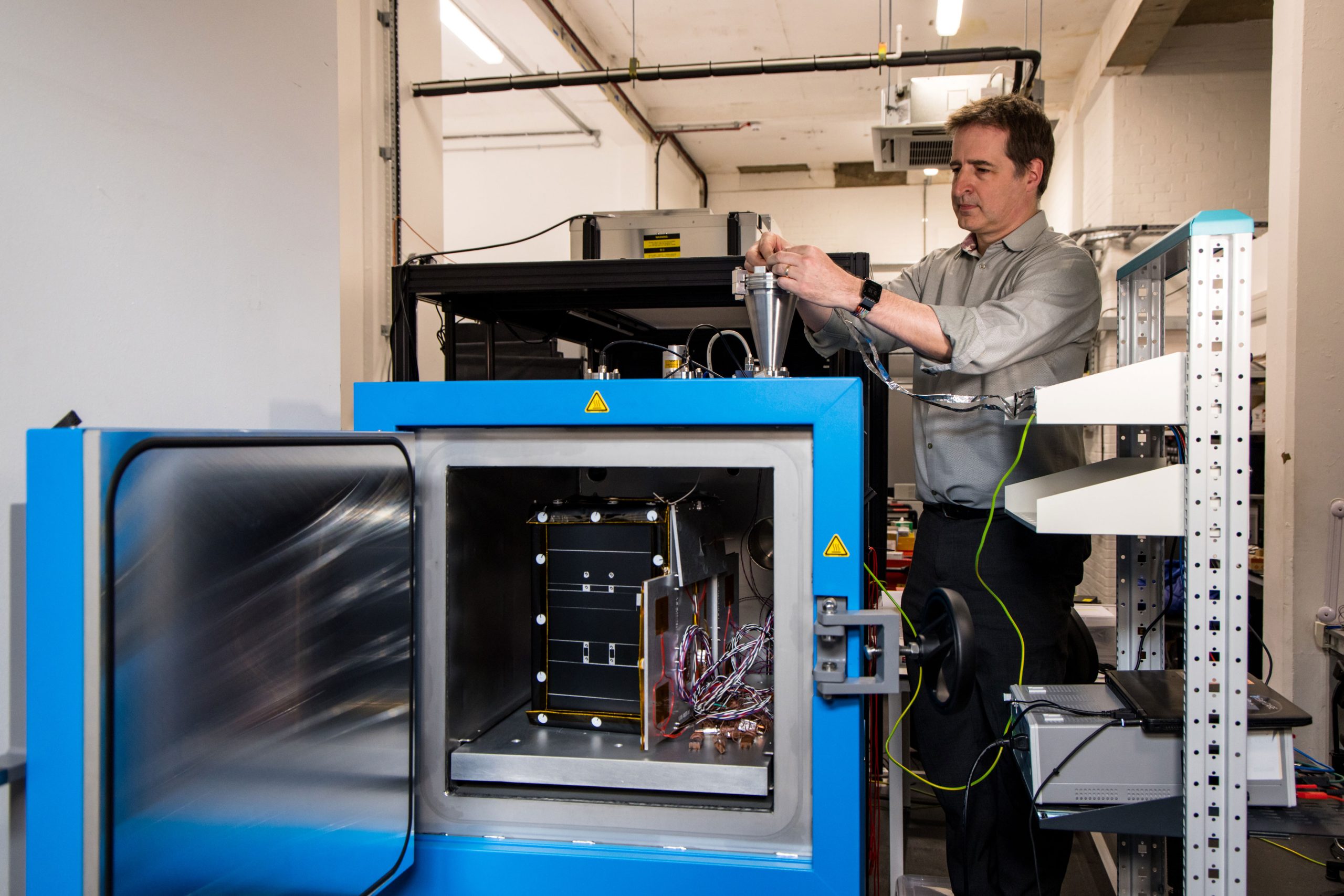
“CosmoCube is aiming to do some ambitious science from a very small satellite in a challenging environment, and to do that requires some clever design techniques,” said co-author Dr Will Grainger from STFC RAL Space. “We’ve worked with the project partners to develop representative models of the satellite and its payload. These have been tested in our facilities to ensure the thermal performance allows the payload to operate and perform the required sensitive measurements under the different temperature conditions it will experience while in orbit around the Moon. In the future, we hope to further develop the full payload in preparation for a full mission.”
“This could be a real UK success story: the hardware, the software, the implementation, and the technology is all being developed here, and it could help us answer one of the most profound questions in the universe,” said de Lera Acedo.
Reference: “The CosmoCube lunar mission for probing the dark ages and cosmic dawn via 21-cm cosmology” by Eloy de lera Acedo, David Bacon, Will Grainger, Dominic Anstey, Harry Bevins, Lucinda King, Kaan Artuc, Mohammed Al-Badri, Chris Pearson, Suresh Balaji, Richard Holdaway, Judd Bowman, Daniel Jacobs, Theodora Varelidi-Strati, Steve Eckersley, Abigail Harvey, Andrea Turconi, Ana-Maria Dorobat, Andri M. Gretarsson, Yabin Liao, Xan Morice-Atkinson and Olugbenga Olumodimu, 14 August 2026, Nature Astronomy.
DOI: 10.1038/s41550-026-02946-y
The work was supported in part by the UK Space Agency, the Kavli Foundation, and the Science and Technology Facilities Council (STFC), part of UK Research and Innovation (UKRI). Eloy de Lera Acedo is a Fellow of Selwyn College, Cambridge.
Never miss a breakthrough: Join the SciTechDaily newsletter.
Follow us on Google and Google News.
1 Comment
A signal with wavelength of 21 cm has a frequency of about 1428 MHz. The cosmological redshift from emissions of 13.4 billion years ago reduces the frequency that we detect to around 25 MHz. That detail is missing. BTW, 25 MHz is in a band known as “HF”, or “high frequency”. Calling 25 MHz “extremely low frequency” depends on your point of view, I guess. Our AM radio band goes down to 0.535 MHz.