
Close Menu
    Facebook X (Twitter) Instagram
    SciTechDaily
    • Biology
    • Chemistry
    • Earth
    • Health
    • Physics
    • Science
    • Space
    • Technology
    Facebook X (Twitter) Pinterest YouTube RSS
    SciTechDaily
    Home»Space»If Life Can Travel Between The Stars We Should Be Able To Detect It
    Space

    If Life Can Travel Between The Stars We Should Be Able To Detect It

    By Harvard-Smithsonian Center for AstrophysicsAugust 27, 2015No Comments3 Mins Read
    Facebook Twitter Pinterest Telegram LinkedIn WhatsApp Email Reddit
    Share
    Facebook Twitter LinkedIn Pinterest Telegram Email Reddit
    Harvard Astronomers Interstellar Seeds Could Create Oases of Life
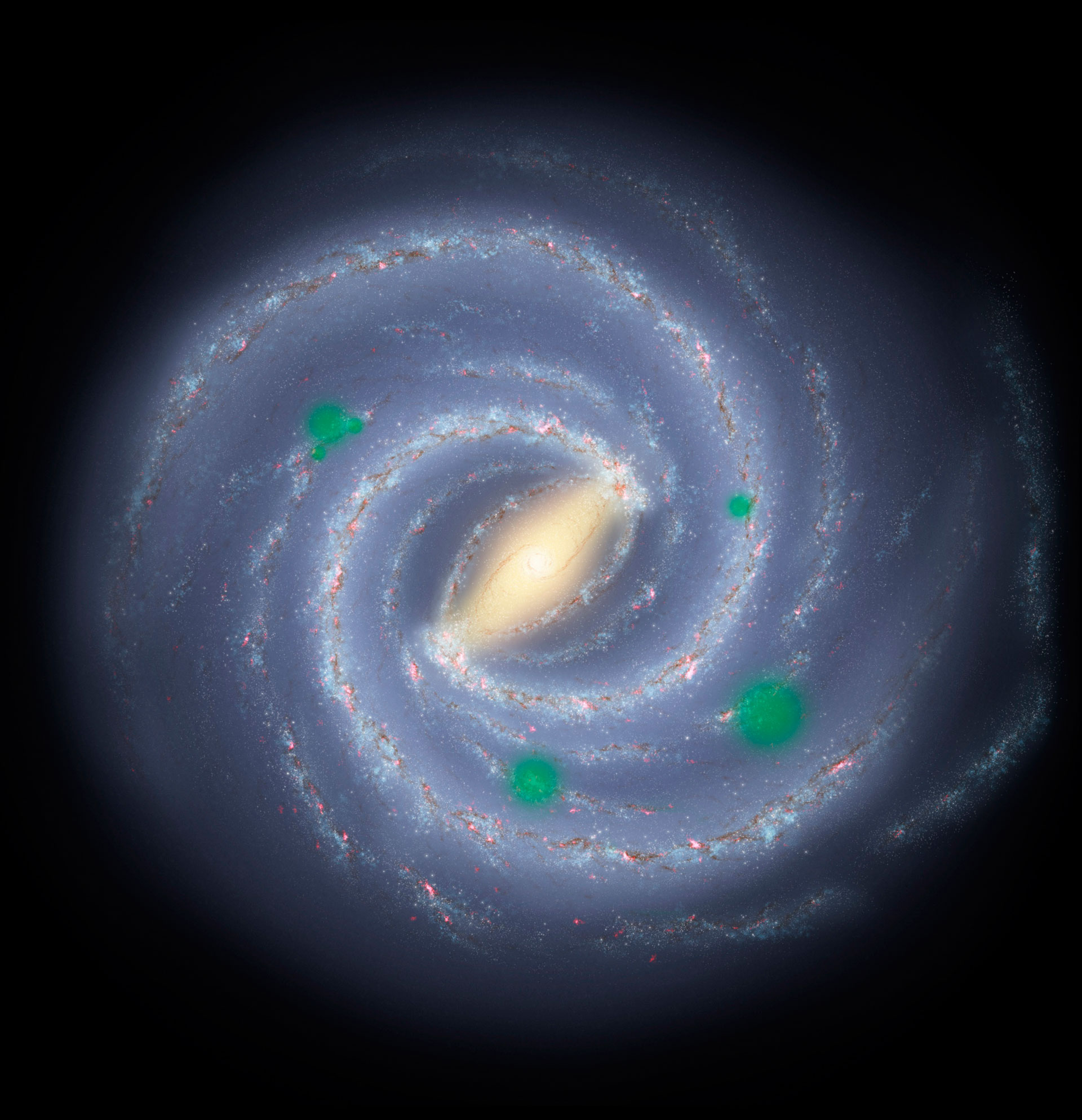
    In this theoretical artist’s conception of the Milky Way galaxy, translucent green “bubbles” mark areas where life has spread beyond its home system to create cosmic oases, a process called panspermia. Credit: NASA/JPL/R. Hurt

    A new study from the Harvard-Smithsonian Center for Astrophysics suggests that if life can travel between the stars (in a process called panspermia), it would spread in a characteristic pattern that we could potentially identify.

    We only have one example of a planet with life: Earth. But within the next generation, it should become possible to detect signs of life on planets orbiting distant stars. If we find alien life, new questions will arise. For example, did that life arise spontaneously? Or could it have spread from elsewhere? If life crossed the vast gulf of interstellar space long ago, how would we tell?

    “In our theory clusters of life form, grow, and overlap like bubbles in a pot of boiling water,” says lead author Henry Lin of the Harvard-Smithsonian Center for Astrophysics (CfA).

    There are two basic ways for life to spread beyond its host star. The first would be via natural processes such as gravitational slingshotting of asteroids or comets. The second would be for intelligent life to deliberately travel outward. The paper does not deal with how panspermia occurs. It simply asks: if it does occur, could we detect it? In principle, the answer is yes.

    The model assumes that seeds from one living planet spread outward in all directions. If a seed reaches a habitable planet orbiting a neighboring star, it can take root. Over time, the result of this process would be a series of life-bearing oases dotting the galactic landscape.

    “Life could spread from host star to host star in a pattern similar to the outbreak of an epidemic. In a sense, the Milky Way galaxy would become infected with pockets of life,” explains CfA co-author Avi Loeb.

    If we detect signs of life in the atmospheres of alien worlds, the next step will be to look for a pattern. For example, in an ideal case where the Earth is on the edge of a “bubble” of life, all the nearby life-hosting worlds we find will be in one half of the sky, while the other half will be barren.

    Lin and Loeb caution that a pattern will only be discernible if life spreads somewhat rapidly. Since stars in the Milky Way drift relative to each other, stars that are neighbors now won’t be neighbors in a few million years. In other words, stellar drift would smear out the bubbles.

    This research has been accepted for publication in The Astrophysical Journal Letters.

    Reference: “Statistical Signatures of Panspermia in Exoplanet Surveys” by Henry W. Lin and Abraham Loeb, 21 August 2015, The Astrophysical Journal Letters.
    DOI: 10.1088/2041-8205/810/1/L3
    arXiv: 1507.05614

    Never miss a breakthrough: Join the SciTechDaily newsletter.
    Follow us on Google and Google News.

    Astronomy Astrophysics Cosmology Harvard-Smithsonian Center for Astrophysics Life Panspermia Space Exploration
    Share. Facebook Twitter Pinterest LinkedIn Email Reddit

    Related Articles

    “Finding Life in Outer Space” – Travel Across Time and Space Exploring Why Life Exists

    Astronomers Measure the Rotation Periods of Thirty Sun-Like Stars

    A Significant Step Towards Explaining the Cosmic Origins of the Seeds of Galaxies

    A Deficit of Ultra-Luminous X-Ray Sources in Starburst Galaxies

    Astronomers Search for Trigger of Nearby Supernova

    Herschel Observations Help Identify the Physical Processes Underway in Cold, Dense Clouds

    CfA Scientists Measure the Rate of Expansion of the Universe

    New Study Challenges Planck Results

    Calculations Show the Ideal Time to Study the Cosmos

    Leave A Reply Cancel Reply

    • Facebook
    • Twitter
    • Pinterest
    • YouTube

    Don't Miss a Discovery

    Subscribe for the Latest in Science & Tech!

    Trending News

    Bone-Strengthening Discovery Could Reverse Osteoporosis

    Scientists Uncover Hidden Trigger Behind Stem Cell Aging

    Scientists Find Way to Reverse Fatty Liver Disease Without Changing Diet

    Could Humans Regrow Limbs? New Study Reveals Promising Genetic Pathway

    Scientists Reveal Eating Fruits and Vegetables May Increase Your Risk of Lung Cancer

    Scientists Reverse Brain Aging With Simple Nasal Spray

    Scientists Uncover Potential Brain Risks of Popular Fish Oil Supplements

    Scientists Discover a Surprising Way To Make Bread Healthier and More Nutritious

    Follow SciTechDaily
    • Facebook
    • Twitter
    • YouTube
    • Pinterest
    • Newsletter
    • RSS
    SciTech News
    • Biology News
    • Chemistry News
    • Earth News
    • Health News
    • Physics News
    • Science News
    • Space News
    • Technology News
    Recent Posts
    • Scientists Decode Mysterious Magnetic “Maze Domains” To Boost EV Efficiency
    • Scientists Say This Fungus Could Survive the Trip to Mars
    • The Universe Is Expanding Too Fast and Scientists Can’t Explain Why
    • Gaining Weight Young May Be More Dangerous Than You Think
    • Scientists Discover Hidden Pathway Inside Catalysts That Defies Decades of Assumptions
    Copyright © 1998 - 2026 SciTechDaily. All Rights Reserved.
    • Science News
    • About
    • Contact
    • Editorial Board
    • Privacy Policy
    • Terms of Use

    Type above and press Enter to search. Press Esc to cancel.