
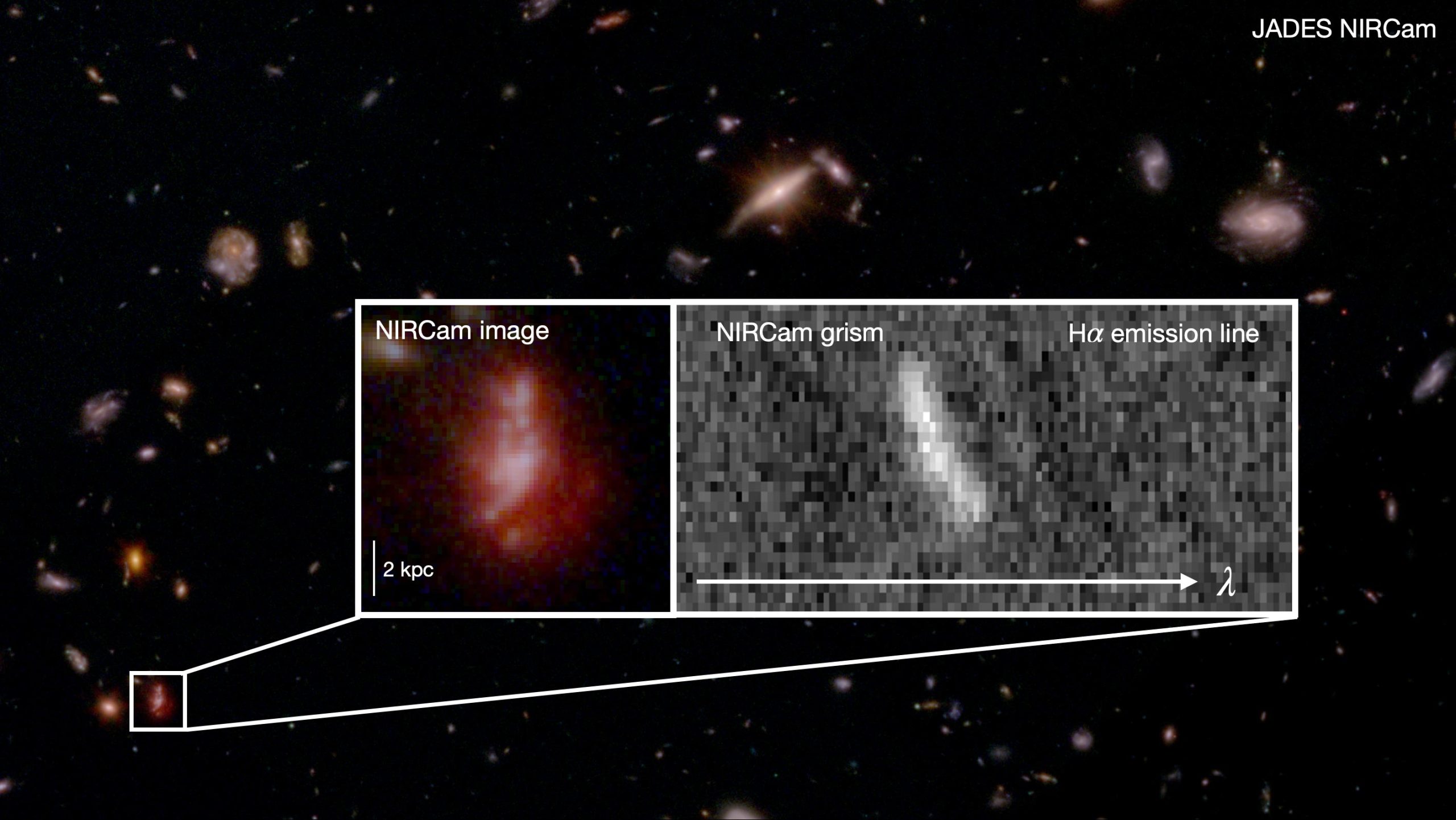
Using the James Webb Space Telescope, astronomers have captured the clearest picture yet of how galaxies formed in the early universe.
Instead of neat spiral structures, these galaxies were gas-filled and chaotic, constantly reshaped by starbursts and collisions. The research bridges a key gap between the universe’s earliest light and its era of peak star formation, showing how disorder slowly evolved into stability.
Chaotic Beginnings of the Cosmos
Astronomers using the James Webb Space Telescope (JWST) have captured the clearest and most detailed view yet of how galaxies formed only a few hundred million years after the Big Bang. Their observations reveal that the earliest galaxies were far more chaotic and disordered than the structured systems seen across the universe today.
The research team, led by scientists from the University of Cambridge, examined over 250 young galaxies that existed when the universe was between 800 million and 1.5 billion years old. By analyzing how gas moved within these galaxies, they found that most were turbulent, uneven collections of material rather than smooth, rotating disks like the Milky Way.
A Universe Moving Toward Order
The results, published in Monthly Notices of the Royal Astronomical Society, indicate that galaxies gradually became calmer and more stable as the universe aged. In its earliest stages, however, powerful bursts of star formation and gravitational forces created intense turbulence that prevented many galaxies from settling into regular patterns.
“We don’t just see a few spectacular outliers – this is the first time we’ve been able to look at an entire population at once,” said first author Lola Danhaive from Cambridge’s Kavli Institute for Cosmology. “We found huge variation: some galaxies are beginning to settle into ordered rotation, but most are still chaotic, with gas puffed up and moving in all directions.”
Unraveling Galactic Motion With JWST’s Grism Mode
To capture these insights, the researchers used JWST’s NIRCam instrument in a specialized “grism mode,” which detects faint light from ionised hydrogen gas in faraway galaxies. Danhaive developed custom software to interpret the complex data, combining it with imagery from other JWST programs to trace how gas moved inside each galaxy.
“Previous results suggested massive, well-ordered disks forming very early on, which didn’t fit our models,” said co-author Dr. Sandro Tacchella from the Kavli Institute and the Cavendish Laboratory. “But by looking at hundreds of galaxies with lower stellar masses instead of just one or two, we see the bigger picture, and it’s much more in line with theory. Early galaxies were more turbulent, less stable, and grew up through frequent mergers and bursts of star formation.”
From Cosmic Chaos to Galactic Order
“This work helps bridge the gap between the epoch of reionisation and the so-called cosmic noon, when star formation peaked,” said Danhaive, who is also affiliated with the Cavendish Laboratory. “It shows how the building blocks of galaxies gradually transitioned from chaotic clumps into ordered structures, and how galaxies such as the Milky Way formed.”
The results show how JWST allows scientists to probe galaxy dynamics at a scale that was impossible before. Future studies will aim to combine these findings with observations of cold gas and dust to paint a fuller picture of how the earliest galaxies took shape.
The Road Ahead for Cosmic Discovery
“This is just the beginning,” said Tacchella. “With more data, we’ll be able to track how these turbulent systems grew up and became the graceful spirals we see today.”
Reference: “The dawn of discs: unveiling the turbulent ionized gas kinematics of the galaxy population at z ∼ 4–6 with JWST/NIRCam grism spectroscopy” by A Lola Danhaive, Sandro Tacchella, Hannah Übler, Anna de Graaff, Eiichi Egami, Benjamin D Johnson, Fengwu Sun, Santiago Arribas, Andrew J Bunker, Stefano Carniani, Gareth C Jones, Roberto Maiolino, William McClymont, Eleonora Parlanti, Charlotte Simmonds, Natalia C Villanueva, William M Baker, Daniel T Jaffe, Daniel Eisenstein, Kevin Hainline, Jakob M Helton, Zhiyuan Ji, Xiaojing Lin, Yichen Liu, Dávid Puskás, Marcia Rieke, Pierluigi Rinaldi, Brant Robertson, Jan Scholz, Christina C Williams and Christopher N A Willmer, 22 October 2025, Monthly Notices of the Royal Astronomical Society.
DOI: 10.1093/mnras/staf1540
The research was supported in part by the Royal Society, the European Union, and the Science and Technology Facilities Council (STFC), part of UK Research and Innovation (UKRI). JWST is an international partnership between NASA, ESA and the Canadian Space Agency (CSA). The data for this result were captured as part of the JWST Advanced Deep Extragalactic Survey (JADES). Sandro Tacchella is a Fellow of St Edmund’s College, Cambridge. Lola Danhaive is a PhD student in the Centre for Doctoral Training (CDT) in Data Intensive Science.
Never miss a breakthrough: Join the SciTechDaily newsletter.
Follow us on Google and Google News.
1 Comment
In my opinion, there is no chaos. Everything remains in a certain order. The expansion of universe is a thermodynamic process of internal energy changing into speed. The previous contraction during which speed changes into internal energy, some bodies disintegrate into atoms, which thus acquire high energy and have random motion. When expansion starts, the atoms reintegrate into bodies, their energies being transferred to the body formed. The universe always remains as an orderly system of super-galaxy clusters, which oscillate between states of maximum internal energy and maximum speed.