
Close Menu
    Facebook X (Twitter) Instagram
    SciTechDaily
    • Biology
    • Chemistry
    • Earth
    • Health
    • Physics
    • Science
    • Space
    • Technology
    Facebook X (Twitter) Pinterest YouTube RSS
    SciTechDaily
    Home»Biology»To Speed Discovery, High-Dimensional Infrared Microscopy Goes “Off the Grid”
    Biology

    To Speed Discovery, High-Dimensional Infrared Microscopy Goes “Off the Grid”

    By Lawrence Berkeley National LaboratoryMay 16, 2021No Comments3 Mins Read
    Facebook Twitter Pinterest Telegram LinkedIn WhatsApp Email Reddit
    Share
    Facebook Twitter LinkedIn Pinterest Telegram Email Reddit
    Tiling Pattern Scanning Roundworm
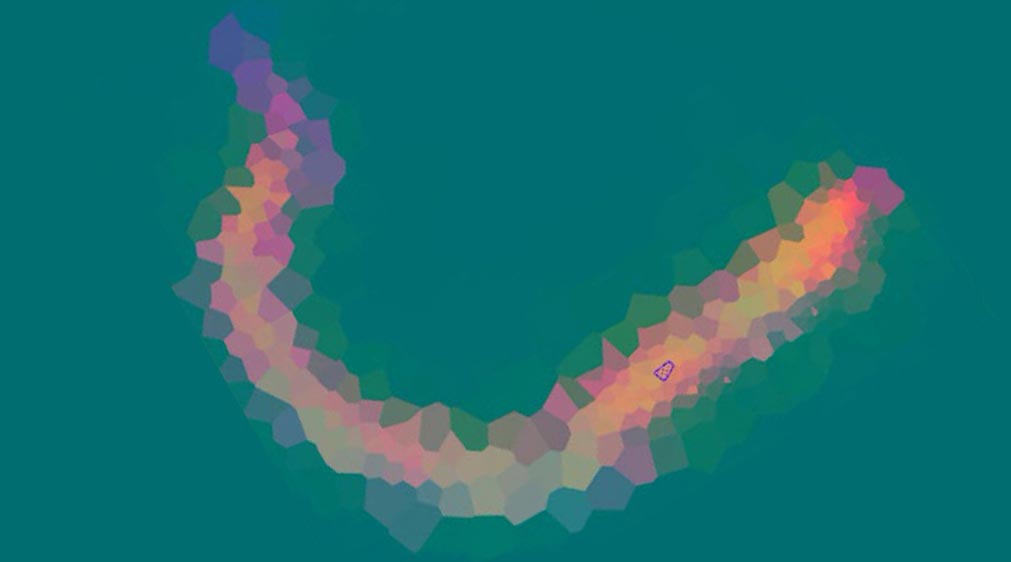
    Example of the tiling pattern used in scanning a C. elegans roundworm. The non-grid-based pattern gives the sampling algorithm greater flexibility to quickly zero in on areas of interest. Credit: Elizabeth Holman/Caltech and Yuan-Sheng Fang/Berkeley Lab

    A highly efficient way to collect infrared microscopy data avoids the use of slow, grid-based raster scans.

    Question: What do a roundworm, a Sharpie pen, and high-vacuum grease have in common? Answer: They’ve all been analyzed in recent proof-of-principle microscopy experiments at Berkeley Lab’s Advanced Light Source (ALS).

     In the journal Communications Biology, researchers from Caltech, UC Berkeley, and the Berkeley Synchrotron Infrared Structural Biology Imaging Program (BSISB) reported a more efficient way to collect “high-dimensional” infrared images – where each pixel contains rich physical and chemical information. With the new method, scans that would’ve taken up to 10 hours to complete can now be done in under an hour, potentially broadening the scope of biological spectromicroscopy to time-sensitive experiments.

    “We realized that sampling our model organism – the small roundworm C. elegans – as it changes over time was challenging for software rather than hardware reasons,” said Elizabeth Holman, a graduate student in chemistry at Caltech and co-first author of the paper. “For example, image sampling was limited to uniform-grid raster scans with rectangular boundaries and fixed distances between sample points.”

    Adaptive Scanning for Better Detail and Efficiency

     The new technique, implemented at the ALS with co-first author Yuan-Sheng Fang, a graduate student in physics at UC Berkeley, uses a grid-less, adaptive approach that autonomously increases sampling in areas displaying greater physical or chemical contrast. In the proof-of-concept infrared microscopy experiments, the researchers examined two samples.

    The first was a two-component system in which both components (permanent-marker ink and high-vacuum grease) were well characterized. Details of the sample were very difficult to see clearly with the naked eye, so it was a good test of how the software would perform with minimal guidance from a human experimenter. The second sample was a live, larval-stage C. elegans, a biological model system studied by thousands of researchers. 

    In both cases, autonomous adaptive data acquisition (AADA) methods clearly outperformed nonadaptive methods. In the second example, increased sampling density corresponded with known C. elegans anatomical features, and the head region was mapped in 45 minutes versus about 4.9 hours using commercially available software. 

    “Outside of our specific published work, the results suggest that integrating AADA into existing scanning-based satellite, drone, and/or microscope techniques can facilitate research in fields ranging from hyperspectral remote sensing to ocean and space exploration,” said Holman.

    Reference: “Autonomous adaptive data acquisition for scanning hyperspectral imaging” by Elizabeth A. Holman, Yuan-Sheng Fang, Liang Chen, Michael DeWeese, Hoi-Ying N. Holman and Paul W. Sternberg, 18 November 2020, Communications Biology.
    DOI: 10.1038/s42003-020-01385-3

    Never miss a breakthrough: Join the SciTechDaily newsletter.
    Follow us on Google and Google News.

    DOE Imaging Lawrence Berkeley National Laboratory
    Share. Facebook Twitter Pinterest LinkedIn Email Reddit

    Related Articles

    A COSMIC Approach to Nanoscale Science: World-Leading Resolution of Nanomaterials

    How to Quickly and Easily Find Mutated Sperm? Just Go FISH

    Scientists Map the Odd Structure of the Coronavirus Protein Linked to Immune Evasion and Disease Severity

    Uncovering Novel Genomes From Earth’s Microbiomes – Expands Known Diversity of Bacteria and Archaea by 44%

    “Missing Link” Discovered in the Evolutionary History of Carbon-Fixing Protein Rubisco

    New Algorithm Sharpens Focus of World’s Most Powerful Microscopes – Improves Cryo-EM 3D Molecular Structure Maps

    The Human Genome’s Instruction Manual: 17-Year Research Project Has Generated a Detailed Genomic Atlas

    A Matchmaker for Microbiomes – Identifying Relationships of Microbes and Metabolites

    New Genetic Engineering Tool Unlocks Biochemical Treasure Chest Within Microbes

    Leave A Reply Cancel Reply

    • Facebook
    • Twitter
    • Pinterest
    • YouTube

    Don't Miss a Discovery

    Subscribe for the Latest in Science & Tech!

    Trending News

    Even Occasional Binge Drinking May Triple Liver Damage Risk

    Liftoff! NASA’s Artemis II Launch Sends Astronauts Around the Moon for First Time in 50 Years

    Scientists Discover New Way To Eliminate “Zombie Cells” Driving Aging

    This New Quantum Theory Could Change Everything We Know About the Big Bang

    This One Vitamin May Help Protect Your Brain From Dementia Years Later

    Stopping Weight-Loss Drugs Like Ozempic Can Quickly Erase Heart Benefits

    A 500-Million-Year-Old Surprise Is Forcing Scientists to Rethink Spider Evolution

    Coffee and Blood Pressure: What You Need To Know Before Your Next Cup

    Follow SciTechDaily
    • Facebook
    • Twitter
    • YouTube
    • Pinterest
    • Newsletter
    • RSS
    SciTech News
    • Biology News
    • Chemistry News
    • Earth News
    • Health News
    • Physics News
    • Science News
    • Space News
    • Technology News
    Recent Posts
    • Scientists Create Healing Gel That Could Stop Chronic Wounds From Turning Deadly
    • Scientists Discover Cancer Tumors Are “Addicted” to This Common Antioxidant
    • Tiny 436-Million-Year-Old Fish Fossil Rewrites the Origins of Vertebrates
    • 1,800 Miles Down: Scientists Uncover Mysterious Movements at the Edge of Earth’s Core
    • Scientists Uncover Earth’s Hidden “Gold Kitchen” Beneath the Ocean Floor
    Copyright © 1998 - 2026 SciTechDaily. All Rights Reserved.
    • Science News
    • About
    • Contact
    • Editorial Board
    • Privacy Policy
    • Terms of Use

    Type above and press Enter to search. Press Esc to cancel.