
Close Menu
    Facebook X (Twitter) Instagram
    SciTechDaily
    • Biology
    • Chemistry
    • Earth
    • Health
    • Physics
    • Science
    • Space
    • Technology
    Facebook X (Twitter) Pinterest YouTube RSS
    SciTechDaily
    Home»Space»Tsunami in the Skies: Unraveling the Mysteries of Atmospheric Acceleration on Venus
    Space

    Tsunami in the Skies: Unraveling the Mysteries of Atmospheric Acceleration on Venus

    By University of SevilleApril 2, 2023No Comments4 Mins Read
    Facebook Twitter Pinterest Telegram LinkedIn WhatsApp Email Reddit
    Share
    Facebook Twitter LinkedIn Pinterest Telegram Email Reddit
    Sulfurous Venusian Cloud Cover
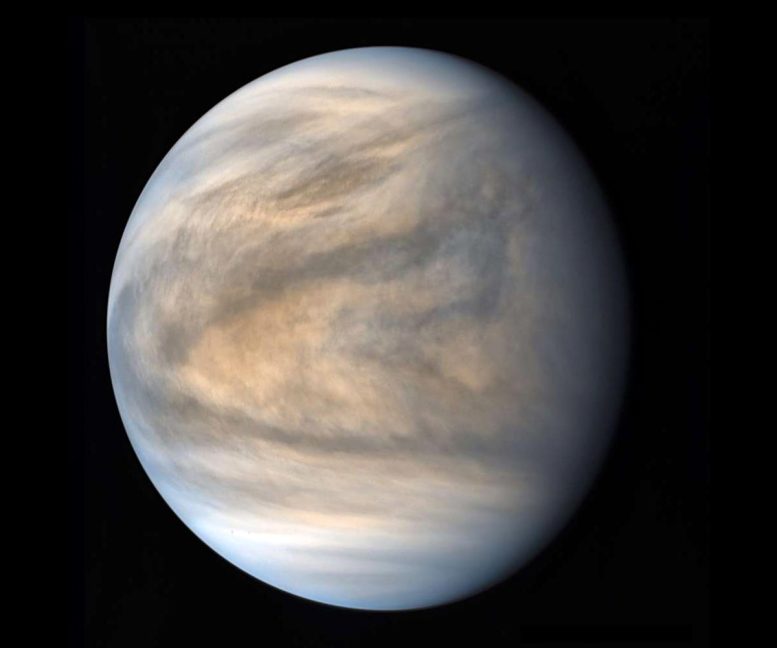
    A false-color image of the sulfurous Venusian cloud cover was produced using two ultraviolet channels from Akatsuki, the Japanese PLANET-C, and Venus Climate Orbiter, which highlights the convective turbulence of the planet’s tropical regions, in contrast with the clear, smoother polar regions. Credit: Daimia Bouic/JAXA/ISAS/DARTS

    Experts from the Universities of Seville and of the Basque Country believe that discontinuity may be playing a very significant role in the acceleration of this planet’s atmosphere.

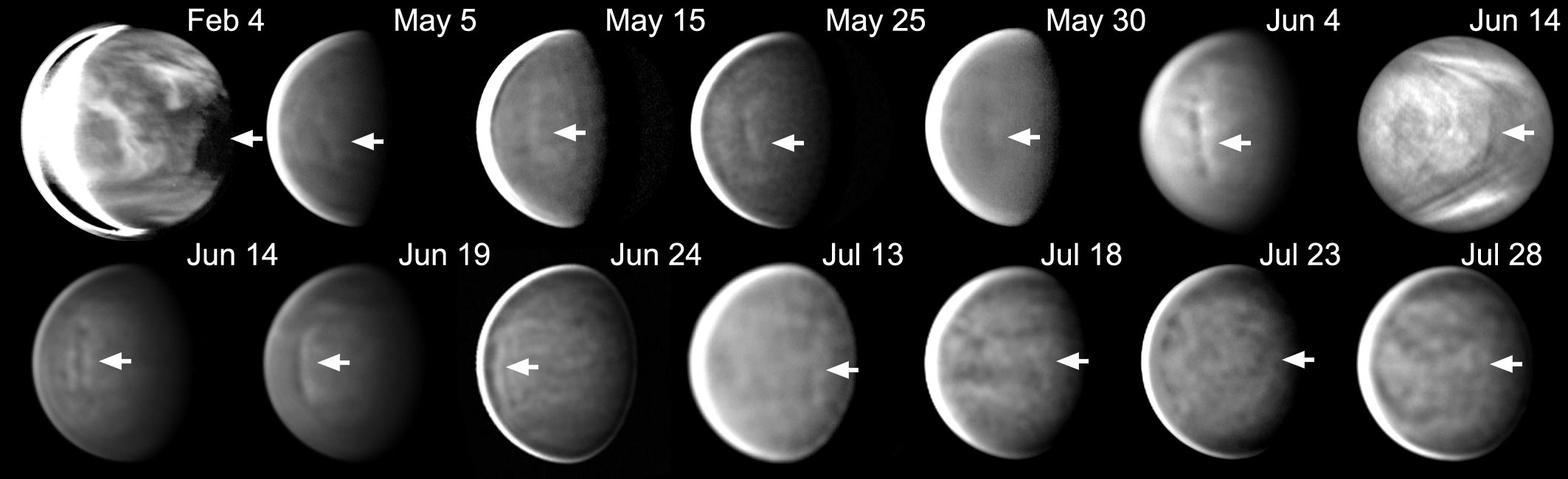
    A group of scientists from the University of Seville, in collaboration with experts from the University of the Basque Country, has led the first detailed study of the evolution of the discontinuity of Venus’s clouds, a gigantic atmosphere wave with the appearance of a “tsunami” that is propagated in the planet’s deepest clouds and which, it is believed, may be playing a very significant role in the acceleration of Venus’s fast-moving atmosphere. The observations were carried out non-stop for more than 100 days. “This observational feat was possible thanks to the collaboration of amateur astronomers from various countries, who have been the leading lights in the worldwide campaign of observations coordinated with the Japanese mission Akatsuki in 2022,” explains the University of Seville researcher and member of this mission, Javier Peralta. 

    This paper published on March 28 in the journal Astronomy & Astrophysics has also revealed a truly unexpected event, since the ultraviolet images taken in June by the UVI camera on board the Akatsuki mission (which allows us to see the highest clouds in Venus) seem to reflect the fact that the discontinuity was capable of propagating for a few hours to around 70 km above the surface of Venus. “This is surprising, because until now the discontinuity appeared ‘trapped’ in the deepest clouds and we had never observed it at such a high altitude,” explains Peralta.
    Venus Discontinuity Events
    Examples of discontinuity events during 2022. The discontinuity was apparent on the nightside lower clouds with 2.26 μm images from IRTF/SpeX taken on February 4, and at the dayside middle clouds as observed in images by amateur observers taken with filters covering wavelengths 700–900 nm from May to July 2022. During June 14, Akatsuki/UVI images at 365 nm suggest that the discontinuity was propagating simultaneously at the upper and middle clouds (last image in upper row). All the images were high-pass filtered to enhance cloud details. Credit: Astronomy & Astrophysics, DOI: 10.1051/0004-6361/202244822

    The astrophysicist Javier Peralta was responsible for designing in 2022 the strategy for WISPR’s Venus observations during the spacecraft’s approach/departure manoeuvres during Parker’s flybys. He also contributed to physical interpretation of the observations, comparing thermal emission images of the surface of Venus taken by WISPR (NASA-Parker) and the IR1 camera (JAXA-Akatsuki).

    In this vein, the Akatsuki images not only point to the fact that the discontinuity may have propagated to Venus’ upper clouds, but also help us to understand the reasons for this displacement. In general, regions where winds have the same speed as a wave act as a physical “barrier” for the propagation of that wave. Because winds gradually increase with height on Venus and have higher speeds than the discontinuity at the peak of the clouds, the discontinuity attempts to propagate upwards from the deep clouds, but meets this obstacle on its way and eventually dissipates. Thus, experts were surprised when they measured the winds in the high clouds with Akatsuki: they found that they were unusually slow in the first half of 2022, several times slower than the discontinuity itself. And if the winds grow much more slowly with height, the discontinuity takes longer to find atmospheric regions as fast as itself, allowing it to propagate to higher altitudes.

    “Measuring the winds on Venus is essential to try to explain why Venus’s atmosphere spins 60 times faster than the surface. This atmospheric phenomenon is known as superrotation. It also happens on the Saturn moon Titan and on many exoplanets, but after more than half a century o research we still cannot satisfactorily explain it,” explains this researcher.

    Reference: “Venus cloud discontinuity in 2022: The first long-term study with uninterrupted observations” by J. Peralta, A. Cidadão, L. Morrone, C. Foster, M. Bullock, E. F. Young, I. Garate-Lopez, A. Sánchez-Lavega, T. Horinouchi, T. Imamura, E. Kardasis, A. Yamazaki and S. Watanabe, 28 March 2023, Astronomy & Astrophysics.
    DOI: 10.1051/0004-6361/202244822

    Never miss a breakthrough: Join the SciTechDaily newsletter.
    Follow us on Google and Google News.

    Atmospheric Science Geophysics Planets University of Seville Venus
    Share. Facebook Twitter Pinterest LinkedIn Email Reddit

    Related Articles

    High-Speed Impacts May Have Shaped Venus’ History – And Explain Why It Is Uninhabitable

    New Findings Suggest Venus Never Had Oceans, Conditions Needed for Life

    Space-Based Infrared Imaging Reveals the Nighttime Weather on Venus

    How Planets Form Determines Whether They Retain Elements Essential for Life

    Life on Venus? Scientists Shed More Light on Molecules Linked to Life on Other Planets

    Devourer of Storms: Jupiter’s Great Red Spot Feeds on Smaller Storms

    Venus’ Ancient Layered, Folded Terrain Points to Volcanic Origin

    How Venus and Mars Can Teach Us About the Past and Future of Earth

    Venus’ Atmosphere Rotates Far Faster Than Its Surface Because of Thermal Tides

    Leave A Reply Cancel Reply

    • Facebook
    • Twitter
    • Pinterest
    • YouTube

    Don't Miss a Discovery

    Subscribe for the Latest in Science & Tech!

    Trending News

    One of the Universe’s Largest Stars May Be Getting Ready To Explode

    Scientists Discover Enzyme That Could Supercharge Ozempic-Like Weight Loss Drugs

    Popular Sweetener Linked to DNA Damage – “It’s Something You Should Not Be Eating”

    Ancient “Rock” Microbes May Reveal How Complex Life Began

    Researchers Capture Quantum Interference in One of Nature’s Rarest Atoms

    “A Plague Is Upon Us”: The Mass Death That Changed an Ancient City Forever

    Scientists Discover Game-Changing New Way To Treat High Cholesterol

    This Small Change to Your Exercise Routine Could Be the Secret to Living Longer

    Follow SciTechDaily
    • Facebook
    • Twitter
    • YouTube
    • Pinterest
    • Newsletter
    • RSS
    SciTech News
    • Biology News
    • Chemistry News
    • Earth News
    • Health News
    • Physics News
    • Science News
    • Space News
    • Technology News
    Recent Posts
    • Natural Compounds Boost Bone Implant Success While Killing Bacteria and Cancer Cells
    • After 60 Years, Scientists Uncover Unexpected Brain Effects of Popular Diabetes Drug Metformin
    • New Research Uncovers Hidden Side Effects of Popular Weight-Loss Drugs
    • Scientists Rethink Extreme Warming After Surprising Ocean Discovery
    • The Surprising Role of Asteroids in the Origin of Life
    Copyright © 1998 - 2026 SciTechDaily. All Rights Reserved.
    • Science News
    • About
    • Contact
    • Editorial Board
    • Privacy Policy
    • Terms of Use

    Type above and press Enter to search. Press Esc to cancel.