
An innovative study of DNA’s hidden structures may open up new approaches for the treatment and diagnosis of diseases, including cancer.
Researchers at the Garvan Institute have unveiled the first comprehensive map of over 50,000 i-motifs in the human genome, structures distinct from the classic double helix that may play crucial roles in gene regulation and disease. These findings highlight the potential of i-motifs in developing new therapies, particularly in targeting genes associated with cancers.
Unraveling the Mysteries of DNA i-Motifs
DNA is well-known for its double helix shape. But the human genome also contains more than 50,000 unusual ‘knot’-like DNA structures called i-motifs, researchers at the Garvan Institute of Medical Research have discovered.
Published today (August 29) in The EMBO Journal is the first comprehensive map of these unique DNA structures, shedding light on their potential roles in gene regulation involved in disease.
In a landmark 2018 study, Garvan scientists were the first to directly visualize i-motifs inside living human cells using a new antibody tool they developed to recognize and attach to i-motifs. The current research builds on those findings by deploying this antibody to identify i-motif locations across the entire genome.
“In this study, we mapped more than 50,000 i-motif sites in the human genome that occur in all three of the cell types we examined,” says senior author Professor Daniel Christ, Head of the Antibody Therapeutics Lab and Director of the Centre for Targeted Therapy at Garvan. “That’s a remarkably high number for a DNA structure whose existence in cells was once considered controversial. Our findings confirm that i-motifs are not just laboratory curiosities but widespread – and likely to play key roles in genomic function.”
Key Roles of i-Motifs in Gene Regulation
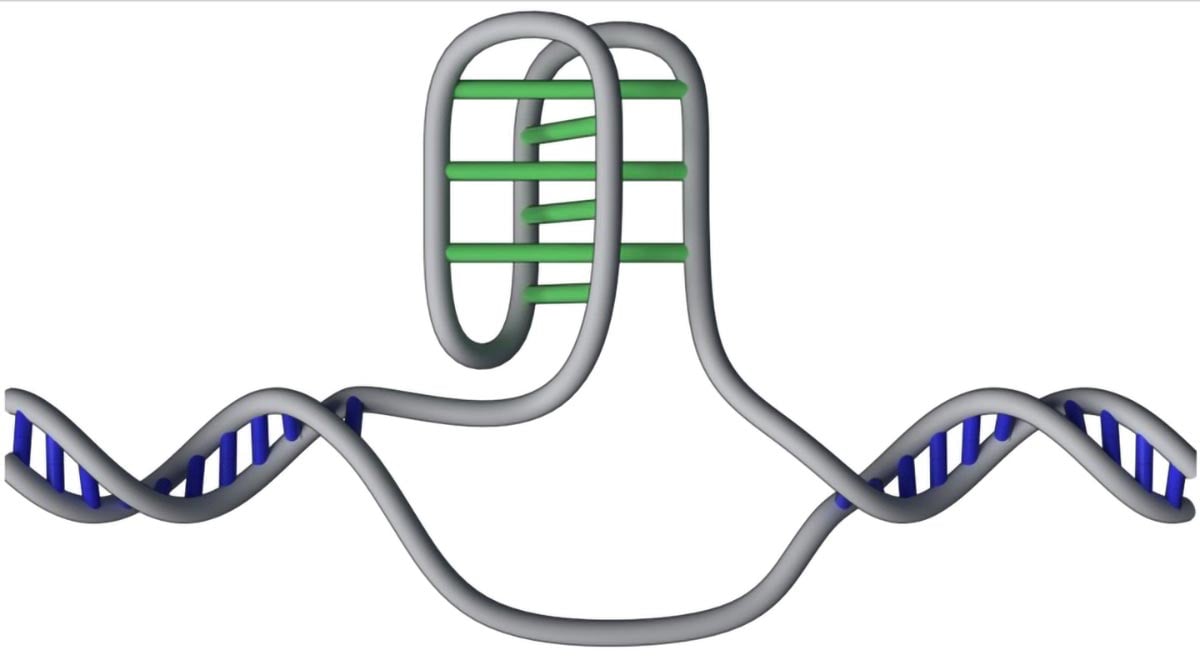
I-motifs are DNA structures that differ from the iconic double helix shape. They form when stretches of cytosine letters on the same DNA strand pair with each other, creating a four-stranded, twisted structure protruding from the double helix.
Animation of DNA’s knot-like i-motif structure the team mapped in 50,000 locations in the human genome, concentrated in key functional areas including regions that control gene activity. Credit: Cristian David Pena Martinez / Garvan Institute
The researchers found that i-motifs are not randomly scattered but concentrated in key functional areas of the genome, including regions that control gene activity.
“We discovered that i-motifs are associated with genes that are highly active during specific times in the cell cycle. This suggests they play a dynamic role in regulating gene activity,” says Cristian David Peña Martinez, a research officer in the Antibody Therapeutics Lab and first author of the study.
“We also found that i-motifs form in the promoter region of oncogenes, for instance, the MYC oncogene, which encodes one of cancer’s most notorious ‘undruggable’ targets. This presents an exciting opportunity to target disease-linked genes through the i-motif structure,” he says.

Therapeutic Potential of i-Motifs
“The widespread presence of i-motifs near these ‘holy grail’ sequences involved in hard-to-treat cancers opens up new possibilities for new diagnostic and therapeutic approaches. It might be possible to design drugs that target i-motifs to influence gene expression, which could expand current treatment options,” says Associate Professor Sarah Kummerfeld, Chief Scientific Officer at Garvan and co-author of the study.
Professor Christ adds that mapping i-motifs was only possible thanks to Garvan’s world-leading expertise in antibody development and genomics. “This study is an example of how fundamental research and technological innovation can come together to make paradigm-shifting discoveries,” he says.
Reference: “Human genomic DNA is widely interspersed with i-motif structures” by Cristian David Peña Martinez, Mahdi Zeraati, Romain Rouet, Ohan Mazigi, Jake Y Henry, Brian Gloss, Jessica A Kretzmann, Cameron W Evans, Emanuela Ruggiero, Irene Zanin, MarušičMaja, Janez Plavec, Sara N Richter, Tracy M Bryan, Nicole M Smith, Marcel E Dinger, Sarah Kummerfeld and Daniel Christ, 29 August 2024, The EMBO Journal.
DOI: 10.1038/s44318-024-00210-5
Professor Daniel Christ is a Conjoint Professor at St Vincent’s Clinical School, Faculty of Medicine and Health, UNSW Sydney. Associate Professor Sarah Kummerfeld is a Conjoint Associate Professor at St Vincent’s Clinical School, Faculty of Medicine and Health, UNSW Sydney.
This research was supported by funding from the National Health and Medical Research Council.
Never miss a breakthrough: Join the SciTechDaily newsletter.
Follow us on Google and Google News.
4 Comments
And we are told that all these complex DNA came from nowhere. Accidentally created by random.
Nonsense. God created this.
Nonsense. Biology is entirely natural processes such as evolution, and the article describes how these regions are likely involved in gene regulation – an evolved mechanism.
Yes… This study brings us to a super-intelligent being which created all the complexities and simplicities of DNA… But when and why? And it seems what we know so far is only a fraction, like a drop into the ocean of knowledge… from the WONDERFUL GOD!
Evolution is an entirely natural process,.
And in any case your personal choice of organized superstition is of no concern for the rest of us. Please take your delusions elsewhere.