
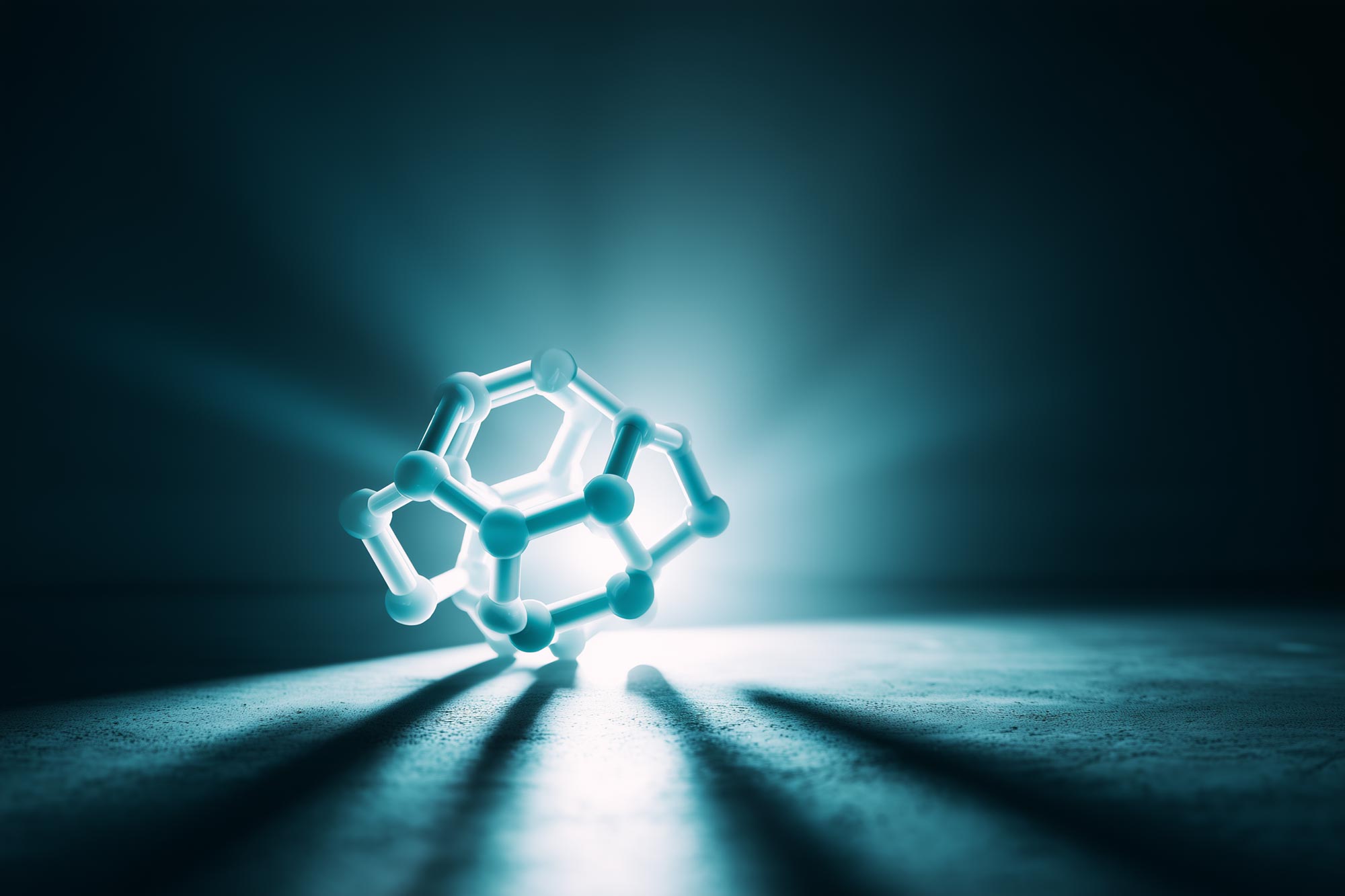
UCLA chemists proved that some of chemistry’s oldest rules can be broken—and new molecules emerge when they are.
Organic chemistry is built on well-known principles that describe how atoms connect, how chemical bonds form, and how molecules take shape. These rules are often treated as firm boundaries that define what structures are possible. Researchers at UCLA, however, are showing that some of these limits are more flexible than long assumed.
Challenging a Century Old Rule
In 2024, a research team led by UCLA chemist Neil Garg overturned Bredt’s rule, a principle that has guided chemists for more than 100 years. The rule states that molecules cannot contain a carbon-to-carbon double bond at the “bridgehead” position (the ring junction of a bridged bicyclic molecule). Building on that work, Garg’s lab has now advanced the chemistry of even more unconventional structures, creating cage-shaped molecules with double bonds known as cubene and quadricyclene.
Double Bonds That Break the Mold
In most organic molecules, atoms connected by double bonds arrange themselves in a flat plane. Garg’s team found that this familiar geometry does not apply to cubene and quadricyclene. Their results, published in Nature Chemistry, expand the range of molecular shapes chemists can create and point toward new possibilities for drug discovery.
“Decades ago, chemists found strong support that we should be able to make alkene molecules like these, but because we’re still very used to thinking about textbook rules of structure, bonding, and reactivity in organic chemistry, molecules like cubene and quadricyclene have been avoided,” said corresponding author Garg, distinguished Kenneth N. Trueblood professor of Chemistry and Biochemistry at UCLA. “But it turns out almost all of these rules should be treated more like guidelines.”
Rethinking Bond Order and Molecular Shape
Organic molecules typically feature three kinds of bonds: single, double, and triple. Carbon double bonds are called alkenes and usually have a bond order of 2, which reflects how many electron pairs are shared between the bonded atoms. In standard alkenes, the carbon atoms adopt a trigonal planar arrangement, producing a flat structure around the double bond.
The molecules examined by Garg’s group, together with longtime collaborator Ken Houk of UCLA, behave differently. Because of their unusual three-dimensional architecture, these cage-shaped molecules have bond orders closer to 1.5 than to 2.
“Neil’s lab has figured out how to make these incredibly distorted molecules, and organic chemists are excited by what might be done with these unique structures,” says Houk.
Why Three Dimensional Molecules Matter
The discovery arrives as researchers increasingly focus on designing molecules with complex three-dimensional shapes for medical applications. Many modern drugs rely on rigid structures that interact more precisely with biological targets.
“Making cubene and quadricyclene was likely considered pretty niche in the 20th century,” said Garg. “But nowadays we are beginning to exhaust the possibilities of the regular, more flat structures, and there’s more of a need to make unusual, rigid 3D molecules.”
How the Molecules Are Formed
To generate these rule-breaking molecules, the team first created stable precursor compounds. These precursors included silyl groups, which are groups of atoms centered on a silicon atom, along with nearby leaving groups. When the precursors were treated with fluoride salts, cubene or quadricyclene formed inside the reaction vessel.
Because these molecules are extremely reactive, they were immediately captured by other reactants. This approach allowed the researchers to produce complex molecular products that are otherwise difficult to synthesize.
Hyperpyramidalized and Short Lived Structures
According to the researchers, the reactions proceed quickly because the alkene carbons in cubene and quadricyclene adopt severely pyramidalized shapes rather than the flat geometries usually seen in alkenes. To describe this extreme distortion, the team introduced the term “hyperpyramidalized” and used computational methods to analyze the unusually weak bonding.
Although cubene and quadricyclene are highly strained and unstable and cannot yet be isolated or directly observed, experimental evidence and computer modeling support their brief existence during the reactions.
“Having bond orders that are not one, two, or three is pretty different from how we think and teach right now,” said Garg. “Time will tell how important this is, but it’s essential for scientists to question the rules. If we don’t push the limits of our knowledge or imaginations, we can’t develop new things.”
Implications for Future Drug Design
Garg’s team believes this work could help pharmaceutical researchers develop future medicines. Compared with drugs from past decades, many new candidates are built around more intricate three-dimensional frameworks, signaling a major shift in what effective medicines can look like.
The researchers see a clear practical need to expand the library of available molecules in order to support increasingly advanced drug discovery.
Education, Creativity, and Collaboration
The study also reflects the creative approach that has made Garg’s organic chemistry courses among the most popular at UCLA. Many of the students trained in his lab have gone on to successful careers in academia and industry.
“In my lab, three things are most important. One is pushing the fundamentals of what we know. Second is doing chemistry that may be useful to others and have practical value for society,” he said. “And third is training all the really bright people who come to UCLA for a world-class education and then go into academia, where they continue to discover new things and teach others, or into industry, where they’re making medicines or doing other cool things to benefit our world.”
Reference: “Hyperpyramidalized alkenes with bond orders near 1.5 as synthetic building blocks” by Jiaming Ding, Sarah A. French, Christina A. Rivera, Arismel Tena Meza, Dominick C. Witkowski, K. N. Houk and Neil K. Garg, 21 January 2026, Nature Chemistry.
DOI: 10.1038/s41557-025-02055-9
The authors of the study include UCLA postdoctoral scholars and graduate students from Garg’s lab: Jiaming Ding, Sarah French, Christina Rivera, Arismel Tena Meza, and Dominick Witkowski, along with Garg’s longtime collaborator and computational chemistry expert Ken Houk, a distinguished research professor at UCLA.
The research was funded by the National Institutes of Health.
Never miss a breakthrough: Join the SciTechDaily newsletter.
Follow us on Google and Google News.
1 Comment
I think drugs need to be classified as an environmental pollutant. Where some architecture of containment can begin to be discussed.