

Close Menu
    Facebook X (Twitter) Instagram
    SciTechDaily
    • Biology
    • Chemistry
    • Earth
    • Health
    • Physics
    • Science
    • Space
    • Technology
    Facebook X (Twitter) Pinterest YouTube RSS
    SciTechDaily
    Home»Technology»UCLA Engineers Build Room-Temperature Quantum-Inspired Computer
    Technology

    UCLA Engineers Build Room-Temperature Quantum-Inspired Computer

    By Wayne Lewis & Alexander Balandin, California NanoSystems InstituteSeptember 4, 2025No Comments4 Mins Read
    Facebook Twitter Pinterest Telegram LinkedIn WhatsApp Email Reddit
    Share
    Facebook Twitter LinkedIn Pinterest Telegram Email Reddit
    Virtual Data Transmission Futuristic Computer Chip
    Scientists have built a physics-inspired computing system that uses oscillators, rather than digital processing, to solve complex optimization problems. Their prototype runs at room temperature and promises faster, low-power performance. Credit: Shutterstock

    Experimental device harnesses quantum properties for efficient processing at room temperature.

    Engineers are working to design computers capable of handling a difficult class of tasks known as combinatorial optimization problems. These challenges are central to many everyday applications, including telecommunications planning, scheduling, and route optimization for travel.

    Current computing technologies face physical limits on how much processing power can be built into a chip, and the energy required to train artificial intelligence models is enormous.

    A collaborative team from UCLA and UC Riverside has introduced a new strategy to address these limitations and tackle some of the hardest optimization problems. Instead of representing all information digitally, their system processes data through a network of oscillators — components that shift back and forth at defined frequencies. This architecture, called an Ising machine, excels at parallel computing, enabling many calculations to run at the same time. The solution to the problem is reached when the oscillators fall into synchrony.

    Quantum properties at room temperature

    In their report published in Physical Review Applied, the researchers described a device that relies on quantum properties connecting electrical activity with vibrations inside a material. Unlike most existing quantum computing approaches, which must be cooled to extremely low temperatures to preserve their quantum state, this device can function at room temperature.
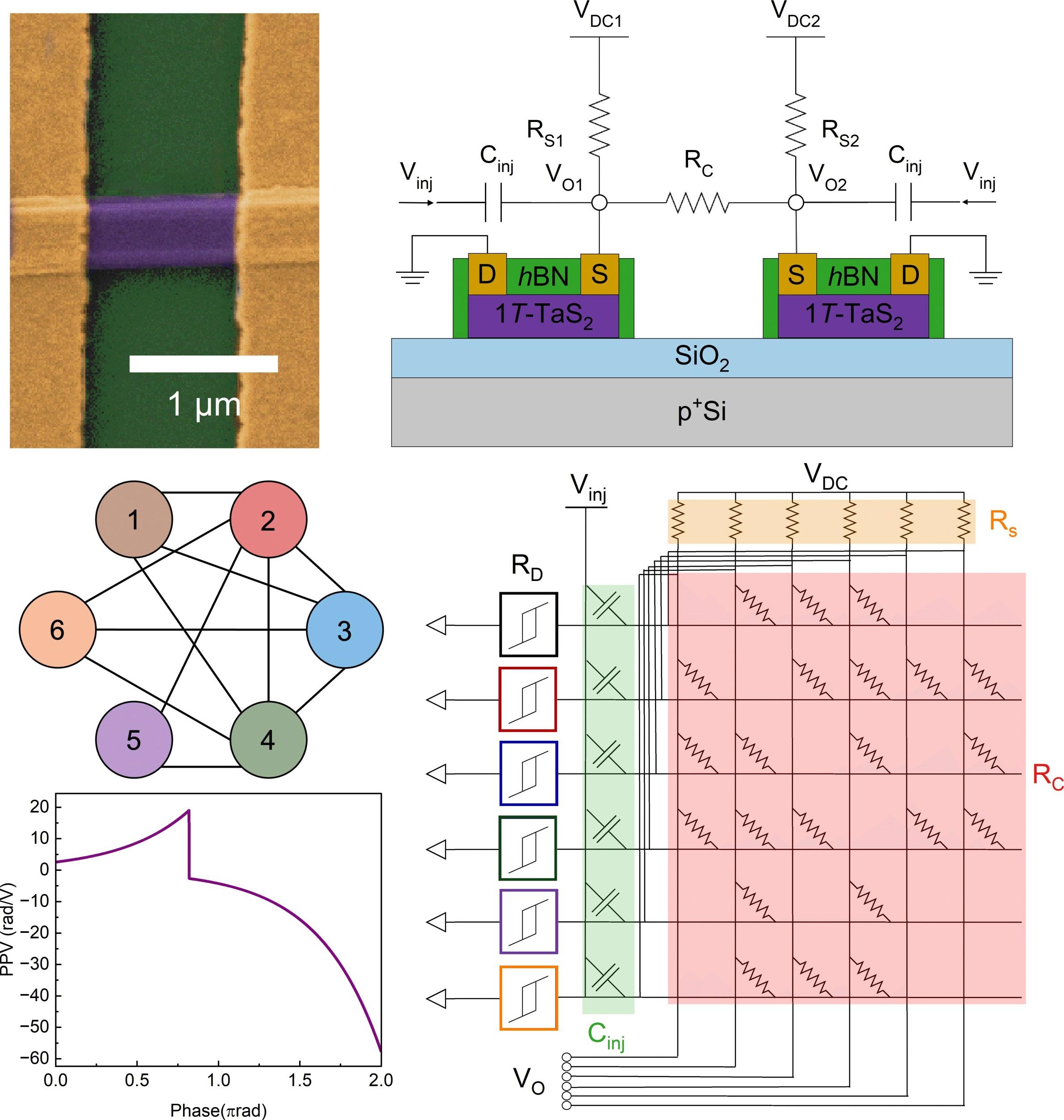
    Scanning Electron Image and Circuit Diagrams of Coupled Oscillators
    Figure: (upper panels) Scanning-electron-microscope image showing a charge-density-wave device channel in the coupled oscillator circuit. Pseudo-coloring is used for clarity. Circuit schematic of the coupled oscillator circuit. (lower panels) Illustration of solving the max-cut optimization problem, showing the 6 × 6 connected graph, circuit representation of the six coupled oscillators using the weights described in the connectivity matrix, and values of the phase-sensitivity function. Credit: Alexander Balandin

    “Our approach is physics-inspired computing, which has recently emerged as a promising method to solve complex optimization problems,” said corresponding author Alexander Balandin, the Fang Lu Professor of Engineering and distinguished professor of materials science and engineering at the UCLA Samueli School of Engineering. “It leverages physical phenomena involving strongly correlated electron–phonon condensate to perform computation through physical processes directly, thus achieving greater energy efficiency and speed.”

    Materials linking quantum and classical physics

    The research showed that oscillators naturally evolve to a ground state, in which they’re synced up, allowing the machine to solve combinatorial optimization problems.

    Alexander Balandin
    Alexander Balandin. Credit: Alexander Balandin

    Balandin and his colleagues used a special material to bridge the gap between quantum mechanics — counterintuitive rules governing interactions between subatomic particles — and the more familiar physics of everyday life. Their prototype hardware is based on a form of tantalum sulfide, a “quantum material” that makes it possible to reveal the switching between electrical and vibrational phases.

    The new technology has the potential for low-power operation; at the same time, it can be compatible with conventional silicon technology.

    “Any new physics-based hardware has to be integrated with the standard digital silicon CMOS technology to impact data information processing systems,” said Balandin, a member of the California NanoSystems Institute at UCLA, or CNSI. “The two-dimensional charge-density-wave material that we selected for this demonstration has the potential for such integration.”

    Reference: “Charge-density-wave quantum oscillator networks for solving combinatorial optimization problems” by Jonas Olivier Brown, Taosha Guo, Fabio Pasqualetti and Alexander A. Balandin, 18 August 2025, Physical Review Applied.
    DOI: 10.1103/zmlj-6nn7

    The coupled oscillators in this research were built at the UCLA Nanofabrication Laboratory, jointly run by CNSI and UCLA Samueli, and tested in UCLA’s Phonon Optimized Engineered Materials laboratory.

    The study was funded by the Office of Naval Research and the Army Research Office.

    Never miss a breakthrough: Join the SciTechDaily newsletter.
    Follow us on Google and Google News.

    Artificial Intelligence Nanotechnology Quantum Computing Quantum Materials UCLA
    Share. Facebook Twitter Pinterest LinkedIn Email Reddit

    Related Articles

    Conventional Computers Can Learn To Solve Tricky Quantum Problems in Physics and Chemistry

    New Artificial Intelligence Device Identifies Objects at the Speed of Light

    A Cost-Effective Fabrication Method for Micro-Scale Graphene-Based Supercapacitors

    Nanocapsules Battle Cancer without Harming Healthy Cells

    Magnetic Nanoparticles Control Thousands of Cells Simultaneously

    Chemical Lift-Off Lithography Patterns Biomolecules at High Resolution

    Electronic Read-Out of the Quantum State of an Atom

    Highly Transparent Polymer Solar Cell Produces Energy by Absorbing Near-Infrared Light

    Nanoparticles in 3-D Atomic-Scale Resolution

    Leave A Reply Cancel Reply

    • Facebook
    • Twitter
    • Pinterest
    • YouTube

    Don't Miss a Discovery

    Subscribe for the Latest in Science & Tech!

    Trending News

    New “Nanozyme Hypothesis” Could Rewrite the Story of Life’s Origins

    Anatomy Isn’t Finished: The Human Body Still Holds Secrets

    “Pretty Close to Home”: The Hidden Earthquake Threat Beneath Seattle

    The Surprising Reason You Might Want To Sleep Without a Pillow

    Scientists Say This Natural Hormone Reverses Obesity by Targeting the Brain

    35-Million-Year-Old Mystery: Strange Arachnid Discovered Preserved in Amber

    Is AI Really Just a Tool? It Could Be Altering How You See Reality

    JWST Reveals a “Forbidden” Planet With a Baffling Composition

    Follow SciTechDaily
    • Facebook
    • Twitter
    • YouTube
    • Pinterest
    • Newsletter
    • RSS
    SciTech News
    • Biology News
    • Chemistry News
    • Earth News
    • Health News
    • Physics News
    • Science News
    • Space News
    • Technology News
    Recent Posts
    • Saturn’s Magnetic Shield Isn’t What Scientists Expected
    • Hidden Oceans of Magma Could Be Protecting Alien Life
    • After Decades of Searching, Astronomers Finally Track Down the Universe’s Missing Hydrogen
    • Scientists Capture Hidden Electron Patterns Inside Quantum Materials
    • New Study Challenges Alzheimer’s Theories: It’s Not Just About Plaques
    Copyright © 1998 - 2026 SciTechDaily. All Rights Reserved.
    • Science News
    • About
    • Contact
    • Editorial Board
    • Privacy Policy
    • Terms of Use

    Type above and press Enter to search. Press Esc to cancel.