
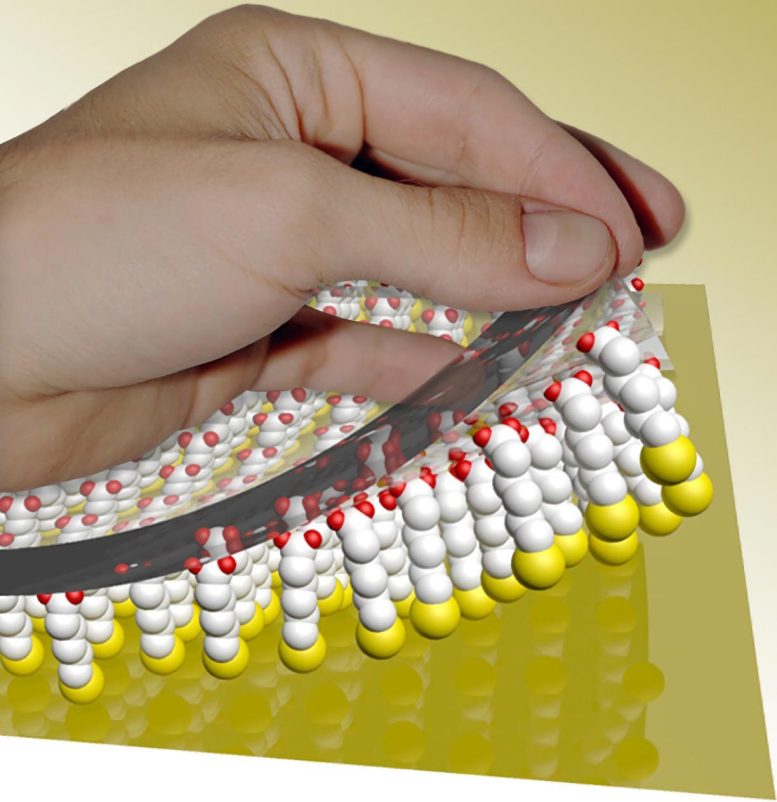
Using chemically treated stamps to remove molecules already in place on gold substrates, scientists have created a new process called chemical lift-off lithography (CLL) that results in higher-resolution patterning and avoids the blurring problems of earlier techniques.
Fabricating precise biomolecular structures at extremely small scales is critical to the progress of nanotechnology and related fields.
Traditionally, one of the ways this has been accomplished has been through the use of rubber stamps with tiny features — similar to those used by children in play, but detailed at the microscopic scale — which are covered with molecular “inks” and then stamped onto substrate surfaces, creating molecular patterns. But when using this technique at the nanoscale, molecules tend to diffuse on the surface both during and after stamping, blurring the patterns.
To address this problem, researchers at UCLA have turned this conventional “soft lithography” process on its head: Instead of using a stamp to transfer molecules onto bare surfaces, they have used chemically treated stamps to remove molecules already in place on gold substrates, essentially peeling away select molecules through chemical bonds to create precise patterns measuring just a few molecules across.
The new process, called chemical lift-off lithography (CLL), results in higher-resolution patterning and avoids the blurring problems of earlier techniques.
The findings are published on September 20 in the journal Science. The research was supported by the U.S. Department of Energy and the Kavli Foundation.
The stamp used in the new process is molded by using a “master” made with more sophisticated and expensive tools than those used in making rubber stamps for offices and children, but the stamps can be used over and over again. Between each use, they are simply reactivated by an oxygen plasma.
The chemical bonds formed at the stamp—substrate interface are sufficiently strong to remove not only molecules in the monolayers but also one layer of gold atoms from the substrate. This observation settled a long-running discussion over whether, for such monolayers, gold–gold bonds break more easily than molecule–gold bonds — they do, the researchers found.
The research team was able to fabricate a variety of high-resolution patterned features, and stamps were cleaned and reused many times with little feature deterioration. The remaining monolayer, they found, can act as a resist for etching exposed gold features. The backfilling of new molecules into the lifted-off areas enabled patterned protein capture, and sharp 40 nanometer chemical patterns were achieved.
Led by Anne Andrews and Paul Weiss, the UCLA team represents a collaboration among researchers from UCLA’s California NanoSystems Institute, the Semel Institute for Neuroscience and Human Behavior at UCLA, and the departments of chemistry and biochemistry, materials science and engineering, and psychiatry and biobehavioral sciences.
Conventional nanolithographic patterning techniques, such as photolithography and electron-beam lithography, are expensive, time-consuming, require specialized equipment and instrumentation, and have limited capabilities for chemical patterning; here, they only need to be used for the fabrication of stamp master molds.
Once individual masters are produced, CLL is used for high-resolution, high-throughput, low-cost pattern fabrication. This method enables patterns to be transferred to underlying substrates, and multiple-stamping strategies can be used to produce high-fidelity nanometer-scale patterns on gold substrates, with the additional possibility of patterning different materials, such as silicon, germanium, platinum and graphene.
The patterns fabricated demonstrate that CLL not only transfers large-area, high-fidelity patterns, but the post–lift-off exposed gold areas are advantageous for producing multiplexed patterned surfaces for selective capture of biomolecules from complex mixtures.
Reference: “Subtractive Patterning via Chemical Lift-Off Lithography” by Wei-Ssu Liao, Sarawut Cheunkar, Huan H. Cao, Heidi R. Bednar, Paul S. Weiss and Anne M. Andrews, 21 September 2012, Science.
DOI: 10.1126/science.1221774
Never miss a breakthrough: Join the SciTechDaily newsletter.
Follow us on Google and Google News.