
Close Menu
    Facebook X (Twitter) Instagram
    SciTechDaily
    • Biology
    • Chemistry
    • Earth
    • Health
    • Physics
    • Science
    • Space
    • Technology
    Facebook X (Twitter) Pinterest YouTube RSS
    SciTechDaily
    Home»Space»UKIDSS Reveals Numerous Unknown Jets of Gas from Young Stars and Planetary Nebulae
    Space

    UKIDSS Reveals Numerous Unknown Jets of Gas from Young Stars and Planetary Nebulae

    By University of KentJuly 31, 2014No Comments5 Mins Read
    Facebook Twitter Pinterest Telegram LinkedIn WhatsApp Email Reddit
    Share
    Facebook Twitter LinkedIn Pinterest Telegram Email Reddit
    Researchers Find Numerous Unknown Jets from Young Stars and Planetary Nebulae
    The area shown here was part of the very first image taken for the UWISH2 survey. It shows on the top a region of massive star formation (called G35.2N) with two spectacular jets. On the bottom an intermediate mass young stellar cluster (Mercer14) can be seen. Several jets are visible in its vicinity, as well as a region of photo-ionized material surrounding a young massive star. Credit: University of Kent

    New research from UK Infra-Red Telescope reveals numerous unknown jets of gas from young stars and planetary nebulae and may prompt significant changes in the understanding of the planetary nebulae population in the Galaxy.

    For many years astronomers have known that young ‘protostars’ drive supersonic jets of gas from their north and south poles. However, this is the first time that so many of them have been detected at once.

    The results come from a five year survey undertaken with the UK Infra-Red Telescope and are expected to prompt significant changes in the understanding of the planetary nebulae population in the Galaxy, as well as the properties of jets ejected from young forming stars.

    By examining images of excited hydrogen molecules at infrared wavelengths, scientists have been able to see through the gas and dust in the Milky Way in order to observe more distant targets. These targets are normally hidden from view and many of them have never been seen before.
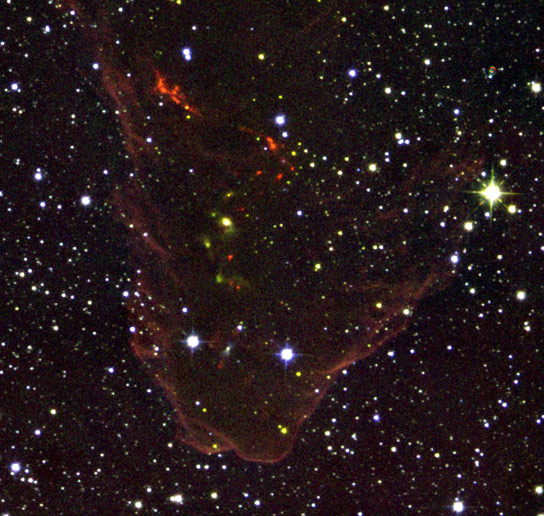
    Image of Triggered Star Formation
    This is a text-book example of triggered star formation. There is the outline of a molecular cloud, which is illuminated by ionizing radiation of massive stars situated off the bottom of the image. The radiation pressure has compressed the cloud and started the process of star formation. The forming stars can be identified by reflection nebulae surrounding them, or by their jets. Models of the process of triggered star formation predict an age gradient of the forming stars with younger objects further inside, away from the source of the ionizing radiation. The object shown here is a prime example that confirms this scenario with reflection nebulae ranging in colors from blue, near the tip of the molecular cloud, to green and yellow further inside. The color change towards red indicates the objects are further embedded in their parental cloud core and thus younger. The youngest object is completely invisible even at these infrared wavelengths, and can only by identified by the jet it is launching (top of image). Credit: University of Kent

    The entire survey area covers approximately 1450 times the size of the full moon, or the equivalent of a 95 GigaPixel image. The survey reveals jets from protostars and planetary nebulae, as well as supernova remnants, the illuminated edges of vast clouds of gas and dust, and the warm regions that envelope massive stars and their associated clusters of smaller stars.

    Based on current estimates using these data, the project expects to identify about 1000 unique jets from young stars – at least 90% of these are new discoveries – as well as 300 planetary nebulae, with almost half of them unknown.

    Dr Dirk Froebrich of the University’s Center for Planetary Science said: ‘These discoveries are very exciting. We will ultimately have much better statistics, meaning we will be able to investigate the physical mechanisms that determine the jet lengths, as well as their power. This will bring us much closer to answering some of the fundamental questions of star formation: How are these jets launched and how much energy, mass and momentum do they feed back into the surrounding interstellar medium.’
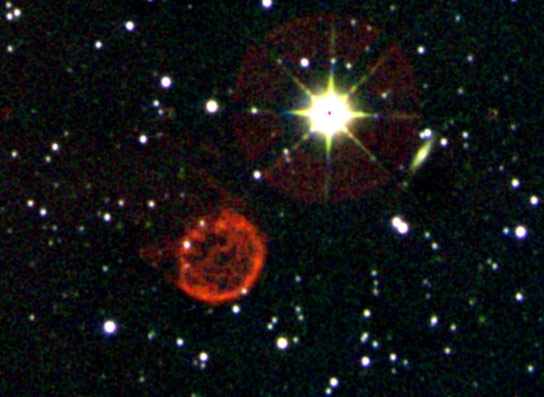
    A Newly Discovered Photogenic Planetary Nebulae
    This image shows a field that contains a newly discovered photogenic planetary nebulae. Internally dubbed by the research team as the ‘Jelly-Fish PN’ it shows an almost circular ring of emission from molecular hydrogen with a variety of structure in the ring itself and inside. The central ionizing source responsible for the radiation is a white dwarf, which is too faint at the near infrared wavelengths to be visible in the image. Credit: University of Kent

    To mark the 5th anniversary of the start of the observations of the survey on 27 August, the project has released a number of images taken with the UK Infra-Red Telescope, based in Hawaii and used for the research.

    All the above images are generated by combining data with observations taken by UKIDSS. The images are false color representation of the objects in the near infrared part of the spectrum and the three color channels are represented by the following wavelength: Blue: broad band emission at 1.2micrometer; Green: broad band emission at 2.2micrometer; Red: Emission of molecular hydrogen at 2.122micrometer. Based on this color-code, objects that contain hydrogen molecules emitting at 2.122micrometer appear very red. The color of all other objects gives a rough indication of their temperature. Hotter objects appear bluer, while cooler objects are redder.

    Never miss a breakthrough: Join the SciTechDaily newsletter.
    Follow us on Google and Google News.

    Astronomy Astrophysics Planetary Science University of Kent
    Share. Facebook Twitter Pinterest LinkedIn Email Reddit

    Related Articles

    Cosmic Death Spiral: Astronomers Catch Planet in Final Orbit Before Destruction

    A Super-Earth Stripped Bare: Astronomers Uncover One of the Densest Planets Ever Found

    “Truly Remarkable” – Scientists Discover Record-Breaking Super-Earth That Is As Dense as Lead

    Jupiter’s Great Red Spot: Study Reveals It’s Not the Same Storm Cassini Observed in 1665

    Cosmic Mystery Solved: Scientists Uncover Two Distinct Sub-Neptune Populations

    What’s Happening to Jupiter’s Great Red Spot? The Solar System’s Largest Storm Could Finally Disappear

    Astronomers Uncover Vast Array of Strange Alien Worlds

    International Planet Hunters Discover Dozens of Strange New Worlds

    Peering Through Cosmic Dust: James Webb Telescope Is on the Hunt for Newborn Planets

    Leave A Reply Cancel Reply

    • Facebook
    • Twitter
    • Pinterest
    • YouTube

    Don't Miss a Discovery

    Subscribe for the Latest in Science & Tech!

    Trending News

    Largest-Ever Study Finds Medicinal Cannabis Ineffective for Anxiety, Depression, PTSD

    250-Million-Year-Old Egg Solves One of Evolution’s Biggest Mysteries

    Living With Roommates Might Be Changing Your Gut Microbiome Without You Knowing

    Century-Old Cleaning Chemical Linked to 500% Increased Risk of Parkinson’s Disease

    What if Your Memories Never Happened? Physicists Take a New Look at the Boltzmann Brain Paradox

    One of the Universe’s Largest Stars May Be Getting Ready To Explode

    Scientists Discover Enzyme That Could Supercharge Ozempic-Like Weight Loss Drugs

    Popular Sweetener Linked to DNA Damage – “It’s Something You Should Not Be Eating”

    Follow SciTechDaily
    • Facebook
    • Twitter
    • YouTube
    • Pinterest
    • Newsletter
    • RSS
    SciTech News
    • Biology News
    • Chemistry News
    • Earth News
    • Health News
    • Physics News
    • Science News
    • Space News
    • Technology News
    Recent Posts
    • A Simpler Path to Super-Resolution: Scientists Reinvent Microscopy
    • Scientists Uncover Hidden Genetic Cause of Diabetes in Babies
    • Amazonian Chocolate Could Become the Next Superfood, Scientists Say
    • Challenging the Narrative: New Study Shows U.S. Life Expectancy Is Rising Across All States
    • Mystery Illness Kills 5 in Burundi As Doctors Scramble for Answers
    Copyright © 1998 - 2026 SciTechDaily. All Rights Reserved.
    • Science News
    • About
    • Contact
    • Editorial Board
    • Privacy Policy
    • Terms of Use

    Type above and press Enter to search. Press Esc to cancel.