
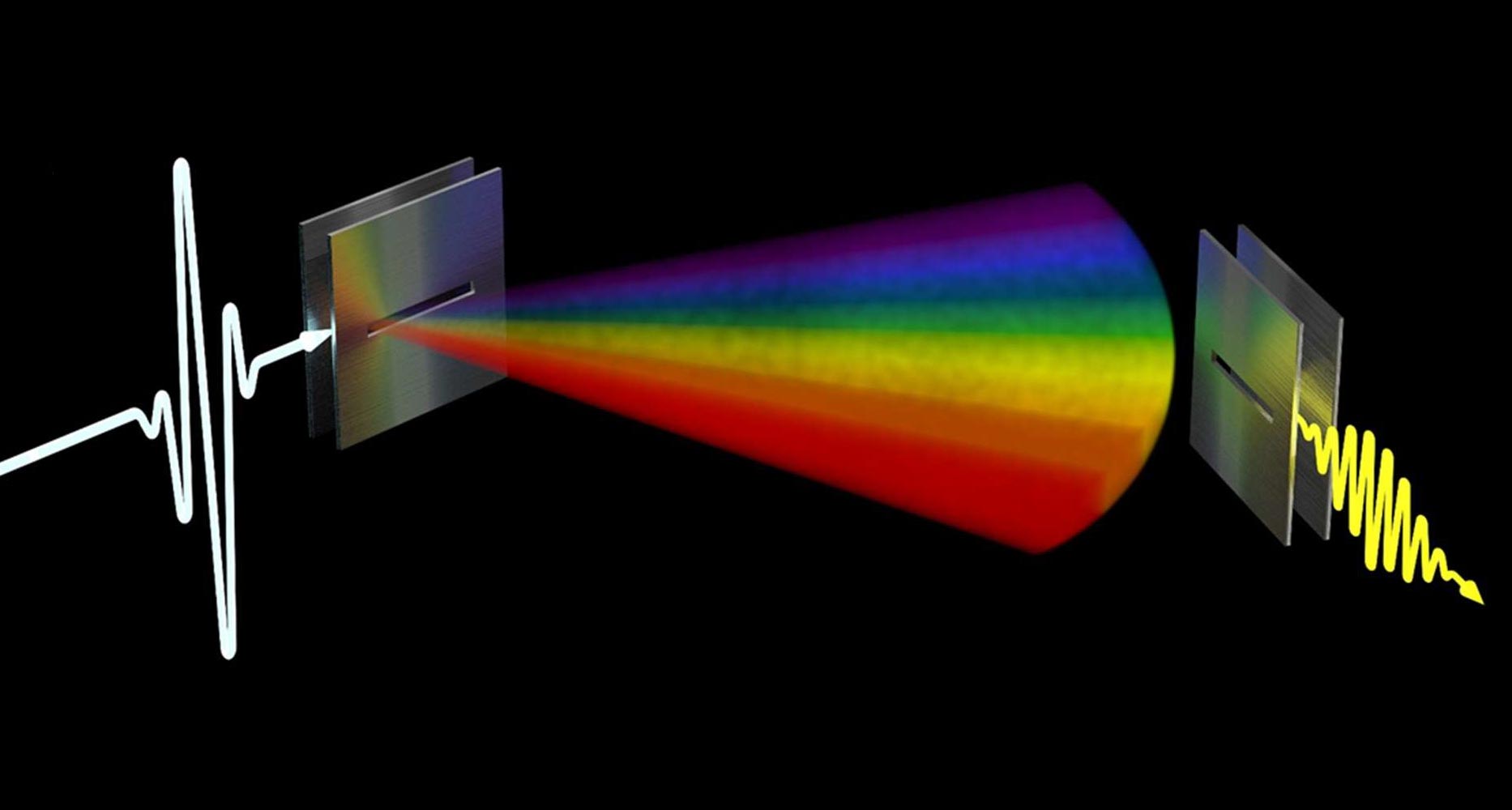
When someone opens a laptop, a router can quickly locate it and connect it to the local Wi-Fi network. That ability is a basic element of any wireless network known as link discovery, and now a team of researchers has developed a means of doing it with terahertz radiation, the high-frequency waves that could one day make for ultra-fast wireless data transmission.
Because of their high frequency, terahertz waves can carry hundreds of times more data than the microwaves used to carry our data today. But that high frequency also means that terahertz waves propagate differently than microwaves. Whereas microwaves emanate from a source in an omnidirectional broadcast, terahertz waves propagate in narrow beams.
“When you’re talking about a network that’s sending out beams, it raises a whole myriad of questions about how you actually build that network,” said Daniel Mittleman, a professor in Brown’s School of Engineering. “One of those questions is how an access point, which you can think of as a router, find out where client devices are in order to aim a beam at them. That’s what we’re thinking about here.”
In a paper published today (April 24, 2020) in Nature Communications, researchers from Brown and Rice University showed that a device known as a leaky waveguide can be used for link discovery at terahertz frequencies. The approach enables link discovery to be done passively, and in one shot.
The concept of a leaky waveguide is simple. It’s just two metal plates with a space between them where radiation can propagate. One of the plates has a narrow slit cut into it, which allows a little bit of the radiation to leak out. This new research shows the device can be used for link discovery and tracking by exploiting one of its underlying properties: that different frequencies leak out of the slit at different angles.
“We input a wide range of terahertz frequencies into this waveguide in a single pulse, and each one leaks out simultaneously at a different angle,” said Yasaman Ghasempour, a graduate student at Rice and co-author on the study. “You can think of it like a rainbow leaking out, with each color representing a unique spectral signature corresponding to an angle.”
Now imagine a leaky waveguide placed on an access point. Depending upon where a client device is relative to the access point, it’s going to see a different color coming out of the waveguide. The client just sends a signal back to the access point that says, “I saw yellow,” and now the access point knows exactly where the client is, and can continue tracking it.
“It is not just about discovering the link once,” Yasaman said. “In fact, the direction of transmission needs to be continually adjusted as the client moves. Our technique allows for ultra-fast adaptation which is the key to achieving seamless connectivity.”
The setup also uses a leaky waveguide on the client side. On that side, the range of frequencies received through the slit in the waveguide can be used to determine the position of the router relative to the local rotation of the device — like when someone swivels their chair while using a laptop.
Mittleman says that finding a novel way to make link discovery work in the terahertz realm is important because existing protocols for link discovery in microwaves simply won’t work for terahertz signals. Even the protocols that have been developed for burgeoning 5G networks, which are much more directional than standard microwaves, aren’t feasible for terahertz. That’s because as narrow as 5G beams are, they’re still around 10 times wider than the beams in a terahertz network.
“I think some people have assumed that since 5G is somewhat directional, this problem had been solved, but the 5G solution simply isn’t scalable,” Mittleman said. “A whole new idea is needed. This is one of those fundamental protocol pieces that you need to start building terahertz networks.”
Reference: “Single-shot link discovery for terahertz wireless networks” by Yasaman Ghasempour, Rabi Shrestha, Aaron Charous, Edward Knightly and Daniel M. Mittleman, 24 April 2020, Nature Communications.
DOI: 10.1038/s41467-020-15761-4
Other co-authors on the paper were Rabi Shrestha and Aaron Charous from Brown University, and Edward Knightly from Rice University. The work was supported by Cisco, Intel and by the National Science Foundation.
Never miss a breakthrough: Join the SciTechDaily newsletter.
Follow us on Google and Google News.