
A new study has challenged the conventional understanding of the three-body problem, revealing that gravitational interactions among three massive objects can produce surprising regularities.
When three massive objects meet in space, they influence each other through gravity in ways that typically evolve unpredictably. In a word: chaos. That’s the conventional wisdom. However, a researcher from the University of Copenhagen has uncovered that these encounters often eschew chaos and instead exhibit regular patterns, frequently resulting in one of the objects quickly being expelled from the system. This breakthrough could be crucial for our understanding of gravitational waves and numerous other cosmic phenomena.
Exploring Cosmic Chaos and Mathematical Mysteries
Currently, the most popular show on Netflix is the science fiction series “3-Body Problem.” Based on a Chinese novel series by Liu Cixin, this series showcases a diverse cast of characters, spans various time periods, and introduces extraterrestrial visitors. Its central theme revolves around a star system where three stars gravitate around one another.
Such a system, with three objects influencing each other’s gravity, has intrigued scientists ever since the “father of gravity,” Isaac Newton, first described it. While interactions between two objects meeting in space are predictable, the introduction of a third massive object makes the triadic encounter not just very complex, but chaotic.
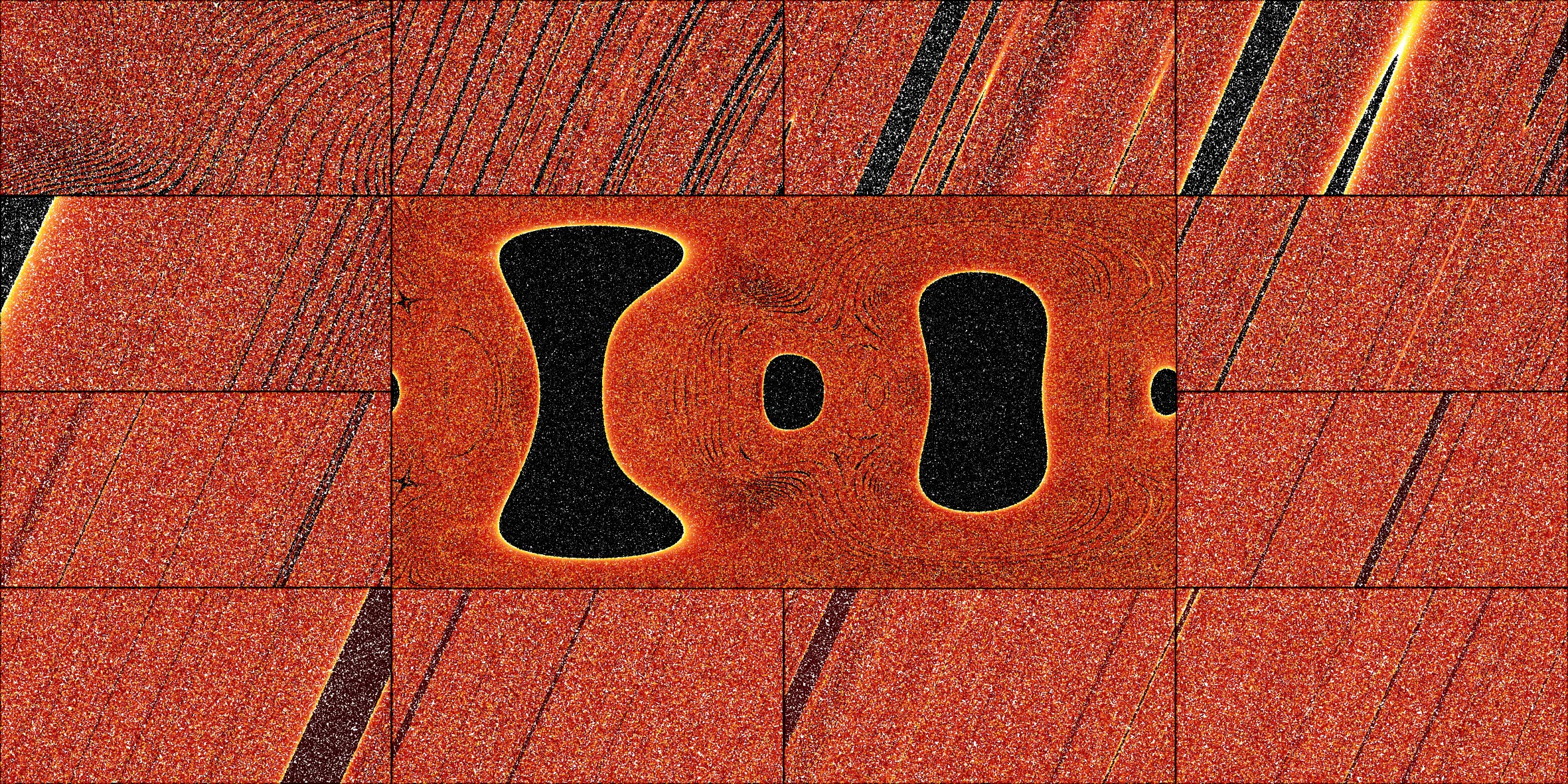
“The Three-Body Problem is one of the most famous unsolvable problems in mathematics and theoretical physics. The theory states that when three objects meet, their interaction evolves chaotically, without regularity, and completely detached from the starting point. But our millions of simulations demonstrate that there are gaps in this chaos – ‘isles of regularity’ – which directly depend on how the three objects are positioned relative to each other when they meet, as well as their speed and angle of approach,” explains Alessandro Alberto Trani of the University of Copenhagen’s Niels Bohr Institute.
Breaking New Ground in Astrophysical Models
Trani hopes the discovery will pave the way for improved astrophysics models, as the Three-Body Problem is not just a theoretical challenge. The encounter of three objects in the universe is a common occurrence and its understanding is crucial.
“If we are to understand gravitational waves, which are emitted from black holes and other massive objects in motion, the interactions of black holes as they meet and merge are essential. Immense forces are at play, particularly when three of them meet. Therefore, our understanding of such encounters could be a key to comprehending phenomena such as gravitational waves, gravity itself, and many other fundamental mysteries of the universe,” says the researcher.
Fun Facts: A 4-Body Problem
During the pandemic, Alessandro Alberto Trani started a side project to investigate fractal universes within the Three-Body Problem. It was then that he came up with the idea of mapping the outcomes in search of regularities.
He knew the famous problem from his studies, but hadn’t delved into the works of fiction – the recent Netflix show or the novel behind it: “The Three-Body Problem” by Liu Cixin. Nevertheless, out of curiosity, he familiarized himself with the plot enough to conclude that it actually deals with a “4-Body Problem.”
“As I understand it, it involves a star system with three stars and one planet, which is regularly thrown into chaotic developments. Such a system is actually best defined as a Four-Body Problem. However you define it though, according to my simulations, the most likely outcome is that the planet would quickly be destroyed by one of the three stars. So it would soon become a Three-Body-Problem,” the researcher grins.
A Tsunami of Simulations
To investigate the phenomenon, Trani coded his own software program, Tsunami, which can calculate the movements of astronomical objects based on the knowledge we have about the laws of nature, such as Newton’s gravity and Einstein’s general relativity. Trani set it to run millions of simulations of three-body encounters within certain defined parameters.
The initial parameters for the simulations were the positions of two of the objects in their mutual orbit – i.e., their phase along a 360-degree axis. Then, the angle of approach of the third object – varying by 90 degrees.
Unveiling Patterns Amidst Cosmic Chaos
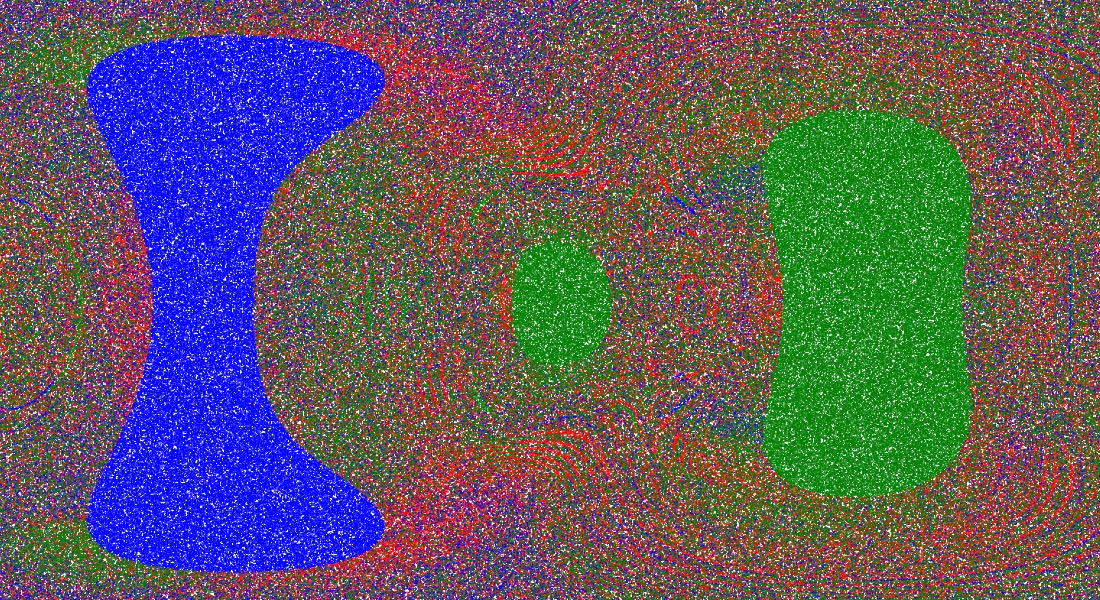
The millions of simulations were spread across the various possible combinations within this framework. As a whole, the results form a rough map of all conceivable outcomes like a vast tapestry woven from the threads of initial configurations. This is where the isles of regularity appear.
The colors represent the object that is eventually ejected from the system after the encounter. In most cases, this is the object with the lowest mass.
“If the three-body problem were purely chaotic, we would see only a chaotic mix of indistinguishable dots, with all three outcomes blending together without any discernible order. Instead, regular “isles” emerge from this chaotic sea, where the system behaves predictably, leading to uniform outcomes—and therefore, uniform colors,” Trani explains.
Challenges and Opportunities in Astrophysical Research
This discovery holds great promise for a deeper understanding of an otherwise impossible phenomenon. In the short term, however, it represents a challenge for researchers. Pure chaos is something they already know how to calculate using statistical methods, but when chaos is interrupted by regularities, the calculations become more complex.
“When some regions in this map of possible outcomes suddenly become regular, it throws off statistical probability calculations, leading to inaccurate predictions. Our challenge now is to learn how to blend statistical methods with the so-called numerical calculations, which offer high precision when the system behaves regularly,” says Alessandro Alberto Trani.
“In that sense, my results have set us back to square one, but at the same time, they offer hope for an entirely new level of understanding in the long run,” he says.
Reference: “Isles of regularity in a sea of chaos amid the gravitational three-body problem” by Alessandro Alberto Trani, Nathan W. C. Leigh, Tjarda C. N. Boekholt and Simon Portegies Zwart, 28 August 2024, Astronomy & Astrophysics.
DOI: 10.1051/0004-6361/202449862
Never miss a breakthrough: Join the SciTechDaily newsletter.
Follow us on Google and Google News.
20 Comments
Memo 2410130438
For a long time I have seen the axis of linearity in the xyz condition of the three bodies in a chaotic pile of numbers. Like the dust in the universe, countless points have become magicsums with regularity. The xyz three-body linear mass in the Void ems, a giant structure in the dark, creates gaps, entanglement, and rigid filament twists that are uniform in mass or equal. Uh-huh.
It requires a boundary condition value for the strict msbase interior. So naturally a huge flow of beautiful patterns arises. Huh.
Source 1. Edit
The three-body problem is one of the most famous open problems in mathematics and theoretical physics. This theory says that when three objects meet, the interaction evolves in confusion without regularity and completely separates from the starting point. But our millions of simulations show that there is a gap in this confusion called the ‘island of regularity’. This gap depends directly on the position, speed, and angle of approach to each other when the three objects meet.
Let’s hope this discovery paves the way for improved astrophysical models. Because the three-body problem is not just a theoretical challenge. It is common for three objects to encounter in space and it is important to understand them.
In order to understand the gravitational waves emitted from black holes and other massive objects in motion, the interaction when black holes meet and merge is essential. A tremendous force is at play, especially when the three meet. Thus, our understanding of these encounters can be key to understanding phenomena such as gravitational waves, gravity itself, and many other fundamental mysteries in the universe.
to reveal patterns in the chaos of the universe
Millions of simulations have been distributed across the various possible combinations within this framework. Overall, the results form a rough map of all possible outcomes, like a giant tapestry woven with threads of the initial configuration. Here appears the island of regularity.
Color represents the object that is eventually emitted from the system after impact. In most cases, it is the object with the lowest mass.
If the three-body problem were purely chaotic, we would only see a chaotic mixture of indistinguishable points, and all three results would be mixed in no discernible order. Instead, in this chaotic sea a regular “island” emerges, where the system operates predictably, yielding uniform results and thus uniform color.
Challenges and Opportunities in Astrophysics Research
This discovery offers great hope for a deeper understanding of phenomena that would otherwise have been impossible. However, in the short term, it poses a challenge to researchers. Pure chaos is something they already know how to calculate using statistical methods, but when chaos is disturbed by regularity, the calculation becomes more complicated.
This possible outcome would lead to false statistical probability calculations and inaccurate predictions if some regions of the map suddenly become regular. Our challenge now is to learn how to mix statistical methods with so-called numerical calculations, which provide high precision when the system operates regularly.
In that sense, my results bring us back to square one, but at the same time offer hope for a whole new level of understanding in the long run.
1.
I applied for a scenario synopsis for the Hand Three-body problem this spring. The scale of the trilogy was extensive. But there was no response. The Hand Three-body abc is the mass a near the pedestal of the horizontal lever and the mass of the center point meson b=a+0,ax1… and the mass minima c of 00 at the end.
The point can be the weight of light, the weight of photons, but it can also be a smaller mass. So the distance cannot actually be reached, and in the dream, the protagonist looks at the multiverse from the boundary of the universe. This is due to the existence of the three-body problem. Humans have found the warm south in the primitive age. And in the modern era, they defect to the world with freedom, away from political ideology. And now they have found the multiverse, which is trying to escape the three bodies at the end of the more distant universe, in their unconscious dreams.
However, my concept of msbase.qpeoms freely deals with a wider range of many-body problems than scenarios. Uh-huh.
ㅡㅡㅡㅡㅡㅡㅡㅡㅡㅡㅡㅡㅡㅡㅡ
Source 1.
https://scitechdaily.com/uncovering-islands-of-regularity-in-the-chaotic-three-body-problem/
find an “island” of regularity in the chaotic three-body problem
Ask the researchers:
1. How is the mass measured?
2. What is the mass of a topological vortex?
3. Can topological vortices generate gravitation?
4. Is the rotation direction of topological vortices left-handed or right-handed?
5. Is a topological vortex a regular “island” ?
All things follow certain laws, which can be revealed through observation and research (such as topological structures).
When physics is passionate about studying imaginary particles and things, it is no longer much different from theology.
Scientific research guided by correct theories can help people avoid detours, failures, and exaggeration. The physical phenomena observed by researchers in experiments are always appearances, never the natural essence of things. The natural essence of things needs to be extracted and sublimated based on mathematical theories via appearances , rather than being imagined arbitrarily.
Everytime scientific revolution, the scientific research space brought by the new paradigm expands exponentially. Physics should not ignore the analyzable physical properties of topological vortices.
(1) Traditional physics: based on mathematical formalism, experimental verification and arbitrary imagination.
(2) Topological Vortex Theory (TVT): Although also based on mathematics (such as topology), it focuses more on non intuitive geometry and topological structures, challenging traditional physical intuition.
Topological Vortex Theory (TVT) points out the limitations of the Standard Model in describing the large-scale structure of the universe, proposes the need to consider non-standard model components such as dark matter and dark energy, and suggests that topological vortex fields may be key to understanding these phenomena. Topological vortex theory heralds innovative technologies such as topological electronics, topological smart batteries, topological quantum computing, etc., which may bring low-energy electronic components, almost inexhaustible currents, and revolutionary computing platforms, etc.
Topology tells us that topological vortices and antivortices can form new spacetime structures via the synchronous effect of superposition, deflection, or twisting of them. Mathematics does not tell us that there must be God particles, ghost particles, fermions, or bosons present. When physics and mathematics diverge, arbitrary imagination will make physics no different from theology. Topological vortex research reflections on the philosophy and methodology of science help us understand the nature essence of science and the limitations of scientific methods. This not only has guiding significance for scientific research itself, but also has important implications for science education and popularization.
Today, so-called official (such as PRL, Nature, Science, PNAS, etc.) in physics stubbornly believes that two sets of cobalt-60 rotating in opposite directions can become two sets of objects that mirror each other, is a typical case that pseudoscience is rampant and domineering.
Please witness the exemplary collaboration between theoretical physicists and experimentalists (https://scitechdaily.com/microscope-spacecrafts-most-precise-test-of-key-component-of-the-theory-of-general-relativity/#comment-854286). Let us continue to witness with facts the dirtiest and ugliest era in the history of human social sciences and humanities. The laws of nature will not change due to misleading of certain so-called academic publications or endorsements from certain so-called scientific awards.
As some comments have stated ( https://scitechdaily.com/super-photons-unveiled-sculpting-light-into-unbreakable-communication-networks/#comment-861546 ): Fortunately, we have enough pieces to put the puzzle together properly, and there are folks who have chosen to forego today’s societal structures in order to do exactly that.
“there are folks who have chosen to forego today’s societal structures”
Is that how you’re going to paint that empty first post clown you answered? Pals yet?
Today, so-called official (such as PRL, Nature, Science, PNAS, etc.) in physics stubbornly believes that two sets of cobalt-60 rotating in opposite directions can become two sets of objects that mirror each other, and it even won awards. Is this a shame for humanity or a shame for individuals?
Bao, looks like you really enjoy hammering away incessantly at the low-IQ/lips-moving-slow end of the audience, where Larsson is most comfortable.
Today, so-called official (such as PRL, Nature, Science, PNAS, etc.) in physics stubbornly believes that two sets of cobalt-60 rotating in opposite directions can become two sets of objects that mirror each otherand even win awards. Do you think this is human misfortune or personal misfortune?
A question about symmetry in time reversal?
Physicists indeed do use the concept of time to disorient themselves and others, and sometimes they even come close to admitting it, if that answers your question. Not much point can I see in getting too hung up on Cobalt-60, seems kind of obscure, unlike gravity and Einstein’s lockstep force-fed abomination version of the thing, people can figure it out if they care.
@Fixed gravity for you
“Not much point can I see in getting too hung up on Cobalt-60.”
Is this your scientific perspective?
bye-bye!
Bao, I make a point of quickly ignoring people who can only make their points by ignoring the gist of my comments. You and your kindred spamming spirit “Larsson” may already have a room together.
Bye Bye!!!
“Larsson” is this someone you know?
NO
Question was directed at “Larsson,” and you answered. Duly noted.
How about “Unclear Engineer?” Want to answer for him and “Larsson” too?
Everytime scientific revolution, the scientific research space brought by the new paradigm expands exponentially. Physics should not ignore the analyzable physical properties of topological vortices.
(1) Traditional physics: based on mathematical formalism, experimental verification and arbitrary imagination.
(2) Topological Vortex Theory (TVT): Although also based on mathematics (such as topology), it focuses more on non intuitive geometry and topological structures, challenging traditional physical intuition.
Topological Vortex Theory (TVT) points out the limitations of the Standard Model in describing the large-scale structure of the universe, proposes the need to consider non-standard model components such as dark matter and dark energy, and suggests that topological vortex fields may be key to understanding these phenomena. Topological Vortex Theory (TVT) heralds innovative technologies such as topological electronics, topological smart batteries, topological quantum computing, etc., which may bring low-energy electronic components, almost inexhaustible currents, and revolutionary computing platforms, etc.
As some comments have stated ( https://scitechdaily.com/super-photons-unveiled-sculpting-light-into-unbreakable-communication-networks/#comment-861546 ): Fortunately, we have enough pieces to put the puzzle together properly, and there are folks who have chosen to forego today’s societal structures in order to do exactly that.
There’s some prof working out of Huntsville who has a gravity model that has been out there for maybe most of the year, and he’s talking about “gravity without mass.” It’s practically like he’s got a picture of someone in a dipole outfit standing on their hands and he is calling it evidence of a ringlike “topological defect,” when I’ve been describing online for decades now the equivalent of a universe full of synchronized summersaulting quantum gravity dipoles in a stationary-phased rippling pattern creating galactic gravity. The straight-line defects are a form of cold linear gravity focus, another idea of mine that I’ve mentioned online for over a decade. I’ve decided not to contact him and probably will continue to ignore him.
Anyway, the point would here be that’s it’s possible that “islands of stability” and “gravity without mass” may have some commonality with the idea of Lagrange points.
Today, so-called official (such as PRL, Nature, Science, PNAS, etc.) in physics stubbornly believes that two sets of cobalt-60 rotating in opposite directions can become two sets of objects that mirror each otherand even win awards. Do you think this is human misfortune or personal misfortune?
Sorry, it’s not looking to be a question about gravity, “Bao.”
This is about parity violation, I guess, said to be discovered before the 60’s. Unlike rainbow-message bent space-time it’s practically never in the news. Time-reversal for anti-matter was Feynman’s goof-spooky brainchild, maybe you should focus on what’s wrong with that and come up with a better idea. Consider anti-particles to be made of inverted mass dipole layers, at least that’s my current approach when bored.
“Consider anti-particles to be made of inverted mass dipole layers”
The connection to “time reversal” is then evident in the reversal of dipole layers encountered on contact.
Quantum spin should be linked to charge surface rotation, but sightless “geniuses” forever try to convince everyone otherwise, using “blind logic.” Free electron spin relates to the direction of drift and has a handedness in that sense. It’s likely not as disoriented and much simpler than others suggest, in other words.
The prof’s Planckian mass dipoles are apparently self-balancing to mass-less-ness so they can ironically sit centered on a galaxy like rings on a log out in space. My decades old idea was to make the radiated dipole longitudinal rotation phase the stationary quantity, instead of the dipole, since making up massless things to have them just be sitting there doing whatever easily explained-away by target-shaped wavy DM large-scale gravity lensing stuff seems like a colossal waste of time.