
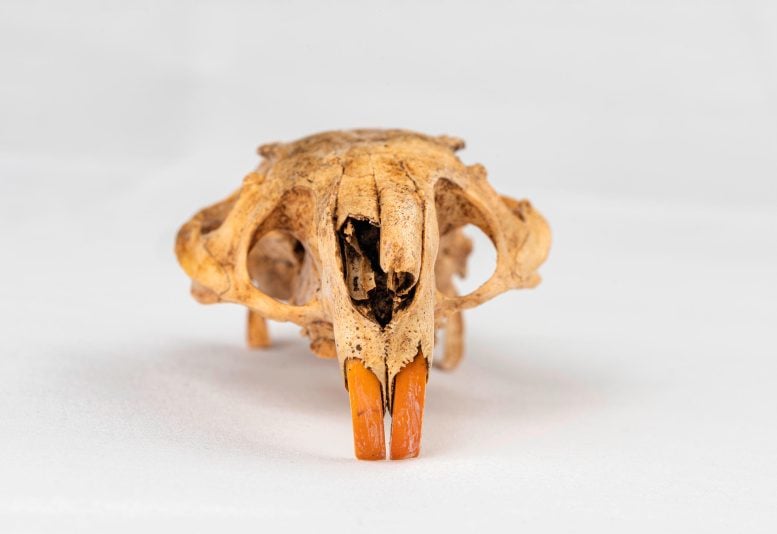
European Colonization and Invasive Species Contributed to Hispaniola’s Rodent Extinctions.
The Caribbean island of Hispaniola used to host 11 different rodent species, but now only one remains in the island’s two countries of Haiti and the Dominican Republic. The reasons for the extinction of the other species are unclear, as the timing of each disappearance is unknown, making it hard to identify the cause. Furthermore, the remaining species’ prospects for survival are uncertain.
A recent study provides new insights into the history of rodent species on Hispaniola. Scientists from the Florida Museum of Natural History and the Museo Nacional de Historia Natural in the Dominican Republic conducted carbon-dating on the fossils of six hutia species, which are related to capybaras and resemble a combination of a squirrel and a beaver. They also studied thousands of bones previously collected over 40 years and stored at the Florida Museum of Natural History, searching for similarities that may shed light on the recent wave of rodent extinctions.
“These hidden gems are what made this study possible,” said Lazaro Viñola Lopez, a doctoral student at the University of Florida and lead author on the study.
Despite the preponderance of material available for study, radiocarbon dating on fossils collected in the tropics can be tricky business. The region’s high humidity, moisture, and heat accelerate the degradation of collagen in the fossils needed to date them, leaving scientists with open questions about their antiquity.
“They mineralize and lose all organic material really quickly, so there are limitations to what you can date,” Lopez said.
The fossils used for this study, however, were excavated from caves and sinkholes, where they were sheltered from harsh conditions and safe from marauding scavengers. Sinkholes often act as traps for animals, which fall in and are unable to escape, while many of the bones found in caves were directly transported there by predators like the Hispaniolan giant barn owl (Tyto ostologa). These large predators declined alongside the hutias and may have succumbed to extinction when their food source disappeared.
Hutias and the biological communities they supported flourished on Hispaniola for nearly 20 million years, and it was previously unclear when they began to disappear. Early theories speculated that the species went extinct due to rapid climate change at the end of the ice ages in the late Pleistocene more than 10,000 years ago. More recent theories posit that the arrival of Indigenous people in the Caribbean and the later arrival of Europeans may have played a stronger role.
However, researchers have been unable to make an accurate estimate as to when they went extinct without knowing a “last appearance date,” or the age of the youngest specimen to have been discovered.
Evidence Points to European Colonization
Prior to this study, researchers had only a handful of radiocarbon dates for hutia fossils on which to base their assumptions. Here, the authors add carbon dates for an additional six species, all of which survived the period of climate change originally theorized to have done them in.
This directly implicates humans in their disappearance.
It is estimated that the first humans arrived on Hispaniola somewhere between 4,000 – 6,000 years ago. This lines up with a handful of older extinctions from the six dated species, including Rhizoplagiodontia lemkei, which was determined to have died out less than 6,000 years ago.
Beginning roughly 3,000 years ago, another group of Indigenous people moved into the Caribbean from present-day Venezuela. These early islanders hunted hutias and even set up an inter-island exchange of the animals, but these practices seem to have been carried out sustainably.
Instead, European colonization appears to have been the main cause of hutia decline. Radiocarbon dates indicate that seven species went extinct within the last 2,000 years. Of these, at least three coincided with the arrival of Europeans.
Lopez suspects that gradual habitat destruction, rising human population numbers, and the introduction of invasive species eventually led to the demise of hutias along with several other mammal and bird species.
“When Europeans came to the island they brought several animals with them, like rats, dogs, and cats,” he said. “Is it possible that these species went extinct because of competition with these new animals? That’s just one of the questions we can ask now because of this study.”
According to Lopez, the results serve as a jumping-off point for many future studies into Caribbean rodents.
“We are just scratching the surface,” he explained. “Right now, we only have nine new biometric dates. Imagine what we could do with 20, or even 50 dates. With a more detailed chronology, we can start to theorize about the past relationships between these species and the humans on the island.”
Reference: “Endemic rodents of Hispaniola: biogeography and extinction timing during the Holocene” by Lazaro Willian Viñola-López, Jonathan I. Bloch, Juan N. Almonte Milán and Michelle J. LeFebvre, 29 October 2022, Quaternary Science Reviews.
DOI: 10.1016/j.quascirev.2022.107828
The study was funded by the American Society of Mammalogists.
Never miss a breakthrough: Join the SciTechDaily newsletter.
Follow us on Google and Google News.