

The 2023 Nobel Prize in physics recognized three researchers for their work with attosecond light pulses, revolutionizing the study of rapid electron movements and broadening understanding in various fields of physics and chemistry.
A group of three researchers earned the 2023 Nobel Prize in physics for work that has revolutionized how scientists study the electron – by illuminating molecules with attosecond-long flashes of light. But how long is an attosecond, and what can these infinitesimally short pulses tell researchers about the nature of matter?
I first learned of this area of research as a graduate student in physical chemistry. My doctoral adviser’s group had a project dedicated to studying chemical reactions with attosecond pulses. Before understanding why attosecond research resulted in the most prestigious award in the sciences, it helps to understand what an attosecond pulse of light is.
How Long Is an Attosecond?
“Atto” is the scientific notation prefix that represents 10-18, which is a decimal point followed by 17 zeroes and a 1. So a flash of light lasting an attosecond, or 0.000000000000000001 of a second, is an extremely short pulse of light.
In fact, there are approximately as many attoseconds in one second as there are seconds in the age of the universe.
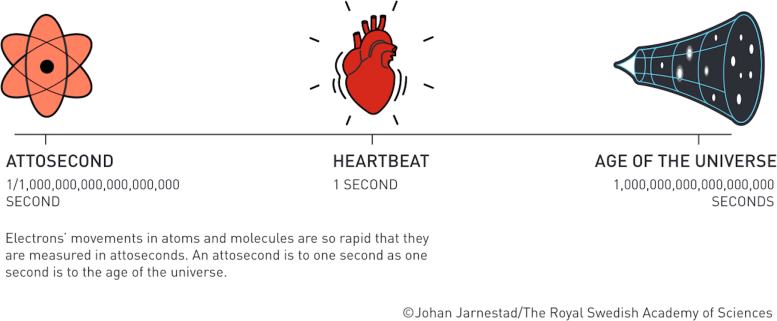
Previously, scientists could study the motion of heavier and slower-moving atomic nuclei with femtosecond (10-15) light pulses. One thousand attoseconds are in 1 femtosecond. But researchers couldn’t see movement on the electron scale until they could generate attosecond light pulses – electrons move too fast for scientists to parse exactly what they are up to at the femtosecond level.
Attosecond Pulses
The rearrangement of electrons in atoms and molecules guides a lot of processes in physics, and it underlies practically every part of chemistry. Therefore, researchers have put a lot of effort into figuring out how electrons are moving and rearranging.
However, electrons move around very rapidly in physical and chemical processes, making them difficult to study. To investigate these processes, scientists use spectroscopy, a method of examining how matter absorbs or emits light. In order to follow the electrons in real time, researchers need a pulse of light that is shorter than the time it takes for electrons to rearrange.
Pump-probe spectroscopy is a common technique in physics and chemistry and can be performed with attosecond light pulses.
As an analogy, imagine a camera that could only take longer exposures, around 1 second long. Things in motion, like a person running toward the camera or a bird flying across the sky, would appear blurry in the photos taken, and it would be difficult to see exactly what was going on.
Then, imagine you use a camera with a 1 millisecond exposure. Now, motions that were previously smeared out would be nicely resolved into clear and precise snapshots. That’s how using the attosecond scale, rather than the femtosecond scale, can illuminate electron behavior.
Attosecond Research
So what kind of research questions can attosecond pulses help answer?
For one, breaking a chemical bond is a fundamental process in nature where electrons that are shared between two atoms separate out into unbound atoms. The previously shared electrons undergo ultrafast changes during this process, and attosecond pulses made it possible for researchers to follow the real-time breaking of a chemical bond.
The ability to generate attosecond pulses – the research for which three researchers earned the 2023 Nobel Prize in physics – first became possible in the early 2000s, and the field has continued to grow rapidly since. By providing shorter snapshots of atoms and molecules, attosecond spectroscopy has helped researchers understand electron behavior in single molecules, such as how electron charge migrates and how chemical bonds between atoms break.
On a larger scale, attosecond technology has also been applied to studying how electrons behave in liquid water as well as electron transfer in solid-state semiconductors. As researchers continue to improve their ability to produce attosecond light pulses, they’ll gain a deeper understanding of the basic particles that make up matter.
Written by Aaron W. Harrison, Assistant Professor of Chemistry, Austin College.
Adapted from an article originally published in The Conversation.
Never miss a breakthrough: Join the SciTechDaily newsletter.
Follow us on Google and Google News.