
Close Menu
    Facebook X (Twitter) Instagram
    SciTechDaily
    • Biology
    • Chemistry
    • Earth
    • Health
    • Physics
    • Science
    • Space
    • Technology
    Facebook X (Twitter) Pinterest YouTube RSS
    SciTechDaily
    Home»Physics»Unified Physics Theory Explains How Materials Transform From Solids to Liquids
    Physics

    Unified Physics Theory Explains How Materials Transform From Solids to Liquids

    By University of Illinois at Urbana-ChampaignSeptember 29, 20212 Comments4 Mins Read
    Facebook Twitter Pinterest Telegram LinkedIn WhatsApp Email Reddit
    Share
    Facebook Twitter LinkedIn Pinterest Telegram Email Reddit
    Mucus Layer Snail
    The mucus layer on the underside of a snail foot is one example of a soft material that yields to stress up to a certain point, then flows. This behavior, simplified in a new study from researchers at the University of Illinois Urbana-Champaign, is what helps the snail move without unwieldy sliding, similar to that of many other natural and synthetic materials, from mud to the additives that make toothpaste flow when squeezed. Credit: Photo courtesy Rodrigo Quarteu

    Researchers at the University of Illinois Urbana-Champaign have developed a new unified mathematical model that describes how materials transition from solid to liquid under stress.
    The model promises more accurate and computationally efficient predictions for events like mudslides, dam failures, and avalanches, and it could also impact fields ranging from geophysics and waste remediation to 3D printing and material design.

    Years of meticulous experimentation have paid off for researchers aiming to unify the physics that defines materials that transition from solids to liquids. The researchers said a new theoretical model could help develop new synthetic materials and inform and predict civil engineering and environmental challenges such as mudslides, dam breaks and avalanches.

    The study, led by University of Illinois Urbana-Champaign chemical and biomolecular engineering professor Simon Rogers, unveils a unified mathematical expression that defines how soft-yet-rigid materials transition from a solid into a liquid flow when they exceed their specific stress threshold. The findings are published in the journal Physical Review Letters.

    “The behavior of yield-stress fluids has traditionally been defined by trying to combine the physics of two different types of materials: solids and liquids,” said lead author Krutarth Kamani, a chemical and biomolecular engineering graduate student at Illinois. “But now, we have shown that these physical states – solid and liquid – can exist together in the same material, and we can explain it using one mathematical expression.”
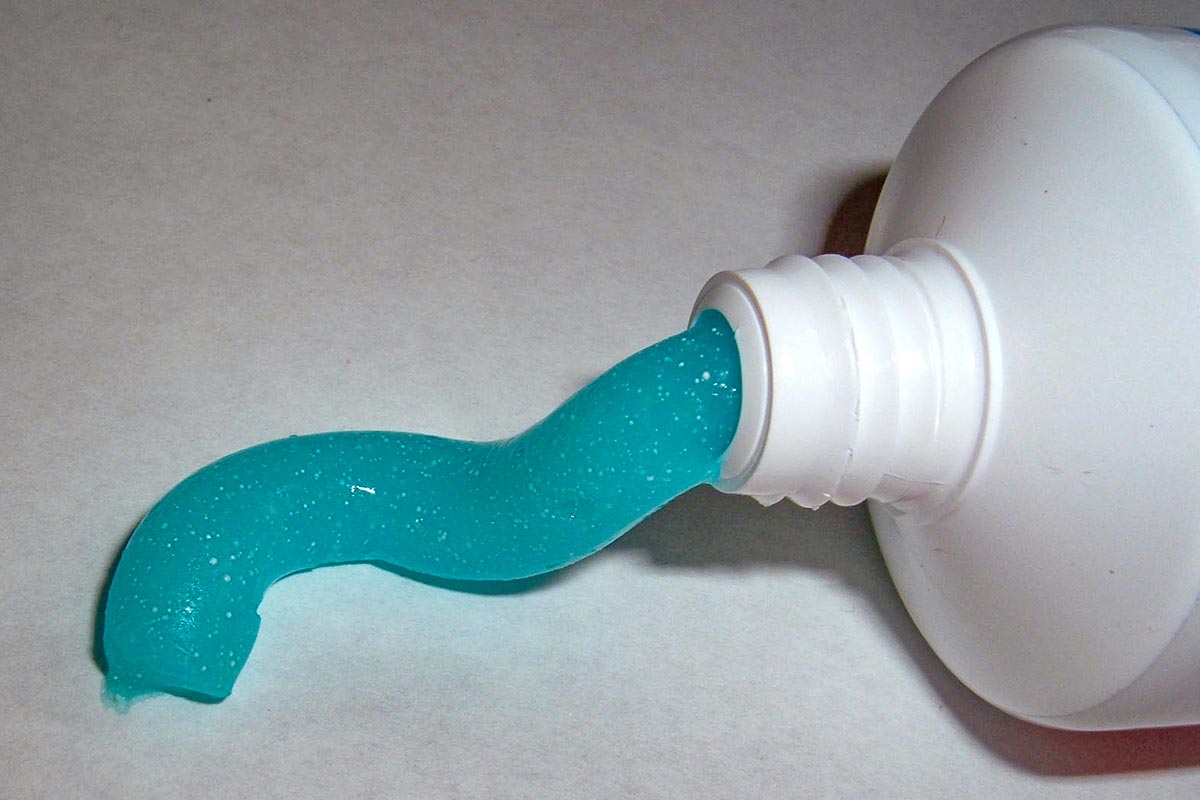
    Toothpaste
    Toothpaste flows when squeezed, making it what researchers call a yield-stress fluid. Credit: Photo courtesy Scott Ehardt

    To develop this model, the team performed numerous studies that subjected a variety of different soft materials to stress while measuring the individual solidlike and liquidlike strain responses using a device called a rheometer.

    A Gradual Transition, Not an Abrupt Shift

    “We were able to observe a material’s behavior and see a continuous transition between the solid and liquid states,” said Rogers, who is also an affiliate at the Beckman Institute for Advanced Science and Technology at the University of Illinois. “The traditional models all describe an abrupt change in behavior from solid to liquid, but we were able to resolve two distinct behaviors that reflect energy dissipation via solid and fluid mechanisms.”

    The study reports that this development gives researchers a simple model to work with, making it easier to make large-scale calculations like those needed to model and predict catastrophic events like mudslides and avalanches.  

    “The existing models are computationally expensive, and researchers need to struggle with the numbers to get the calculations to be as accurate as possible,” Rogers said. “Our model is simple and more accurate, and we have shown that through many proof-of-concept experiments.”

    The researchers said complex yield-stress studies of fluids are a hot topic for those investigating geophysical flows, waste remediation and industrial processes like new materials development, 3D printing and the minimization of waste transport costs. “Our model defines a basic example of solid-to-liquid behavior, but I think it will serve as a jumping-off point for researchers to make significant progress in defining the more complex yield-stress fluid phenomena.”

    Reference: “Unification of the Rheological Physics of Yield Stress Fluids” by Krutarth Kamani, Gavin J. Donley and Simon A. Rogers, 25 May 2021, Physical Review Letters.
    DOI: 10.1103/PhysRevLett.126.218002

    The National Science Foundation, the U.S. Department of Energy and Sandia National Laboratories supported this research.

    Never miss a breakthrough: Join the SciTechDaily newsletter.
    Follow us on Google and Google News.

    Chemical Engineering Fluid Mechanics Popular University of Illinois at Urbana-Champaign
    Share. Facebook Twitter Pinterest LinkedIn Email Reddit

    Related Articles

    Yikes! Flushing Toilets Create Long-Lasting Clouds of Virus-Containing Particles

    Solved: Fluid Mechanics Mystery That’s Been Puzzling Scientists for Decades

    Glug, Glug: Physics of Bubble Dynamics Reveals How to Empty Bottles Faster

    Laser Doppler Velocimetry Delivers New Insights Into Mysterious Fluid Motions

    Galileo’s Jupiter Entry Probe Vaporized – New Gaps Revealed in Heat Shield Modeling

    World’s Most Efficient Single-Photon Source Created Using Time Multiplexing

    Defrosting Surfaces in Seconds at 100x Efficiency

    After 127 Years, Physics Riddle Finally Solved

    Unraveling One of the Greatest Mysteries in Condensed Matter Physics

    2 Comments

    1. Clyde Spencer on September 29, 2021 8:30 am

      The transition from solid to liquid is a phase change defined as melting. What this article is about is a solid, elastic material transitioning to plastic flow while remaining solid, or at least very viscous, not unlike what happens with glacial ice as it thickens.

      Reply
    2. Boog on September 30, 2021 7:44 am

      Yeah man, what he said.

      Reply
    Leave A Reply Cancel Reply

    • Facebook
    • Twitter
    • Pinterest
    • YouTube

    Don't Miss a Discovery

    Subscribe for the Latest in Science & Tech!

    Trending News

    Largest-Ever Study Finds Medicinal Cannabis Ineffective for Anxiety, Depression, PTSD

    250-Million-Year-Old Egg Solves One of Evolution’s Biggest Mysteries

    Living With Roommates Might Be Changing Your Gut Microbiome Without You Knowing

    Century-Old Cleaning Chemical Linked to 500% Increased Risk of Parkinson’s Disease

    What if Your Memories Never Happened? Physicists Take a New Look at the Boltzmann Brain Paradox

    One of the Universe’s Largest Stars May Be Getting Ready To Explode

    Scientists Discover Enzyme That Could Supercharge Ozempic-Like Weight Loss Drugs

    Popular Sweetener Linked to DNA Damage – “It’s Something You Should Not Be Eating”

    Follow SciTechDaily
    • Facebook
    • Twitter
    • YouTube
    • Pinterest
    • Newsletter
    • RSS
    SciTech News
    • Biology News
    • Chemistry News
    • Earth News
    • Health News
    • Physics News
    • Science News
    • Space News
    • Technology News
    Recent Posts
    • Scientists Find Way to Reverse Fatty Liver Disease Without Changing Diet
    • Could Humans Regrow Limbs? New Study Reveals Promising Genetic Pathway
    • Black Hole Jets Pack Power of 10,000 Suns, Stunning New Study Reveals
    • A Cosmic Crash Turned This Nearby Galaxy Into Chaos
    • This Alien Solar System Doesn’t Follow the Rules – and Scientists Are Intrigued
    Copyright © 1998 - 2026 SciTechDaily. All Rights Reserved.
    • Science News
    • About
    • Contact
    • Editorial Board
    • Privacy Policy
    • Terms of Use

    Type above and press Enter to search. Press Esc to cancel.