
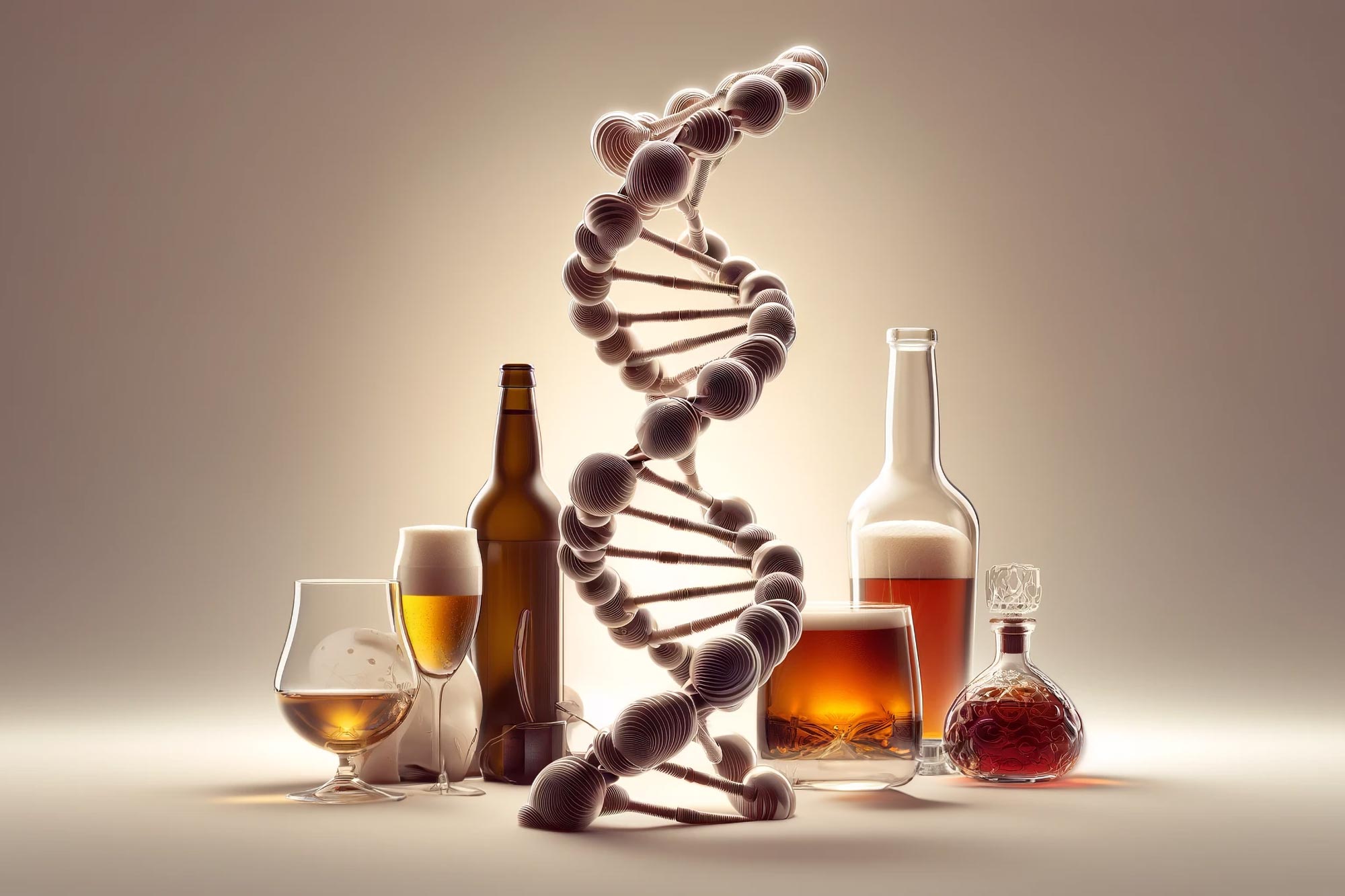
Exploration of 3 million records uncovers connections between gene variants governing alcohol use and many non-alcohol-related conditions.
A research group centered at the University of California San Diego School of Medicine has drilled deep into a dataset of over 3 million individuals compiled by the direct-to-consumer genetics company 23andMe, Inc., and found intriguing connections between genetic factors influencing alcohol consumption and their relationship with other disorders.
The study was recently published in the Lancet eBioMedicine.
Genetic Data Analysis
Sandra Sanchez-Roige, Ph.D., corresponding author and associate professor at UC San Diego School of Medicine Department of Psychiatry, explained that the study used genetic data to broadly classify individuals as being European, Latin American and African American. Such classifications “are needed to avoid a statistical genetics pitfall called population stratification,” noted co-author Abraham A. Palmer, Ph.D., professor and vice chair for basic research in the psychiatry department.
The researchers analyzed genetic data from the 3 million 23andMe research participants, focusing on three specific little snippets of DNA known as single-nucleotide polymorphisms, or SNPs. Sanchez-Roige explained that variants, or alleles, of these particular SNPs are “protective” against a variety of alcohol behaviors, from excessive alcohol drinking to alcohol use disorder.

Genetic Variants and Alcohol Metabolism
One of the alcohol-protective variants they considered is very rare: the most prevalent among the three alleles found in the study showed up in 232 individuals of the 2,619,939 European cohort, 29 of the 446,646 Latin American cohort and in 7 of the 146,776 African American cohort; others are much more common. These variants affect how the body metabolizes ethanol — the intoxicating chemical in alcoholic beverages.
“The people who have the minor allele variant of the SNP convert ethanol to acetaldehyde very rapidly. And that causes a lot of negative effects,” said Sanchez-Roige. She went on to say that the resulting nausea eclipses any pleasurable effects of alcohol — think of a bad hangover that sets in almost immediately.
“These variants are primarily associated with how much someone may consume alcohol,” she said. “And they also tend to prevent alcohol use disorder, because these variants are primarily associated with the quantity of alcohol someone may drink.”
Broader Implications of Genetic Variants
Sanchez-Roige explained that the SNP variants’ influence on alcohol consumption is well researched, but her group took a “hypothesis-free” approach to the 23andMe dataset, which contains survey data on thousands of traits and behaviors. The researchers wanted to find out if the three SNP variants might have any other effects beyond alcohol consumption.
Sanchez-Roige and Palmer noted that their group has developed a 10-year partnership with 23andMe that has focused on numerous traits, especially those with relevance for addiction. This work is the basis of an academic collaboration through the 23andMe Research Program.
They data-mined the analyses of DNA from saliva samples submitted by consenting 23andMe research participants, as well as the responses to the surveys of health and behavior available from the 23andMe database, and found a constellation of associations, not necessarily connected with alcohol. Individuals with the alcohol-protecting alleles had generally better health, including less chronic fatigue and needing less daily assistance with daily tasks.
But the paper notes individuals with the alcohol-protective alleles also had worse health outcomes in certain areas: more lifetime tobacco use, more emotional eating, more Graves’ disease and hyperthyroidism. Individuals with the alcohol-protective alleles also reported totally unexpected differences, such as more malaria, more myopia and several cancers, particularly more skin cancer and lung cancer, and more migraine with aura.
Health Associations and Genetic Insights
Sanchez-Roige acknowledged that there is a chicken-and-egg aspect to their findings. For example: Cardiovascular disease is just one of a number of maladies known to be associated with alcohol consumption. “So is alcohol consumption leading to these conditions?” she asks. Palmer finishes the thought: “Or do these genetic differences influence traits like malaria and skin cancer in a manner that is independent of alcohol consumption?”
Sanchez-Roige said that such broad, hypothesis-free studies are only possible if researchers have access to very large sets of data. Many datasets, including the one used in the study, rely heavily on individuals with European ancestry.
“It is important to include individuals from different ancestral backgrounds in genetic studies because it provides a more complete understanding of the genetic basis of alcohol behaviors and other conditions, all of which contributes to a more inclusive and accurate understanding of human health,” she said. “The study of only one group of genetically similar individuals (for example, individuals of shared European ancestry) could worsen health disparities by aiding discoveries that will disproportionately benefit only that population.”
Conclusion and Future Research Directions
She said their study opens numerous doors for future research, chasing down possible connections between the alcohol-protective alleles and conditions that have no apparent connection with alcohol consumption.
“Understanding the underlying mechanisms of these effects could have implications for treatments and preventative medicine,” Sanchez-Roige noted.
Reference: “A phenome-wide association and Mendelian randomisation study of alcohol use variants in a diverse cohort comprising over 3 million individuals” by Mariela V. Jennings, José Jaime Martínez-Magaña, Natasia S. Courchesne-Krak, Renata B. Cupertino, Laura Vilar-Ribó, Sevim B. Bianchi, Alexander S. Hatoum, Elizabeth G. Atkinson, Paola Giusti-Rodriguez, Janitza L. Montalvo-Ortiz, Joel Gelernter, María Soler Artigas, Stella Aslibekyan, Adam Auton, Elizabeth Babalola, Robert K. Bell, Jessica Bielenberg, Katarzyna Bryc, Emily Bullis, Daniella Coker, Gabriel Cuellar Partida, Devika Dhamija, Sayantan Das, Sarah L. Elson, Nicholas Eriksson, Teresa Filshtein, Alison Fitch, Kipper Fletez-Brant, Pierre Fontanillas, Will Freyman, Julie M. Granka, Karl Heilbron, Alejandro Hernandez, Barry Hicks, David A. Hinds, Ethan M. Jewett, Yunxuan Jiang, Katelyn Kukar, Alan Kwong, Keng-Han Lin, Bianca A. Llamas, Maya Lowe, Jey C. McCreight, Matthew H. McIntyre, Steven J. Micheletti, Meghan E. Moreno, Priyanka Nandakumar, Dominique T. Nguyen, Elizabeth S. Noblin, Jared O’Connell, Aaron A. Petrakovitz, G. David Poznik, Alexandra Reynoso, Morgan Schumacher, Anjali J. Shastri, Janie F. Shelton, Jingchunzi Shi, Suyash Shringarpure, Qiaojuan Jane Su, Susana A. Tat, Christophe Toukam Tchakouté, Vinh Tran, Joyce Y. Tung, Xin Wang, Wei Wang, Catherine H. Weldon, Peter Wilton, Corinna D. Wong, Sarah L. Elson, Howard J. Edenberg, Pierre Fontanillas, Abraham A. Palmer and Sandra Sanchez-Roige, 4 April 2024, eBioMedicine.
DOI: 10.1016/j.ebiom.2024.105086
Co-authors on the paper from the University of California San Diego School of Medicine Department of Psychiatry are Mariela V. Jennings, Natasia S. Courchesne-Krak, Renata B. Cupertino and Sevim B. Bianchi. Sandra Sanchez-Roige is also associated with the Department of Medicine, Division of Genetic Medicine, Vanderbilt University.
Other co-authors are: José Jaime Martínez-Magaña, Department of Psychiatry, Division of Human Genetics, Yale University School of Medicine; Laura Vilar-Ribó, Psychiatric Genetics Unit, Group of Psychiatry, Mental Health and Addiction, Vall d’Hebron Research Institute, Universitat Autònoma de Barcelona, Barcelona, Spain; Alexander S. Hatoum, Department of Psychology & Brain Sciences, Washington University in St. Louis; Elizabeth G. Atkinson, Department of Molecular and Human Genetics, Baylor College of Medicine; Paola Giusti-Rodriguez, Department of Psychiatry, University of Florida College of Medicine; Janitza L. Montalvo-Ortiz, Department of Psychiatry, Division of Human Genetics, Yale University School of Medicine, National Center of Posttraumatic Stress Disorder, VA CT Healthcare Center; Joel Gelernter, VA CT Healthcare Center, Department of Psychiatry, West Haven CT; and Departments of Psychiatry, Genetics & Neuroscience, Yale Univ. School of Medicine; María Soler Artigas, Psychiatric Genetics Unit, Group of Psychiatry, Mental Health and Addiction, Vall d’Hebron Research Institute, Universitat Autònoma de Barcelona, Barcelona, Spain; Department of Mental Health, Hospital Universitari Vall d’Hebron, Barcelona; Biomedical Network Research Centre on Mental Health (CIBERSAM), Madrid; and Department of Genetics, Microbiology, and Statistics, Faculty of Biology, Universitat de Barcelona; Howard J. Edenberg, Department of Biochemistry and Molecular Biology, Indiana University School of Medicine; and the 23andMe Inc. Research Team, including Sarah L. Elson and Pierre Fontanillas.
The study was funded, in part, by Tobacco-Related Disease Research Program grants T32IR5226 and 28IR-0070, National Institute of Health (NIH) National Institute of Drug Abuse (NIDA) DP1DA054394, and NIH National Institute of Mental Health (NIMH) R25MH081482.
Never miss a breakthrough: Join the SciTechDaily newsletter.
Follow us on Google and Google News.