
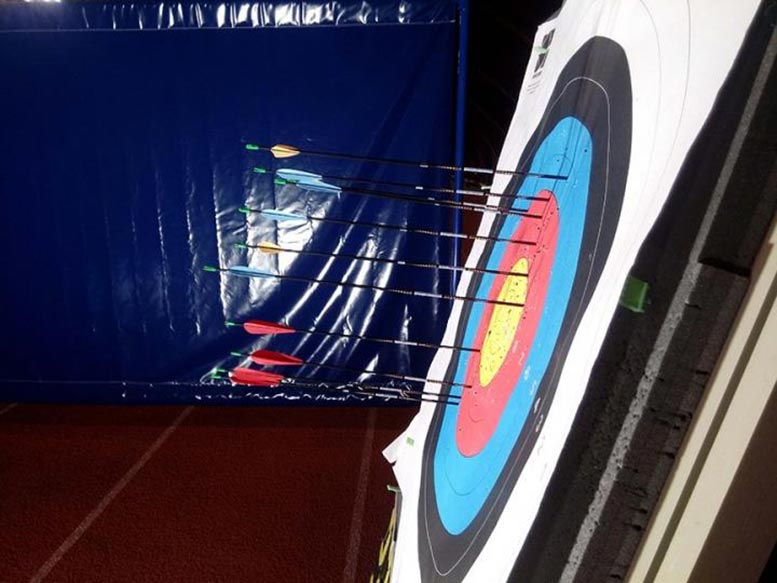
Researchers examine how archery accuracy is affected by arrow size and shape, and the impact of wind conditions.
When it comes to archery, choosing the right feathers for an arrow is the key to winning. This necessity for precision makes it crucial to understand how environment and design affect arrows in flight.
Scientists from the Laboratoire d’Hydrodynamique at the Ecole Polytehcnique will explain the physics behind optimal arrow design at the 72nd Annual Meeting of the APS Division of Fluid Dynamics in Seattle on Saturday, November 23, 2019. The presentation is part of a session on biological fluid dynamics in flight.
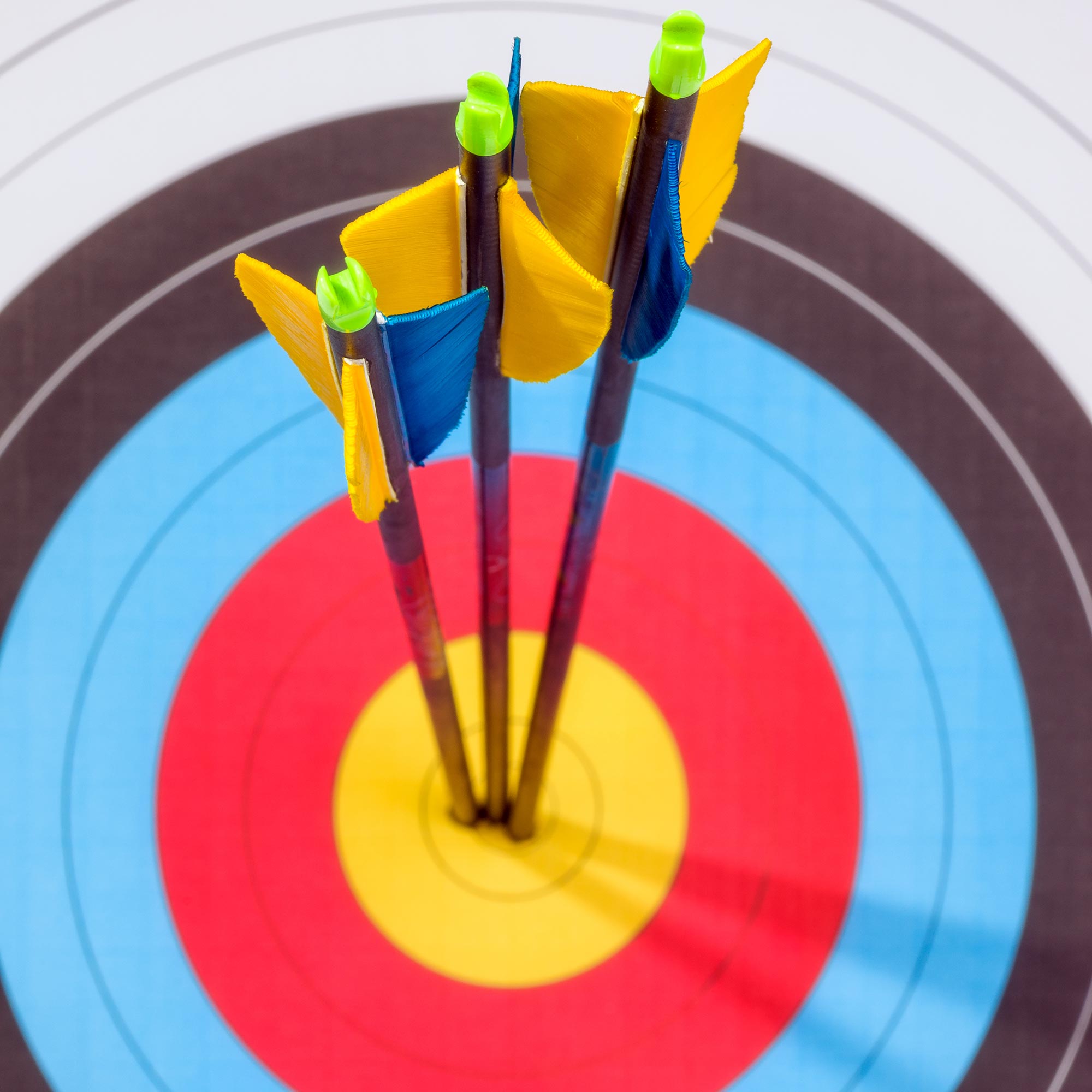
The researchers said the aspect of feather size and shape in archery accuracy has not yet been studied in depth. To discover the optimal feather design, Tom Maddalena, Caroline Cohen, and Christophe Clanet first shot arrows with various feathers using a throwing machine. They then used a wind tunnel to observe the aerodynamic forces on the arrow. These experiments were compared to theoretical models of arrow flight.
“We found that the best size depends on the environmental conditions. If there is no wind, a shooter must use very large feathers. The limit of the size is actually mostly dictated by geometrical constraints of the bow,” said Maddalena.
The authors plan to further investigate the environmental effects on the arrows. Although large feathers provide more stability, they’re also affected more easily by the wind.
“We collaborated with the French Archery Federation to conduct this research. Currently, the choice of the feathers is based on intuition and comes directly from the athletes and their coaches. With our work, we hope able to tell them which feathers are the best, so that they can fully trust their equipment,” said Maddalena.
Reference: “Arrow flight and optimal feathers in archery” by Tom Maddalena, Caroline Cohen and Christophe Clanet, 23 November 2019, 72nd Annual Meeting of the APS Division of Fluid Dynamics.
Never miss a breakthrough: Join the SciTechDaily newsletter.
Follow us on Google and Google News.
5 Comments
Any Long-bow archer could have told you this straight away, as most build their own arrows. For example, Shooting indoors at 18m or 20yds would allow you to use large feathers so they can “cut” the air sooner and be effective immediately. Whereas shooting clout at 180 yds. one would reduce the size of the feather to sat a 2″ (50mm) shield or parabellum to facilitate less drag and less area to be bffeted by the wind and yet still be effective during the longer flight.
I am just shaking my head… What is this nonsense?? The abstract makes it clear that they’re analysing for the 70m distance, where the margin of error is, indeed, very small. Lovely! No one shoots a feather for 70m archery. Maybe they’re looking at traditional archery; if so, their claim that the “limit of the size is actually mostly dictated by geometrical constraints of the bow” is ridiculous – the limiting factor is DRAG, and that’s not intuition, that’s watching an arrow with a too-big feather crash into the dirt 30m short of a target at 70m. Study a modern plastic vane or the actual standard for Olympic archery, the curled mylar “spin” vane, and then maybe you can rock the world of archery with some hard science, because yeah – there’s a lot of trial and error and error and error based on very, very fuzzy math. It would be awesome to see the results of serious research!
The Trad Lab and The Push Archery have already done extensize testing of fletching size, configuration and material. You should have probably researched what they have reported.
as usual we have the comments saying that the research is dumb, without any real detail. welcome to 2019 where science is subject to overabundance of underqualified opinion.
Well, I guess that makes me No one. I shoot olympic archery at 60 meters (age restricted) with feathers. I have found them to be more consistent than the Mylar vanes.