
This may well be the most interesting story about pillows and bedding you will ever read.
The burial field in Valsgärde outside Uppsala in central Sweden contains over 90 graves from the Iron Age.
“On a light note, we could say that Valsgärde is Scandinavia’s answer to Sutton Hoo in England as portrayed in the film The Dig on Netflix,” says Birgitta Berglund, professor emeritus of archaeology at the Norwegian University of Science and Technology (NTNU) University Museum.

Valsgärde is especially known for its spectacular boat graves from the 600s and 700s CE. This timeframe is in the middle of what Norway calls the Merovingian period, the era just before the Viking Age.
Two of these spectacular boat graves are at the center of this story – or more specifically, the down bedding that was found in the graves.
When researchers from NTNU investigated which birds contributed their feathers to the bedding, they made a surprising discovery that provides new insight into Iron Age society.
Rowing to the Underworld
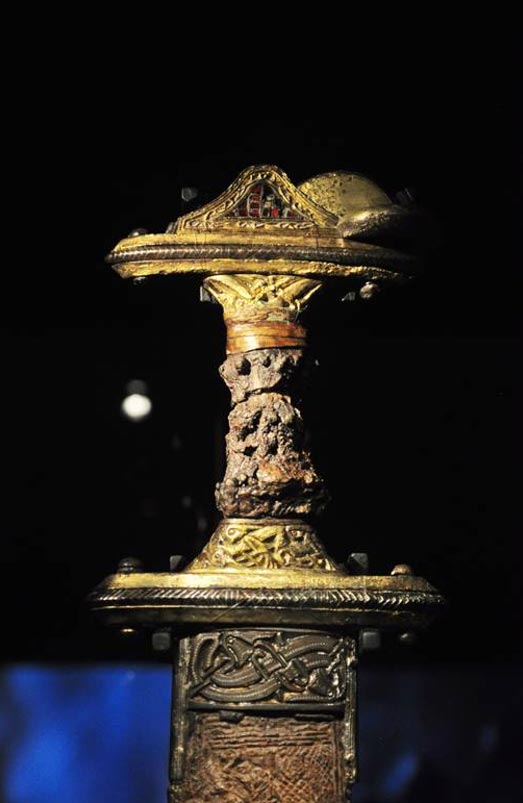
The boats carrying the two dead men were about 10 meters (33 feet) long, with room for four to five pairs of oars. Both were outfitted for high-ranking warriors, with richly decorated helmets, shields, and weapons. Provisions and tools for hunting and cooking were also included for their last voyage.

In one grave, a Eurasian eagle owl (Bubo bubo) had been laid, with its head cut off. We’ll return to that. Horses and other animals were arranged close to the boats.
“Beauty sleep was also taken care of in death. Down bedding was found under the two warriors.”
“The buried warriors appear to have been equipped to row to the underworld, but also to be able to get ashore with the help of the horses,” says Berglund.
Beauty sleep was also taken care of in death. Under the two warriors were several layers of down bedding. Their contents probably had a greater function than simply serving as fillers.
Feathers With Ritual Significance
You might have thought of down bedding as a modern concept, which admittedly only became available for the common folk in recent times. The down bedding in the graves at Valsgärde is the oldest known one from Scandinavia and indicates that the two buried men belonged to the top strata of society.
Wealthy Greeks and Romans used down for their bedding a few hundred years earlier, but probably not until the Middle Ages was down used more widely by wealthy people in Europe, says Birgitta Berglund.
Berglund has been researching down harvesting in Helgeland coastal communities in southern Nordland county for many years, where people commercialized down production early on by building houses for the eider ducks. The theory was that down from this location might have been exported south, so Berglund wanted to investigate whether the bedding at Valsgärde contained eiderdown.
“It turned out that a lot of kinds of feathers had been used in the bedding at Valsgärde. Only a few feathers from eider ducks were identified, so we have little reason to believe that they were a commodity from Helgeland or other northern areas,” says Berglund.
However, she was not disappointed by this discovery. The great variety of species gave the researchers unique insight into the bird fauna in the immediate area in prehistoric times, along with people’s relationship to it.
“The feathers provide a source for gaining new perspectives on the relationship between humans and birds in the past. Archaeological excavations rarely find traces of birds other than those that were used for food,” the researcher says.
“We also think the choice of feathers in the bedding may hold a deeper, symbolic meaning. It’s exciting.”
Wrong Feathers Led to Prolonged Death Struggle
Berglund explains that according to Nordic folklore, the type of feathers contained in the bedding of the dying person was important.
“For example, people believed that using feathers from domestic chickens, owls and other birds of prey, pigeons, crows and squirrels would prolong the death struggle. In some Scandinavian areas, goose feathers were considered best to enable the soul to be released from the body.
These are well-known folk traditions that have been collected from the 18th century onwards. But they may have their roots in prehistoric times.
In the Icelandic Erik the Red saga, a pillow stuffed with feathers from domestic hens was placed on the throne at Heriólfsnes in Greenland, where a visiting female shaman was to sit. The saga is considered to have been written down in the 13th century, but deals with events around the year 1000, says Berglund.
“The examples show that feathers in the bedding from Valsgärde most likely also had a deeper meaning than just serving as a filler. It’s also well known that birds could hold special importance for obtaining information in shamanism – think of Odin’s two ravens Hugin and Munin.
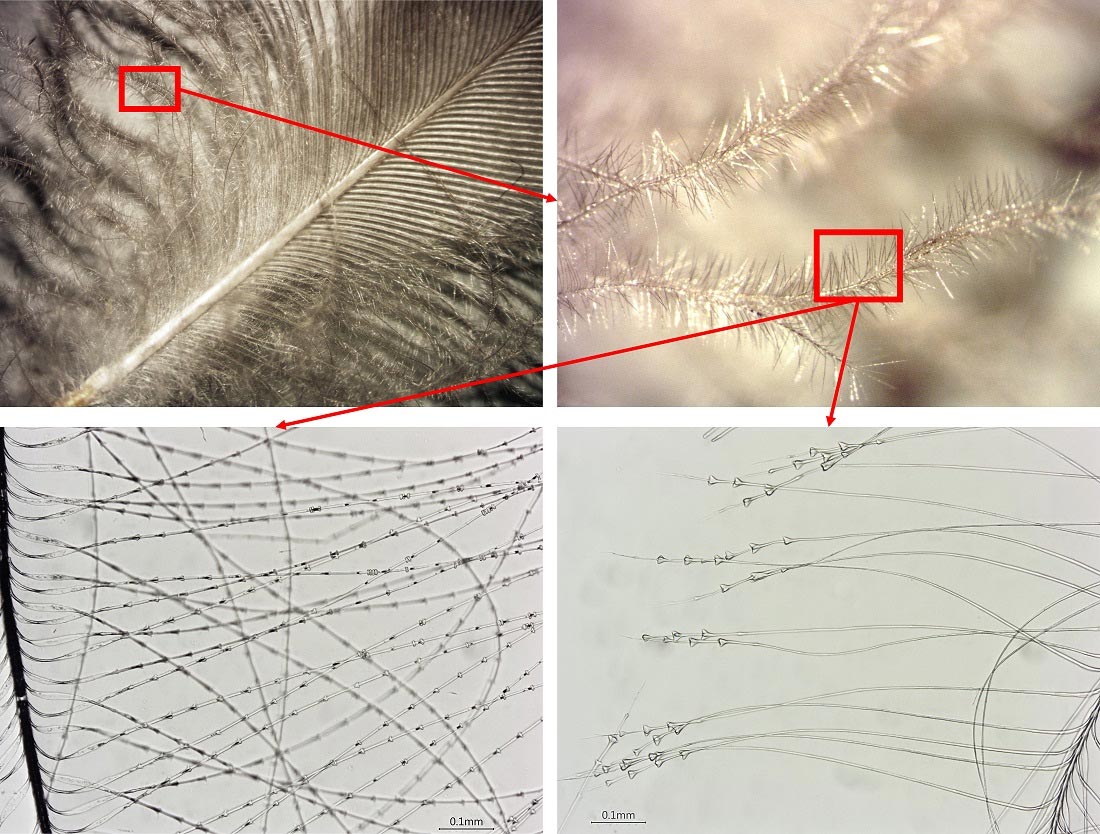
Exactly what ritual function the feathers at Valsgärde had is hard to say. But the bedding contained feathers from geese, ducks, grouse, crows, sparrows, waders and – perhaps most surprisingly – eagle owls.
Biologist Jørgen Rosvold, now employed at the Norwegian Institute for Natural History (NINA) identified the species of the feather material.
“It was a time-consuming and challenging job for several reasons. The material is decomposed, tangled, and dirty. This means that a lot of the special features that you can easily observe in fresh material has become indistinct, and you have to spend a lot more time looking for the distinctive features,” Rosvold says.
“I’m still surprised at how well the feathers were preserved, despite the fact that they’d been lying in the ground for over 1000 years.”
A Beheaded Owl
The feathers in the down bedding weren’t the sole intriguing bird discovery in the graves. One of the graves also contained a headless owl.
“We believe the beheading had a ritual significance.”
From recent graves, we know that people took measures to prevent the buried from returning from the dead, and it’s easy to imagine that this was also done longer ago as well.
“We believe the beheading had a ritual significance in connection with the burial,” says Berglund.
Swords found in tombs from Viking times were sometimes intentionally bent before being laid in the tomb. This was probably done to prevent the deceased from using the weapon if he returned.
“It’s conceivable that the owl’s head was cut off to prevent it from coming back. Maybe the owl feather in the bedding also had a similar function? In Salme in Estonia, boat graves from the same period have recently been found that are similar to those in Valsgärde. Two birds of prey with a severed head were found there,” says Berglund.
Reference: “Microscopic identification of feathers from 7th century boat burials at Valsgärde in Central Sweden: Specialized long-distance feather trade or local bird use?” by Birgitta Berglund and Jørgen Rosvold, 19 February 2021, Journal of Archaeological Science: Reports.
DOI: 10.1016/j.jasrep.2021.102828
Never miss a breakthrough: Join the SciTechDaily newsletter.
Follow us on Google and Google News.
3 Comments
An alternative explanation to bending the sword blades might be to discourage grave robbing and disturbing the souls of the deceased. A high-ranking sword would have been very valuable in those days. However, if it was common knowledge that the sword had been ‘decommissioned,’ there would be less incentive to retrieve it!
Does anybody realize how many afterlifes you have disturbed by digging up these graves and separating them from their belongings?? This price process was important to these people. You have no respect. Now they may be wandering the afterlife wondering why they are no longer in Val Halla with their brothers.
Your article title may draw clicks, but it explicitly is contrary to your website’s affiliation with science and objectivity. Claiming such is pure conjecture.