
Close Menu
    Facebook X (Twitter) Instagram
    SciTechDaily
    • Biology
    • Chemistry
    • Earth
    • Health
    • Physics
    • Science
    • Space
    • Technology
    Facebook X (Twitter) Pinterest YouTube RSS
    SciTechDaily
    Home»Earth»Unprecedented Insight: SWOT Satellite Monitors Warming Ocean off California Coast
    Earth

    Unprecedented Insight: SWOT Satellite Monitors Warming Ocean off California Coast

    By Jet Propulsion LaboratorySeptember 26, 2023No Comments4 Mins Read
    Facebook Twitter Pinterest Telegram LinkedIn WhatsApp Email Reddit
    Share
    Facebook Twitter LinkedIn Pinterest Telegram Email Reddit
    SWOT Satellite in Earth Orbit
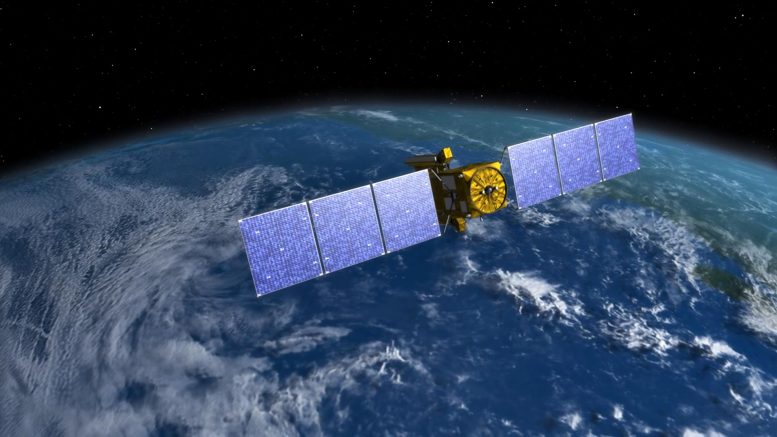
    The SWOT satellite, a NASA and CNES collaboration, is monitoring the warm waters from the emerging El Niño in the eastern Pacific Ocean. This satellite offers insights into global weather patterns influenced by El Niño by providing detailed views of Earth’s water surfaces. Credit: NASA/JPL-Caltech

    The international Surface Water and Ocean Topography mission is able to measure ocean features, like El Niño, closer to a coastline than previous space-based missions.

    Warm ocean waters from the developing El Niño are shifting north along coastlines in the eastern Pacific Ocean. Along the coast of California, these warm waters are interacting with a persistent marine heat wave that recently influenced the development of Hurricane Hilary. The Surface Water and Ocean Topography (SWOT) satellite is able to spot the movement of these warm ocean waters in unprecedented detail.

    A collaboration between NASA and the French space agency, CNES (Centre National d’Études Spatiales), SWOT is measuring the height of nearly all water on Earth’s surface, providing one of the most detailed, comprehensive views yet of the planet’s oceans and freshwater lakes and rivers.

    Understanding Sea Levels and El Niño

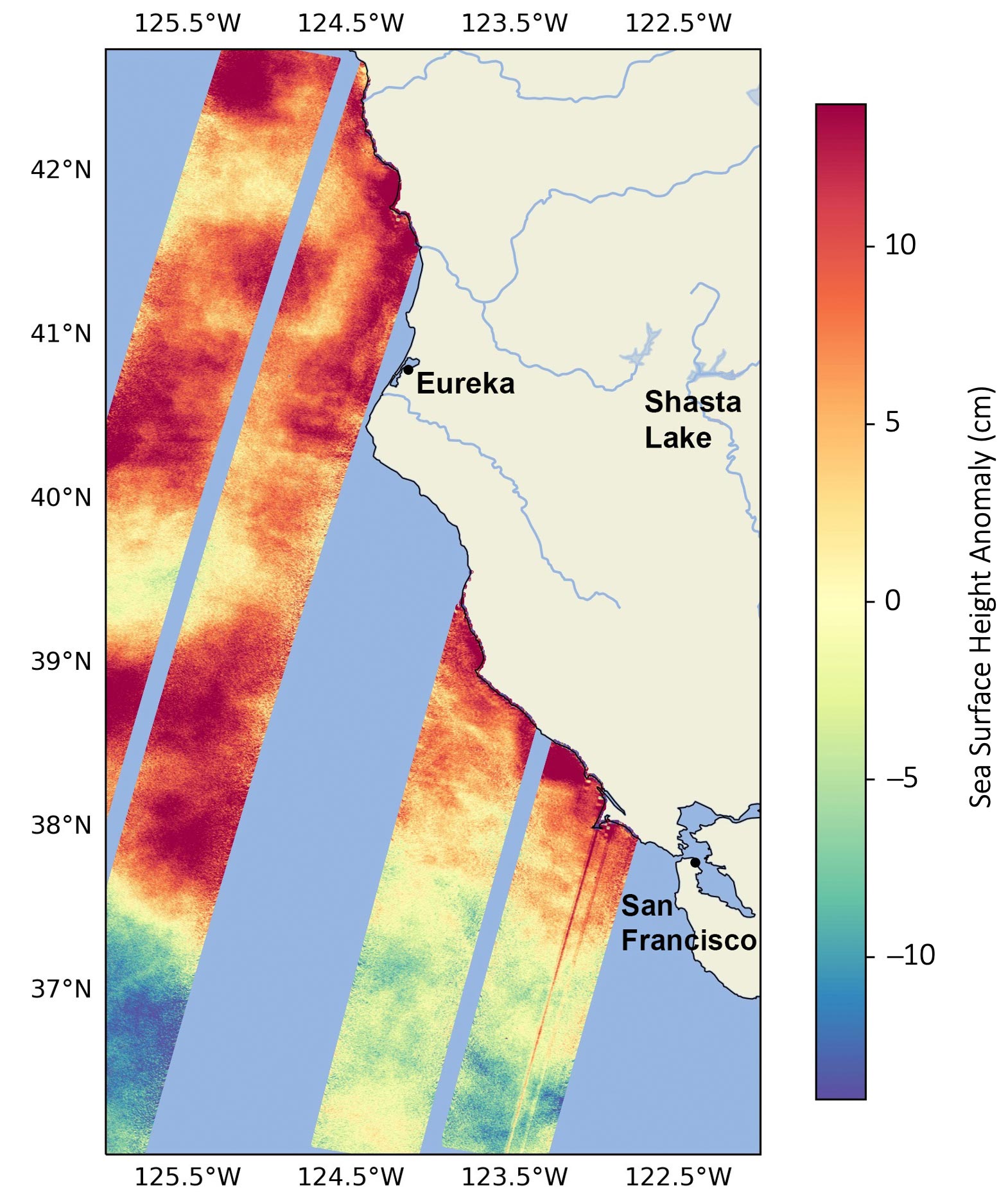
    Water expands as it warms, so sea levels tend to be higher in places with warmer water. El Niño – a periodic climate phenomenon that can affect weather patterns around the world – is characterized by higher sea levels and warmer-than-average ocean temperatures along the western coast of the Americas. The image above shows sea surface heights off the U.S. West Coast, near the California-Oregon border, in August. Red and orange indicate higher-than-average ocean heights, while blue and green represent lower-than-average heights.

    The SWOT science team made the measurements with the Ka-band Radar Interferometer (KaRIn) instrument. With two antennas spread 33 feet (10 meters) apart on a boom, KaRIn produces a pair of data swaths as it circles the globe, bouncing radar pulses off the water’s surface to collect water-height measurements. The visualization combines data from two passes of the SWOT satellite.
    SWOT Monitors Warming Waters Off California Coast
    This data visualization shows sea surface heights off the northern California coast in August as measured by the Surface Water and Ocean Topography satellite. Red indicates higher-than-average heights, due to a marine heat wave and a developing El Niño, while blue signals lower-than-average heights. Credit: NASA/JPL-Caltech

    “SWOT’s ability to measure sea surface so close to the coast will be invaluable for researchers but also forecasters looking at things like the development and progress of worldwide phenomena like El Niño,” said Ben Hamlington, a sea level researcher at NASA’s Jet Propulsion Laboratory in Southern California.

    El Niño’s Expected Impact

    In its September outlook, the U.S. National Oceanic and Atmospheric Administration forecast a greater than 70% chance for a strong El Niño this coming winter. In addition to warmer water, El Niño is also associated with a weakening of the equatorial trade winds. The phenomenon can bring cooler, wetter conditions to the U.S. Southwest and drought to countries in the western Pacific, such as Indonesia and Australia.


    The SWOT mission will collect information on the height of water in Earth’s lakes, rivers, reservoirs, and oceans. Credit: NASA/JPL-Caltech/CNES/Thales Alenia Space

    More About the SWOT Mission

    Launched on December 16, 2022, from Vandenberg Space Force Base in central California, SWOT is now in its operations phase, collecting data that will be used for research and other purposes.

    SWOT was jointly developed by NASA and CNES, with contributions from the Canadian Space Agency (CSA) and the UK Space Agency. NASA’s Jet Propulsion Laboratory (JPL), which is managed for the agency by the California Institute of Technology (Caltech) in Pasadena, California, leads the U.S. component of the project.

    For the flight system payload, NASA provided the KaRIn instrument, a GPS science receiver, a laser retroreflector, a two-beam microwave radiometer, and NASA instrument operations. CNES provided the Doppler Orbitography and Radioposition Integrated by Satellite (DORIS) system, the dual frequency Poseidon altimeter (developed by Thales Alenia Space), the KaRIn radio-frequency subsystem (together with Thales Alenia Space and with support from the UK Space Agency), the satellite platform, and ground operations. CSA provided the KaRIn high-power transmitter assembly. NASA provided the launch vehicle and the agency’s Launch Services Program, based at Kennedy Space Center, managed the associated launch services.

    Never miss a breakthrough: Join the SciTechDaily newsletter.
    Follow us on Google and Google News.

    JPL NASA SWOT
    Share. Facebook Twitter Pinterest LinkedIn Email Reddit

    Related Articles

    Mapping Earth’s Waterways From Space: How SWOT Transforms Flood Forecasting

    NASA’s SWOT Satellite Reveals the Depths of California’s Weather Woes

    SWOT Mission: See an Unprecedented View of Global Sea Levels [Video]

    NASA SWOT Water Mission To Gauge Alaskan Rivers on Front Lines of Climate Change

    How SWOT Will Look at the World’s Water: 5 Things To Know

    Latest International Water Satellite Packs Powerful Engineering Punch

    Meet the People Behind NASA’s Incredible New SWOT Water-Tracking Satellite

    NASA To Launch 4 Fascinating Earth Science Missions in 2022 – Monitoring Our Changing Planet

    NASA Turns to the Cloud for Help With Deluge of Data From Next-Generation Earth Missions

    Leave A Reply Cancel Reply

    • Facebook
    • Twitter
    • Pinterest
    • YouTube

    Don't Miss a Discovery

    Subscribe for the Latest in Science & Tech!

    Trending News

    Scientists Uncover Potential Brain Risks of Popular Fish Oil Supplements

    Scientists Discover a Surprising Way To Make Bread Healthier and More Nutritious

    After 60 Years, Scientists Uncover Unexpected Brain Effects of Popular Diabetes Drug Metformin

    New Research Uncovers Hidden Side Effects of Popular Weight-Loss Drugs

    Scientists Rethink Extreme Warming After Surprising Ocean Discovery

    Landmark Study Links Never Marrying to Significantly Higher Cancer Risk

    Researchers Discover Unknown Beetle Species Just Steps From Their Lab

    Largest-Ever Study Finds Medicinal Cannabis Ineffective for Anxiety, Depression, PTSD

    Follow SciTechDaily
    • Facebook
    • Twitter
    • YouTube
    • Pinterest
    • Newsletter
    • RSS
    SciTech News
    • Biology News
    • Chemistry News
    • Earth News
    • Health News
    • Physics News
    • Science News
    • Space News
    • Technology News
    Recent Posts
    • Researchers Uncover Source of Strange Deformation in Earth’s Largest Continental Rift
    • Scientists Solve Mystery of Where the Colorado River Vanished Millions of Years Ago
    • Not Just Alzheimer’s: Scientists Uncover Clues to a Second, Overlooked Disorder
    • Scientists Uncover Dangerous Connection Between Serotonin and Heart Valve Disease
    • Scientists Discover a “Protector” Protein That Could Help Reverse Hair Loss
    Copyright © 1998 - 2026 SciTechDaily. All Rights Reserved.
    • Science News
    • About
    • Contact
    • Editorial Board
    • Privacy Policy
    • Terms of Use

    Type above and press Enter to search. Press Esc to cancel.