
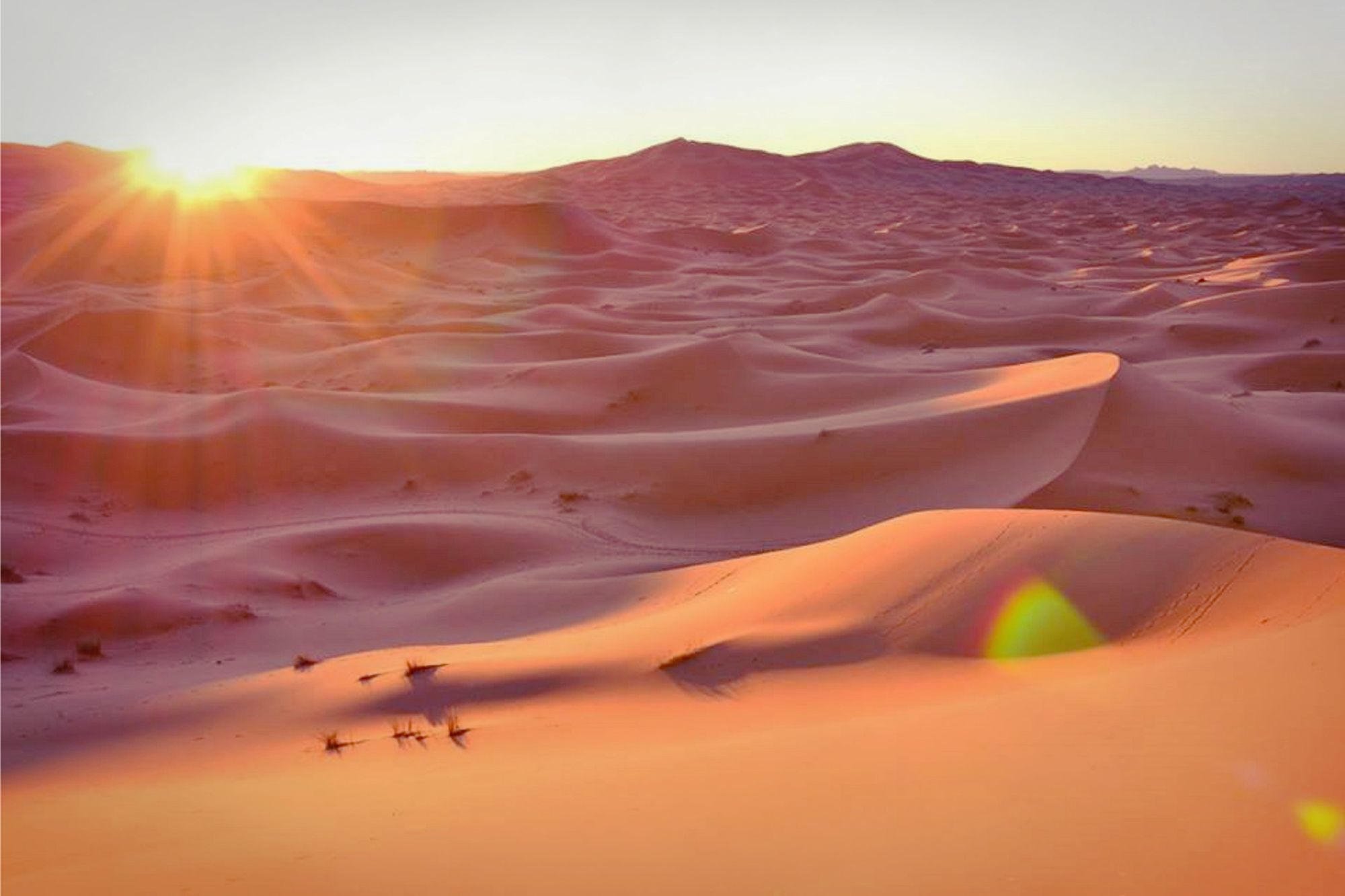
Scientists at TUM have developed a new method for the early detection of climate tipping points.
From the end of the last ice age up until about 6,000 years ago, the area now recognized as the Sahara Desert was a fertile, green landscape rich with life. This era, known as the “African Humid Period,” came to a sudden end, turning the once-vibrant region into the dry, barren desert we see today.
Scientists have long puzzled over how the slow changes in solar radiation due to variations in Earth’s orbit could lead to such an abrupt large-scale climate transition. This mystery highlights the broader challenge of understanding and predicting abrupt shifts in natural systems—commonly linked to tipping points.
A new study by Andreas Morr and Prof. Niklas Boers, researchers at TUM and PIK, introduces an advanced early detection method that provides more accurate and reliable early warnings, particularly under more realistic external conditions. Traditional methods assume that random disturbances in a system are uncorrelated in time.
However, this is not realistic for climate systems, because it assumes each day’s weather would be independent of the previous day. In reality, tomorrow’s weather heavily depends on today’s. This mismatch reduces the reliability of conventional methods for early warning signals. The new method by Morr and Boers addresses this limitation by developing estimators of system stability designed specifically for more realistic climate conditions.
Early Warnings and Tipping Points
When applying their methods to the desertification of the West Sahara, they found a clear early warning before the loss of vegetation, consistent with the crossing of a tipping point.
“Our findings suggest that the abrupt end of the African Humid Period was likely caused by a weakening of the system’s stability as the orbital configuration of the Earth changed, gradually pushing the system toward a tipping point,” says Andreas Morr. Niklas Boers adds: “The advanced detection method that we developed enhances our ability to monitor and respond to potential tipping points in various natural systems. Our results suggest that large-scale climate tipping events such as this can in principle be anticipated, hopefully enabling timely interventions.”
By improving the accuracy of early warning signals, the research supports better preparedness and response strategies, ultimately helping to protect ecosystems and human societies from severe impacts of potential climate tipping points that might be crossed due to anthropogenic climate change.
Reference: “Detection of Approaching Critical Transitions in Natural Systems Driven by Red Noise” by Andreas Morr and Niklas Boers, 4 June 2024, Physical Review X.
DOI: 10.1103/PhysRevX.14.021037
Never miss a breakthrough: Join the SciTechDaily newsletter.
Follow us on Google and Google News.
9 Comments
Missing from consideration for massive climate change is a world wide flood. One does not have to be a believer to see the geological record of massive sedimentation demonstrated all over the world.
One does not have to trust the written record of tectonic world altering activity . Unfortunately, self-enlightened adopted unproven theories as fact and taught them as truth without proof.
These presuppositions drive scientific thinking and design of testing technology to support unproven theory..uniformitarian
based conclusions.
And which particular flood would that have been? The one mentioned in ‘The Epic Of Gilgamesh’ written approx. 2000 BC in Sumerian mythology, involving the gods’ genocide of mankind & an ark? Or the later rip-off? Just wondering… & you really need to read up on your geology.
“Our findings suggest that the abrupt end of the African Humid Period was likely caused by a weakening of the system’s stability *as the orbital configuration of the Earth changed*…” [Emphasis added by me]
Weakening of which system’s stability, the climate system? What specifically? I’ve reread the article a few times and still… Am I missing something here?
Even more, what exactly “changed” about “the orbital configuration of the Earth”? Did an impact from outer space change our orbit somehow? This is confusing and insufficient as an explanation of the change in the Sahara.
youre right it completely avoided anwsering the articles question in the 1st place but that was probably rhe journalists fault or editor they should have titled it something with a lil more meaning and relevance to the article like “what the sahara desert can tell us about early warning indicators”
when they say the orbital configuration only one thing comes to [my] mind: Malakovich cycles, the procession of the equinox as its called comes full circle in 200 or so years with the start of the age of Aquarius, an the end of the age of pisces, aka the two fish aka the age of jesus but that only changes the timing of changes not create or ntensofy them that would be the 1st an 3rd cycles the 1st being every i think 6,000 years an full circle every 12,000, that changes the geographical poles shifting from 10 degrees to i think 26 degrees, greater tilt means stronger seasons an the 3rd is earths orbit from circular tonmore eliptical every 300,000 years. With that said, and the procession of the Equinox, being every 26000 years, it’s got to be the first cycle, the changing of the Earth geographic North tilt. I’m not sure if it’s further North or further South right now. Relatives to geomagnetic North. That is, but that’s more than likely what created the change was. The miloke of its cycle, the changing of the Earth’s tilt. I’m not sure if it was of greater tilt or less. But i’m willing to bet of lesser till we made it desert.Is jus a guess
You might want to get in the habit of doing at least a once-over proof reading of your comments before hitting the box — what is a “miloke?”
For some unknown reason, the word “send,” just before “box,” was deleted when my comment posted.
Yeah, seriously. Which flood(s)?
So.. 2 source can’t be independent. K. And so .. the star of Bethlehem recorded in historical accounts in China, and South America, and Europe, and Persia all must have been copying one and other.
Calenders from every culture on earth, recording sun,moon and stars all must have copied one another. (My sarcasm is to point out your absurdity)
The term “tipping point” is THE most over-used term in contemporary climatology. There is no agreement on the definition of a ‘tipping point’ either with respect to the rapidity with which it happens, the extent of the impact, or the severity. It seems that those who use the term are relying on the mental image of a tree or tower falling over to scare readers into thinking that the phenomenon is always catastrophic and there is nothing that Man or Nature can do to recover from the event. The article found at the provided link offers higher mathematics it claims to be able to predict such “abrupt” events, without providing a definition of “tipping point” or even “abrupt” in the context of geological time. How does a “tipping point” differ from other ‘natural’ changes? They offer a solution to an unrigorously defined problem. Is their solution applicable to any situation other than the Sahara Desert?