
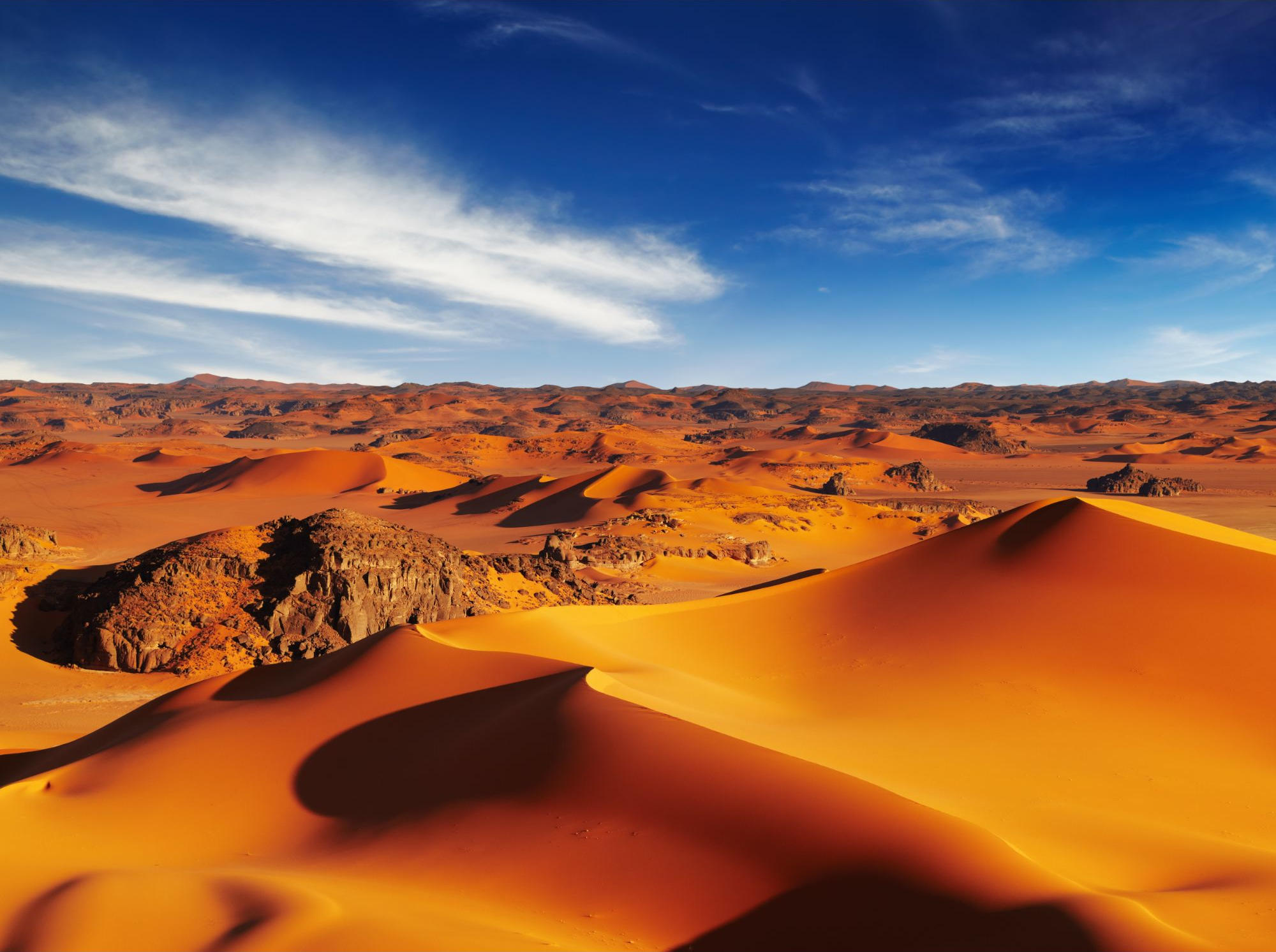
Once one of the planet’s driest landscapes, the Sahara Desert may become far wetter by the end of this century.
The Sahara Desert ranks among the driest places on Earth, receiving only about 3 inches of precipitation each year — roughly one-tenth of what Chicago experiences from rain, sleet, and snow.
However, scientists from the University of Illinois Chicago (UIC) predict that this arid landscape could become significantly wetter in the latter half of the 21st century.
Their findings, published in npj Climate and Atmospheric Science, suggest that the Sahara could receive up to 75% more rainfall compared with its historical average. The researchers also project that under extreme climate scenarios, precipitation will rise across southeastern and south-central Africa.
“Changing rainfall patterns will affect billions of people, both in and outside Africa,” said lead author Thierry Ndetatsin Taguela, a postdoctoral climate researcher in the College of Liberal Arts and Sciences. “We have to start planning to face these changes, from flood management to drought-resistant crops.”
Taguela said understanding how rising temperatures affect rainfall can help in the development of adaptation strategies. In the study, he used an ensemble of 40 climate models to simulate summer precipitation in Africa in the second half of the 21st century (2050-2099) compared with the historical period (1965-2014). Taguela analyzed models’ outputs under two climate scenarios: one that simulated moderate greenhouse gas emissions and one that simulated very high greenhouse gas emissions.
The Scenarios and Results
Both scenarios predicted that precipitation over Africa will generally increase by the end of the 21st century, with some regional variation. Notably, rainfall in the Sahara Desert is expected to increase by 75%, followed by a 25% increase in southeastern Africa and a 17% increase in south-central Africa. In contrast, researchers expect the southwestern region to be drier, with an anticipated 5% decline in precipitation.
“The Sahara is projected to almost double its historical precipitation levels, which is surprising for such a climatologically dry region,” Taguela said. “But while most models agree on the overall trend of wetter conditions, there’s still considerable uncertainty in how much rainfall they project. Improving these models is critical for building confidence in regional projections.”
For the most part, these projected changes are associated with the effects of climate change, as higher temperatures help the atmosphere hold more moisture, which in turn enhances rainfall. Changes in atmospheric circulation also played a part in reducing rainfall.
“Understanding the physical mechanisms driving precipitation is essential for developing adaptation strategies that can withstand both wetter and drier futures,” Taguela said.
Reference: “Understanding drivers and uncertainty in projected African precipitation” by Thierry N. Taguela, Akintomide A. Akinsanola, Tolulope E. Adeliyi, Alan Rhoades and Robert H. Nazarian, 17 June 2025, npj Climate and Atmospheric Science.
DOI: 10.1038/s41612-025-01123-8
Funding: U.S. Department of Energy
Never miss a breakthrough: Join the SciTechDaily newsletter.
Follow us on Google and Google News.
3 Comments
“In the study, he used an ensemble of 40 climate models to simulate summer precipitation in Africa in the second half of the 21st century (2050-2099) compared with the historical period (1965-2014). ”
39 of which are inferior to the one best model. Even the best model may not even be close enough to be reliable and useful. Ensembles are only useful if one can be assured that the ‘errors’ are symmetrical about the true value. However, all the common models (except the Russian model), are known to run warm and thus are demonstrating a bias probably resulting from similar unstated (unexamined?) assumptions. The best model, as determined by comparison to actual weather, is the Russian model. Averaging it with the other 39 models just dilutes the estimate with inferior estimates.
“The Sahara is projected to almost double its historical precipitation levels [3″], …”
Even at 5″ per year, the Sahara will still be a desert.
“For the most part, these projected changes are associated with the effects of climate change, as higher temperatures help the atmosphere hold more moisture, which in turn enhances rainfall.”
The Clausius–Clapeyron relationship predicts the upper-bound, or potential for water vapor — saturation, ASSUMING that there is sufficient water vapor from evapotranspiration to saturate the air. That means, one is likely to find high humidity over tropical oceans and perhaps along the coasts. However, in the interior of continents, the actual water vapor is usually limited by availability, especially on the leeward side of mountain ranges transverse to the prevailing winds, because of what is known as the ‘Rain Shadow’ effect. Orographic uplift cools the air, causing it to precipitate that entrained water, and then as the dried air mass goes down the leeward side, it is warmed by compression, thus further reducing the relative humidity.
“Taguela [et al.] analyzed models’ outputs under two climate scenarios: one that simulated moderate greenhouse gas emissions and one that simulated very high greenhouse gas emissions.”
It has been demonstrated (Curry, et al.) that the Representative Concentration Pathway 8.5 scenario (very high greenhouse gas emissions) is improbable because there are insufficient fossil fuels to continue “business as usual” for the amount of time assumed for the scenario. In other words, the author is comparing what is likely to something that is improbable.
If that can happen, why still tout the climate change as a bad thing?
“Historical” – meaning only back to 1965 – is a risible definition. The Roman Provence of Africa – which extended from the western border of Egypt to what is now eastern Algeria – was one of the largest grain suppliers from the end of the 3d Punic War (146 BC) until the conquest of Carthage by the Vandals (439 AD), and later to the Eastern Roman Empire from 534 to 698 AD, until Carthage was conquered by Muslim armies.
There is a huge aquifer under the Sahara from when annual monsoons would sweep across it in prehistoric times.
The current expansive desert in North Africa probably owes much to deforestation by nomadic conquerors. Before the Zionist movement brought Jews from Eastern Europe to the Levant, it was a desert. Much of that desert has been reclaimed by sound agricultural practices. There is no reason to doubt that couldn’t be replicated in Northern Africa.
There’s a lot of good historical and archaeological data relevant to climate studies for North Africa. However, finding it would take looking, instead of running computer models.