
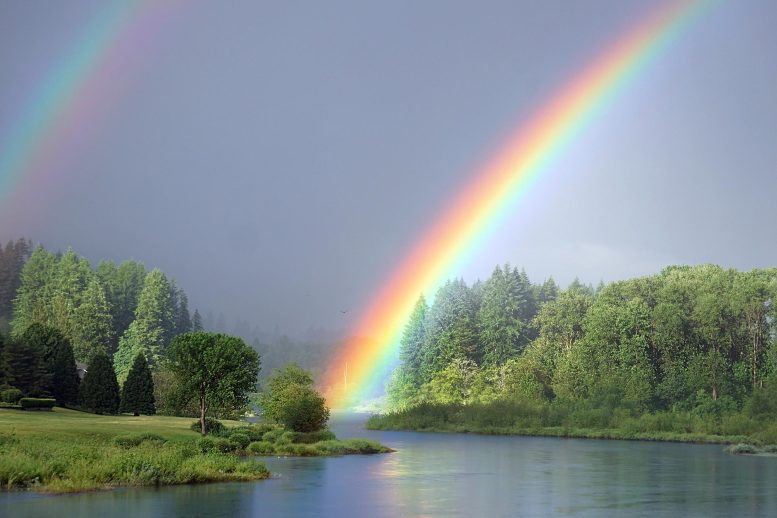
According to new research, chances to see rainbows will rise in northern latitudes while falling in many tropical regions.
According to a recent study conducted by scientists at the University of Hawai’i at Manoa (UH), there will be more opportunities to see rainbows as a result of climate change. The authors of the study predict that by 2100, there will be 5% more days with rainbows than there were at the start of the twenty-first century at the average land location on Earth. The biggest increases in rainbow occurrence will occur in northern latitudes and extremely high elevations, where warming is projected to result in less snow and more rain. However, locations with less rainfall as a result of climate change, such as the Mediterranean, are expected to lose rainbow days.
Rainbows form when water droplets refract sunlight. Sunlight and rainfall are therefore essential ingredients for rainbows. Human activities such as the use of fossil fuels warm the atmosphere, altering the patterns and amounts of rainfall and cloud cover.
“Living in Hawai‘i, I felt grateful that stunning, ephemeral rainbows were a part of my daily life,” said the lead author of the study, Kimberly Carlson, who is now at New York University’s Department of Environmental Studies. “I wondered how climate change might affect such rainbow-viewing opportunities.”
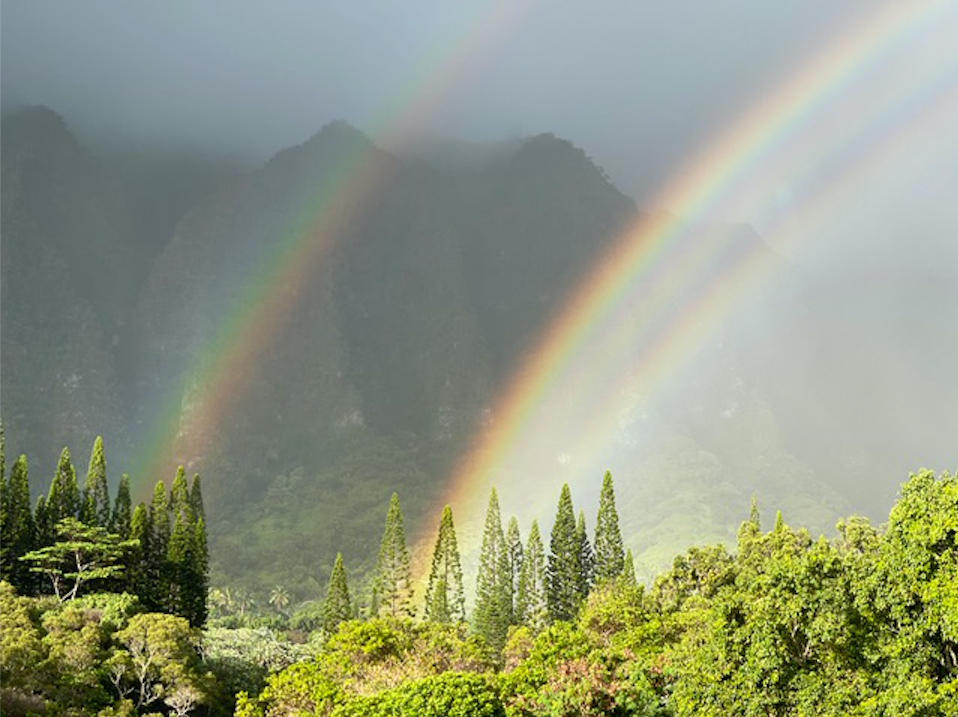
The topic piqued the interest of Camilo Mora of the UH Mānoa Geography and Environment department, who pitched it as the subject of a project for one of his graduate courses.
According to Mora, “We often study how climate change directly affects people’s health and livelihoods, for instance via the occurrence of heat stroke during climate change-enhanced heat waves.”
However, few studies have looked at how environmental aesthetics may be impacted by climate change, and no one has attempted to map rainbow occurrences, much less in the context of climate change.
Predicting Rainbows
To answer this question, a team including students at UH Mānoa looked at photographs uploaded to Flickr, a social media platform where people share photographs. They sorted through tens of thousands of photos taken around the world, labeled with the word “rainbow,” to identify rainbows generated from the refraction of light by rain droplets.
Amanda Wong, then an undergraduate student in Global Environmental Science at the UH Mānoa School of Ocean and Earth Science and Technology (SOEST) and a co-author on the paper, noted, “We had to sort through photos of rainbow artwork, rainbow flags, rainbow trout, rainbow eucalyptus, and rainbow foods to find the real rainbows.”
Then, the scientists trained a rainbow prediction model based on rainbow photo locations and maps of precipitation, cloud cover, and sun angle. Finally, they applied their model to predict present-day and future rainbow occurrences over global land areas. The model suggests that islands are rainbow hotspots.
Islands as Rainbow Hotspots
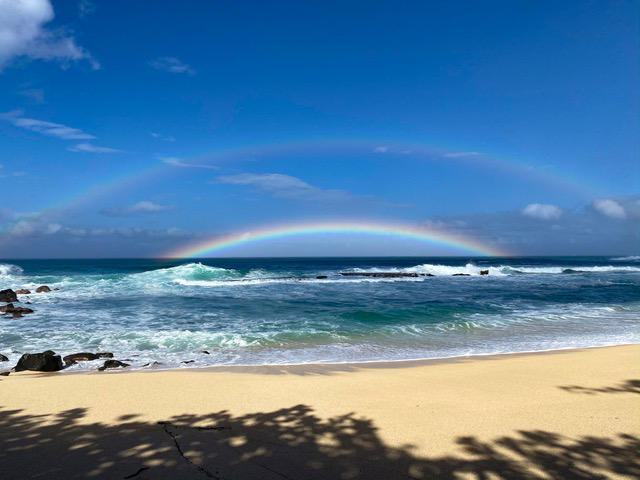
“Islands are the best places to view rainbows,” according to Steven Businger, professor of Atmospheric Sciences in SOEST. “This is because island terrain lifts the air during daily sea breezes, producing localized showers surrounded by clear skies that let the sun in to produce majestic rainbows.”
The Hawaiian Islands, recently dubbed the “rainbow capital of the world”, are predicted to experience a few more days with rainbows per year. The authors stopped short of discussing how changes in rainbow occurrence might affect human well-being. However, rainbows are an important part of human culture throughout history and around the world and are aesthetically pleasing.
“Climate change will generate pervasive changes across all aspects of the human experience on Earth. Shifts in intangible parts of our environment—such as sound and light—are part of these changes and deserve more attention from researchers,” said Carlson.
In this case, the overall findings are encouraging—it seems people will have more opportunities to make a rainbow connection under climate change.
Reference: “Global rainbow distribution under current and future climates” by Kimberly M. Carlson, Camilo Mora, Jinwen Xu, Renee O. Setter, Michelle Harangody, Erik C. Franklin, Michael B. Kantar, Matthew Lucas, Zachary M.Menzo, Daniele Spirandelli, David Schanzenbach, C. Courtlandt Warr, Amanda E. Wong and Steven Businger, 28 October 2022, Global Environmental Change.
DOI: 10.1016/j.gloenvcha.2022.102604
The study was funded by NYU IT High Performance Computing and USDA Cooperative State Research, Education and Extension
Never miss a breakthrough: Join the SciTechDaily newsletter.
Follow us on Google and Google News.
1 Comment
How did they validate their model before publishing their prediction?
Rainbows not only depend on the lack of covering clouds and rain, but on the viewing position of the observer with respect to the sun. Being on an island may preclude potential observers from being in the right position. Also, their model was probably influenced by population density (the probability of an observer with a camera being present).
“The rainbow is beautiful and ephemeral, a spectrum of color visible only while conditions of light and rain droplets are just right.”
I’m left with the impression that the authors were more concerned with expressing non-rhyming bio-geo-poetry than doing hard science.
If a tree fall in the forest and there is no one to hear it, does it make a sound? If the conditions are ideal for a rainbow, but there is no one to view it, is there a rainbow?