
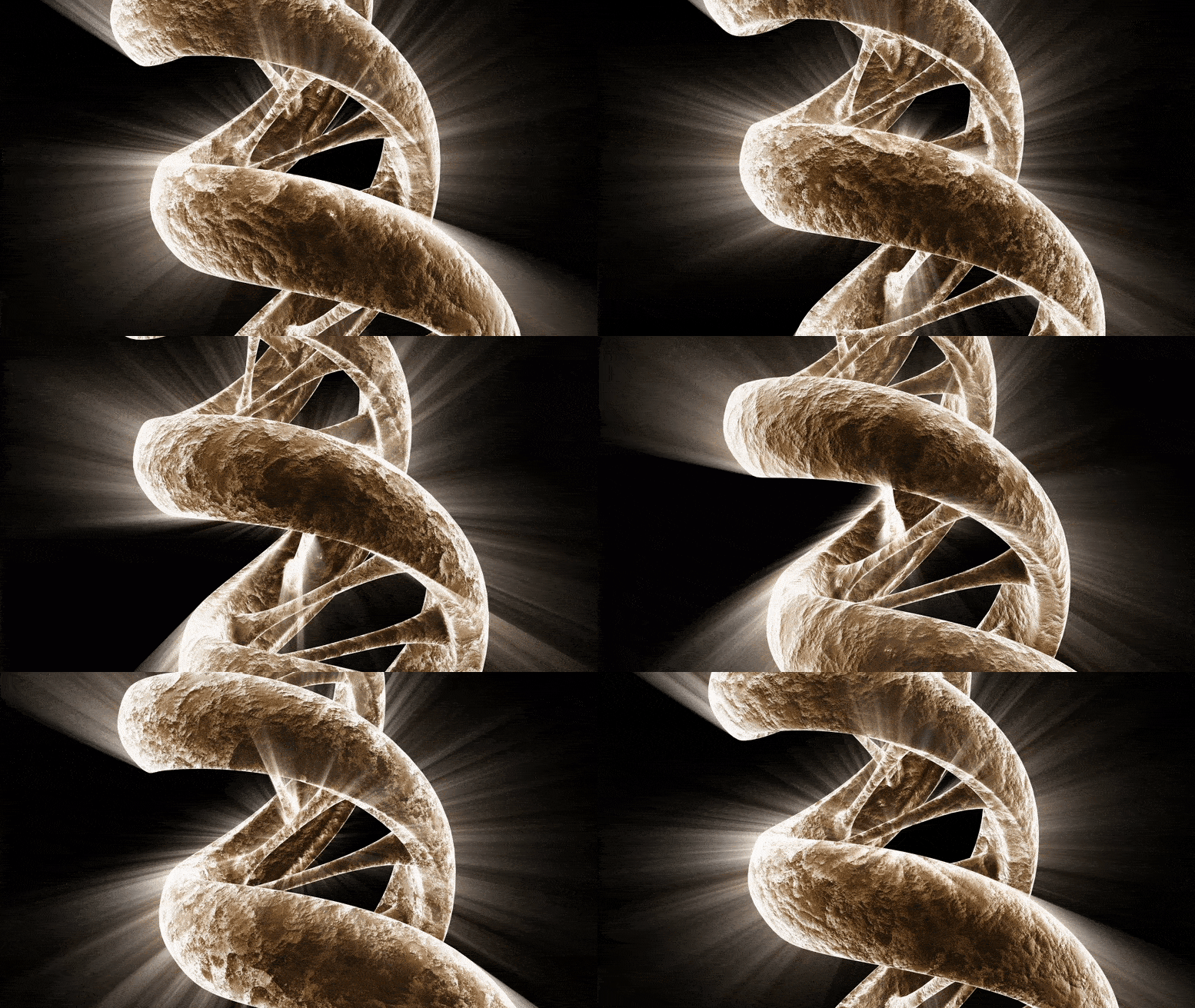
- Scientists have revealed that the genomes of marine invertebrates have been surprisingly stable across deep time.
- Over millions of years, random mutations cause sections of chromosomes to become rearranged, and, in some cases, fused and mixed, resulting in differences in the genomes between species.
- In this study, the genomes of species from three vast groups—sponges, cnidarians, and bilaterians—were compared, revealing that they are remarkably similar.
- In a variety of mollusks, the researchers found that four sets of genes had mixed together and that these mixtures were so ancient that they had to be shared by all mollusks and other related species.
- In total, the researchers identified 29 ancestral segments of chromosomes and found that some of these segments were present some 800-900 million years, before the existence of animals, when all life was in unicellular or very simple multicellular forms.
Stability of Marine Invertebrate Genomes Across Deep Time
Scientists have discovered that the genomes of marine invertebrates have been surprisingly stable across deep time. Published in Science Advances, this new study provides an overarching analysis of distantly related animal groups, including sponges, jellyfish, scallops, and the invertebrates most closely related to humans, and found that their chromosomes are remarkably similar.
Think of a genome as the instruction manual located in each cell and written in DNA code. It contains all the inherited information for the operation of an organism. This instruction manual is divided into chapters—the chromosomes—and those are, in turn, further subdivided into pages—the genes.

“Over deep time—and by that, I mean at least 550 million years—due to random mutations, the order of genes within chromosomes become scrambled, kind of like mixing up pages within a chapter of a book. And more dramatically, sometimes we find that two chromosomes have come together and become mixed, as if the chapters were merged and shuffled.” explained Prof. Daniel Rokhsar, last author of the paper and principal investigator of the Molecular Genetics Unit at the Okinawa Institute of Science and Technology Graduate University (OIST) in Japan. “But overall, we found a remarkable amount of stability. Even though the last common ancestor of these three groups lived over half a billion years ago, many of their chromosomes are recognizably similar in the sense that they contain the same groups of genes.”
The study compared the genomes of species from the three vast groups—sponges (very simple animals with no muscles or nerves), cnidarians (specifically jellyfish and hydra), and bilaterians (scallops and amphioxus). These genomes had either been previously sequenced or were first reported in this study. Although many of these organisms had had “draft” versions of their genomes sequenced before, this early research fell short of being able to study overall chromosomal organization. Now, with advancements in genetic technology, researchers are able to put the puzzles together and compare the way genes are organized into the long threads. In this study, the chromosomes of the hydra were, for the first time, reconstructed, those of the amphioxus were vastly improved, and a wide-ranging comparative analysis was completed.
Chromosomal Fusions as Markers of Evolutionary History
The international group of researchers, which included scientists from OIST, University of Vienna, the University of California campuses at Berkeley, Irvine, and Santa Cruz, Ludwig Maximilian University of Munich, and University College, London, found striking similarities between the chromosomes of the five different animals, and confirmed that these similarities were also present in other animal genomes. In some cases, they identified patterns of chromosomal fusion that were specific to certain sub-groups of animals. For example, the researchers found four ancient fusions shared by scallops and several other mollusks, which also resembled a fusion in the draft genome of a marine worm.
“We see that genes can be on the same chromosome in different species but often in a different order,” explained Prof. Rokhsar. “In rare cases where two chromosomes fuse together and then get mixed up by scrambling across the newly fused chromosome, this fusion can’t be undone, and serves as a permanent marker of the evolutionary history of the chromosome. It’s like shuffling two packs of cards together. We can keep shuffling them, but they will never divide into the two exact packs again.”
When living animals share the same fusions, the researchers infer that the fusions must have occurred in an ancient common ancestor of these species. They have now made several testable predictions about yet-to-be-sequenced genomes. For example, the team predicts that the genomes of all mollusks and related “spiralian” animals must show the specific set of fusions seen in scallops.
Ancient Gene Linkages and Evolutionary Paradoxes
These results showcase an interesting paradox. “Mammals have only been around for about 100 million years,” Prof. Rokhsar explained. “But when we compare the genome of two mammals, say, a human and a mouse, the chromosomes look like they have been broken up into a few hundred pieces and then mixed together. The chromosome-scale conservation characteristic that we found in invertebrates is simply not seen in mammals.” He speculated that mammalian chromosomes could have evolved differently because, historically, mammals have lived in smaller groups than most marine invertebrates. Small groups facilitate the survival of these random mutations, which could be why chromosomal rearrangements spread more easily in mammals.
In total, the researchers identified 29 ancestral segments of chromosomes. Furthermore, the group found that some of these segments were present some 800-900 million years, before the existence of animals, when all the organisms were in unicellular or very simple multicellular forms. Thus, some genes have been traveling together for almost a billion years, yet the consequence of these ancient gene linkages remains a mystery.
Reference: “Deeply conserved synteny and the evolution of metazoan chromosomes” by Oleg Simakov, Jessen Bredeson, Kodiak Berkoff, Ferdinand Marletaz, Therese Mitros, Darrin T. Schultz, Brendan L. O’Connell, Paul Dear, Daniel E. Martinez, Robert E. Steele, Richard E. Green, Charles N. David and Daniel S. Rokhsar, 2 February 2022, Science Advances.
DOI: 10.1126/sciadv.abi5884
Never miss a breakthrough: Join the SciTechDaily newsletter.
Follow us on Google and Google News.