
Close Menu
    Facebook X (Twitter) Instagram
    SciTechDaily
    • Biology
    • Chemistry
    • Earth
    • Health
    • Physics
    • Science
    • Space
    • Technology
    Facebook X (Twitter) Pinterest YouTube RSS
    SciTechDaily
    Home»Space»Unusual Isotopic Abundances Discovered in Nova Vul 1670
    Space

    Unusual Isotopic Abundances Discovered in Nova Vul 1670

    By Harvard-Smithsonian Center for AstrophysicsApril 10, 2015No Comments4 Mins Read
    Facebook Twitter Pinterest Telegram LinkedIn WhatsApp Email Reddit
    Share
    Facebook Twitter LinkedIn Pinterest Telegram Email Reddit
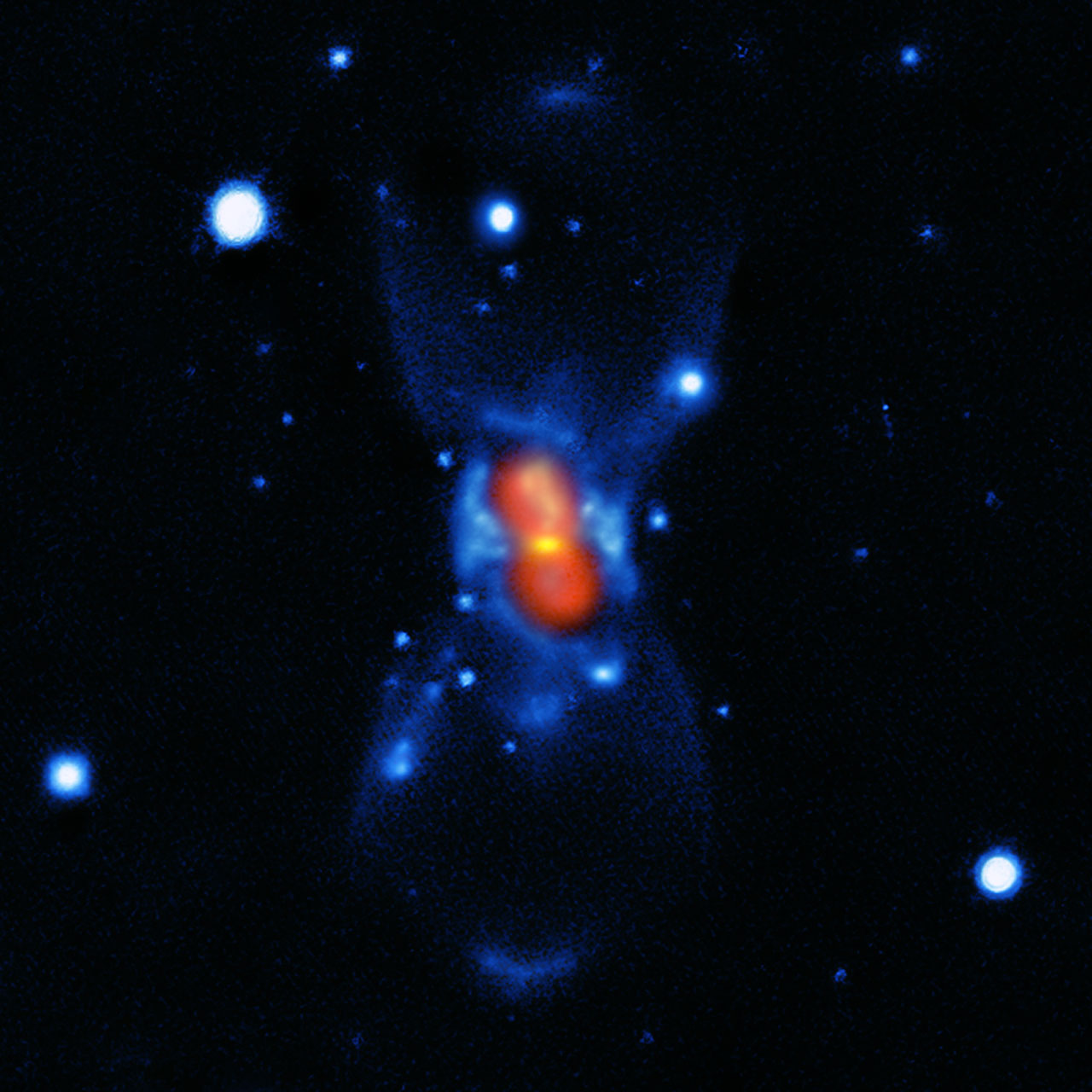
    The remnant of the new star of 1670 seen with modern instruments
    This picture shows the remains of the new star that was seen in the year 1670. It was created from a combination of visible-light images from the Gemini telescope (blue), a submillimetre map showing the dust from the SMA (yellow) and finally a map of the molecular emission from APEX and the SMA (red). The star that European astronomers saw in 1670 was not a nova, but a much rarer, violent breed of stellar collision. It was spectacular enough to be easily seen with the naked eye during its first outburst, but the traces it left were so faint that very careful analysis using submillimetre telescopes was needed before the mystery could finally be unraveled more than 340 years later.

    A newly published study reveals that Nova Vul 1670 is not only rich in molecular species, its gas has dramatically unusual isotopic abundances (that is, the atoms present, carbon, oxygen, and nitrogen in particular, have extra neutrons in their nuclei).

    Astronomers have known for decades that the merger of two normal stars is a frequent and astronomically important phenomenon. In globular clusters, for example, with as many as several million stars gravitationally bound together, collisions often occur between stars, producing stars that are more massive, hotter, and bluer than usual. In star-forming clusters, mergers of small stars have been proposed as a way to form massive young stars, and computer simulations lend some support to this idea. Not least, some kinds of novae — stars that suddenly brighten and were once thought to be “new” stars — are the result of stellar mergers or near-mergers.

    The variable star CK Vulpeculae (Nova Vul 1670) had a bright outburst in 1670-1672 and then dimmed. No counterpart was seen until 1982 when a nebula was found at its location, presumably a remnant of the outburst of 1670. The star itself remains undetected, presumably hidden behind a heavy dust layer ejected in that outburst. The nebula itself has been of interest to astronomers for decades because it is rich in molecular gas. CfA astronomer Nimesh Patel and his colleagues studied Nova Vul 1670 and its chemical composition using two-millimeter telescopes capable of measuring its molecular constituents in detail, the Submillimeter Array and the Atacama Pathfinder Experiment (APEX).

    The scientists report in the latest issue of Nature that Nova Vul 1670 is not only rich in molecular species, its gas has dramatically unusual isotopic abundances (that is, the atoms present, carbon, oxygen, and nitrogen in particular, have extra neutrons in their nuclei). Element synthesis in stars is well understood, and produces specific isotopic ratios; in the solar system, for example, the ratio of carbon with an atomic number of 12 to carbon 13 is 89, but in Nova Vul 1670 it is ten times less. Similarly low ratios were found for nitrogen and oxygen isotopes.

    The astronomers conclude that the atoms in Nova Vul 1670 were not produced in a normal stellar furnace, nor for that matter even in a furnace operating under very different conditions. Neither could they identify any kind of explosive event that would produce these ratios. The team argues that the most likely scenario is the violent merger in 1670 of two stars; the event ejected inner parts of the stars into the nebula, exposing the ashes from earlier stages of nuclear burning, and mixing them with more processed material. People watching the nova in 1670 were no doubt amazed at the appearance of a “new star”. Imagine what their reaction would have been to find out it was actually the merger of two stars.

    Reference: “Nuclear ashes and outflow in the eruptive star Nova Vul 1670” by Tomasz Kamiński, Karl M. Menten, Romuald Tylenda, Marcin Hajduk, Nimesh A. Patel and Alexander Kraus, 23 March 2015, Nature.
    DOI: 10.1038/nature14257
    arXiv: 1503.06570


    Never miss a breakthrough: Join the SciTechDaily newsletter.
    Follow us on Google and Google News.

    Astronomy Astrophysics Cosmology Harvard-Smithsonian Center for Astrophysics
    Share. Facebook Twitter Pinterest LinkedIn Email Reddit

    Related Articles

    Webb’s Mysterious “Little Red Dots” May Be the Cradle of the First Black Holes

    Mysterious Radio Signals Reveal What’s Hiding Between Galaxies

    Cosmic Mystery Solved: Astronomers Have Discovered the Universe’s “Missing” Matter

    Invisible Storm Lights Up Galaxy Cluster With Record-Breaking Radio Glow

    Astronomers Search for Trigger of Nearby Supernova

    Herschel Observations Help Identify the Physical Processes Underway in Cold, Dense Clouds

    CfA Scientists Measure the Rate of Expansion of the Universe

    New Study Challenges Planck Results

    Calculations Show the Ideal Time to Study the Cosmos

    Leave A Reply Cancel Reply

    • Facebook
    • Twitter
    • Pinterest
    • YouTube

    Don't Miss a Discovery

    Subscribe for the Latest in Science & Tech!

    Trending News

    Massive Study Warns Marijuana Use in Teens Is Linked to Serious Mental Illness

    Scientists Discover a Completely Unexpected Way T Cells Kill Cancer

    Scientists Just Found the Solar System’s Original “Planet Factory”

    Study Warns Widely Used Food Preservatives Linked to High Blood Pressure and Heart Disease

    New Treatment Could Reverse Osteoarthritis Within Weeks

    Physicists Have Measured “Negative Time” in Bizarre Quantum Experiment

    The Deadly Tapeworm Spreading Across America Has Reached the Pacific Northwest

    Could Low Vitamin D Be Making Your Pain Worse?

    Follow SciTechDaily
    • Facebook
    • Twitter
    • YouTube
    • Pinterest
    • Newsletter
    • RSS
    SciTech News
    • Biology News
    • Chemistry News
    • Earth News
    • Health News
    • Physics News
    • Science News
    • Space News
    • Technology News
    Recent Posts
    • Scientists Discover Two Strange Dead Stars That Defy Astronomical Expectations
    • Scientists Find a Smarter Way To Measure the Universe Using Exploding Stars
    • Earth May Be Seeding Venus With Life, According to New Research
    • Streetlights Are Trapping Thousands of Isopods in Mysterious “Death Spirals”
    • Scientists Have Discovered These Deadly Parasites Are Secretly Swapping DNA
    Copyright © 1998 - 2026 SciTechDaily. All Rights Reserved.
    • Science News
    • About
    • Contact
    • Editorial Board
    • Privacy Policy
    • Terms of Use

    Type above and press Enter to search. Press Esc to cancel.